
Chelostoma
Latreille, 1809
Scissor Bees
Species Guides
5- Chelostoma californicum
- Chelostoma campanularum(Small Scissor Bee)
- Chelostoma phaceliae
- Chelostoma philadelphi(Mock-orange Scissor Bee)
- Chelostoma rapunculi(Rampion Scissor Bee)
Chelostoma is a of solitary bees in the tribe Osmiini ( Megachilidae), comprising approximately 56-60 described across five subgenera. These bees are predominantly Palaearctic in distribution and are notable for their high degree of pollen specialization: most species are strict oligoleges, collecting pollen from flowers of a single plant genus, , or family. Common plant associations include Campanula (bellflowers), Ornithogalum, Ranunculus, Asteraceae, and Brassicaceae. Nesting occurs in preexisting cavities in dead wood or hollow plant stems, with females constructing partitions and nest plugs using mud often reinforced with pebbles and sand grains.

Pronunciation
How to pronounce Chelostoma: //kɛˈlɒstəmə//
These audio files are automatically generated. While they are not always 100% accurate, they are a good starting point.
Identification
Distinguished from other osmiine bees by combination of slender elongated body, specialized pollen-collecting on specific plants, and nesting in narrow preexisting cavities. Subgenera and distinguished by morphological details of mouthpart length, shape, and host plant associations. Molecular and detailed morphological keys available for some subgenera (e.g., Chelostoma s.s., Gyrodromella).
Images
Appearance
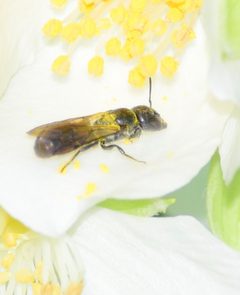
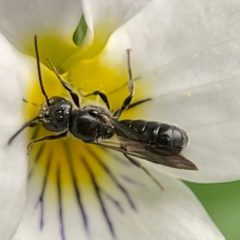
Slender, elongated body form with narrow ; body proportions adapted for of narrow linear cavities. Some possess elongated and very long mouthparts, representing adaptations for accessing nectar from long-tubed zygomorphic flowers such as those in Lamiaceae. present: females carry pollen on scopal hairs beneath the abdomen (typical of Megachilidae), while males lack pollen-carrying structures.
Habitat
Preexisting linear cavities in dead wood or hollow plant stems; requires warm, sheltered locations with nearby floral resources. Some associated with specific plant (e.g., Campanula-rich meadows, Ornithogalum ).
Distribution
Primarily Palaearctic region; 19 of 21 in subgenus Chelostoma s.s. occur in Western Palaearctic. Documented from Europe, Turkey, Middle East, and parts of Central Asia. Specific species have restricted ranges (e.g., new species described from southeastern Turkey, northern Iraq, Iran, Levant, Israel). North American records limited to introduced or vagrant species.
Seasonality
Active from early spring through late summer depending on and plant flowering ; specific timing tied to bloom periods of specialized host plants.
Diet
Most are strict pollen (oligoleges) collecting from actinomorphic flowers of single plant : Campanula and related Campanulaceae (subgenus Gyrodromella and C. rapunculi), Ornithogalum (Asparagaceae), Ranunculus (Ranunculaceae), Dipsacoideae (Caprifoliaceae), Asteraceae, or Brassicaceae. Two pollen known in subgenus Chelostoma s.s. Three related species with elongated and long mouthparts use Lamiaceae. Nectar feeding from and non-host flowers documented.
Host Associations
- Campanula - pollen Primary for subgenus Gyrodromella and C. rapunculi
- Ornithogalum - pollen Asparagaceae; for some Chelostoma s.s.
- Ranunculus - pollen Ranunculaceae
- Dipsacoideae - pollen Caprifoliaceae
- Asteraceae - pollen -level specialization
- Brassicaceae - pollen -level specialization
- Lamiaceae - pollen Used by three with elongated and long mouthparts adapted for long-tubed zygomorphic flowers
Life Cycle
Solitary nesting: each female constructs individual nests comprising series of . cells provisioned with pollen-nectar mixture, then sealed. Development through egg, larva, pupa, and stages within sealed cells. No social colony structure. Some may nest in at favorable sites.
Behavior
Nesting females use mud to construct partitions and nest plugs, often reinforcing outer surface with embedded tiny pebbles and sand grains. In C. florisomne, females construct empty cells in front of brood cells as anti- defense; empty cells found in front of 64-74% of brood cells, reducing from 28.9% to 5.4%. Females detect and remove parasite deposited prior to cell closure. Rapid cell closure construction (5 , 6-13 minutes) minimizes vulnerable provisioning period. Some occasionally visit non- flowers (e.g., C. rapunculi visiting Malva moschata, Geranium sanguineum), attracted by olfactory cues in naïve bees and visual cues in experienced foragers.
Ecological Role
Important of specialized plant due to strict oligolecty; pollen transfer enhanced by dry pollen carriage on body hairs without nectar mixing. Contributes to maintenance of plant dominated by Campanula, Ornithogalum, and other specialized hosts. Serves as host for cleptoparasitic bees and (e.g., Sapyga clavicornis).
Human Relevance
Potential in gardens and urban parks where plants (especially Campanula ) are cultivated. Some species documented in hotel nesting . No direct economic importance for honey production (solitary, non-honey-producing).
Similar Taxa
- OsmiaBoth osmiine megachilid bees, but Osmia typically broader-bodied, often uses chewed leaf material or mud for nesting (not pebble-reinforced mud), and shows different patterns of pollen specialization
- HoplitisRelated osmiine with different nesting substrates (often soil, plant stems, or cavities with different closure materials) and generally different plant associations
- MegachileLeafcutter bees in same but cut leaf pieces for nest construction rather than using mud with pebbles; broader body form; different pollen carriage
More Details
Anti-parasite nesting strategy
C. florisomne demonstrates sophisticated defense through construction of empty 'vestibule' that trap parasite offspring. This represents a rare documented case of architectural defense against cleptoparasitism in solitary bees.
Morphological adaptations for host exploitation
of elongated and extremely long mouthparts in at least three Chelostoma enables exploitation of Lamiaceae, a new for the subgenus Chelostoma s.s., representing host range expansion through morphological innovation.
Taxonomic complexity
Recent revisions have described multiple new (8 in Chelostoma s.s., 2 in Gyrodromella) and synonymized previously recognized species, indicating ongoing taxonomic refinement and cryptic diversity in the .
Sources and further reading
- BugGuide
- Wikipedia
- GBIF taxonomy match
- iNaturalist taxon
- NCBI Taxonomy
- Catalogue of Life
- Gardening for Solitary Bees - Buglife Blog - Buglife
- Western Palaearctic Chelostoma bees of the subgenus Chelostoma (Megachilidae, Osmiini): biology, taxonomy and key to species
- Floral Cues of Non-host Plants Attract Oligolectic Chelostoma rapunculi Bees
- Palaearctic Chelostoma bees of the subgenus Gyrodromella (Megachilidae, Osmiini): biology, taxonomy and key to species
- Interaction between the solitary bee Chelostoma florisomne and its nest parasite Sapyga clavicornis − empty cells reduce the impact of parasites
- PATTERNS OF HOST-PLANT CHOICE IN BEES OF THE GENUSCHELOSTOMA: THE CONSTRAINT HYPOTHESIS OF HOST-RANGE EVOLUTION IN BEES
- Descriptions of the Egg and Mature Larva of the BeeChelostoma(Prochelostoma)philadelphiwith Additional Notes on Nesting Biology (Hymenoptera: Megachilidae: Megachilinae: Osmiini)