
Chelostoma campanularum
(Kirby, 1802)
Small Scissor Bee, Harebell Carpenter Bee
Chelostoma campanularum is a small solitary in the Megachilidae. It is a pollen strongly associated with Campanula (bellflower) . The species is notable for its distinctive pollen-collecting using abdominal scopae rather than leg scopae, and for nesting in hollow plant stems.

Pronunciation
How to pronounce Chelostoma campanularum: //kɛˈlɔstoʊmə kæmˌpæn.jʊˈlɛərəm//
These audio files are automatically generated. While they are not always 100% accurate, they are a good starting point.
Identification
Most reliably identified by its strict association with Campanula flowers. Female can be distinguished from other small black bees by the white abdominal scopae—pollen is carried on the underside of the rather than on the hind legs. Male identified by the two-pronged peg on the terminal abdominal segment, a diagnostic feature for the . Distinguished from the related Campanula (Melitta haemorrhoidalis) by smaller size, black coloration, and abdominal (not leg-based) pollen transport.
Images
Appearance
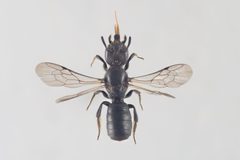
Small black , 6–7 mm in length. Male possesses a two-pronged peg on the terminal abdominal segment. Female has dense snow-white pollen-collecting hairs (scopae) on the surface of the . Body otherwise lacks conspicuous hair or color patterns.
Habitat
Associated with supporting Campanula , including meadows, grasslands, woodland edges, and gardens. Requires access to dry hollow plant stems for nesting, notably reed stems.
Distribution
Recorded from Europe and Northern Asia (excluding China), and North America. Present in both native and introduced ranges.
Seasonality
Single period from mid-June to mid-August. active during peak flowering period of Campanula .
Diet
Oligolectic pollen on Campanula (bellflowers) and Jasione montana (Sheep's-bit). Nectar feeding from same flowers.
Host Associations
- Campanula glomerata - pollen sourcenative bellflower
- Campanula trachelium - pollen sourcenative bellflower
- Campanula rotundifolia - pollen sourcenative bellflower, harebell
- Jasione montana - pollen and nectar sourceSheep's-bit
Life Cycle
Solitary nesting . Female constructs nest in hollow stems, creating series of provisioned with pollen-nectar mixture. Cells sealed with partition walls. Developmental stages: , larva, pupa, . Unvoltine (one per year).
Behavior
Female collects pollen by brushing abdominal scopae against anthers using hind legs, while gripping flower with forelegs and . Males frequently found in same flowers as females. Mating occurs within flowers. Both sexes occasionally observed resting inside flowers during overcast conditions.
Ecological Role
of Campanula . Contributes to of bellflower through obligate mutualism. Serves as prey or for unspecified cleptoparasitic bees.
Human Relevance
Subject of conservation interest; naturalists plant Campanula and provide reed stems to encourage . for healthy Campanula-associated .
Similar Taxa
- Melitta haemorrhoidalisAlso specializes on Campanula, but larger, has leg scopae for pollen transport, and exhibits different coloration.
- Other Chelostoma speciesShare abdominal scopae and male terminal peg, but differ in plant associations and minor morphological details.
More Details
Nesting biology
Accepts dry reed stems as artificial nesting substrate; this trait has been exploited in conservation management.
Pollen transport
Unlike most bees, does not mix pollen with nectar; carries dry pollen on abdominal scopae, potentially enhancing pollen transfer .