
Chelostoma philadelphi
(Robertson, 1891)
Mock-orange Scissor Bee
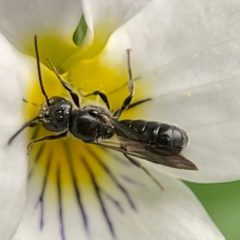
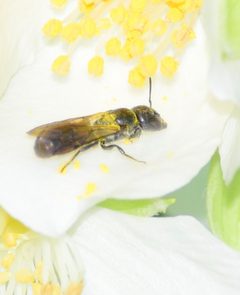
Chelostoma philadelphi is a small solitary in the Megachilidae, commonly known as the Mock-orange Scissor Bee. The is native to North America and has been documented in the northeastern United States, including Vermont. Its and nesting have been formally described, though detailed ecological data remain limited. The species belongs to a of scissor bees characterized by specialized nesting habits.
Pronunciation
How to pronounce Chelostoma philadelphi: //kəˈlɒstəˌmə ˌfɪləˈdɛlfi//
These audio files are automatically generated. While they are not always 100% accurate, they are a good starting point.
Identification
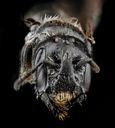
As a member of Chelostoma, this likely exhibits the -typical scissor-like used for cutting leaf or petal pieces for nest construction. However, specific diagnostic features distinguishing C. philadelphi from are not documented in available sources. Formal identification requires examination of microscopic morphological characters.
Images
Distribution
Documented from North America, with confirmed records from Vermont, United States. The ' broader range within North America requires further verification.
Life Cycle
and mature larva have been formally described. Nesting has been documented, though specific details are not provided in available sources. Complete developmental sequence and remain unreported.
Behavior
Nesting has been observed and documented in scientific literature. Like other megachilid bees, females likely construct nests using cut plant material, though specific nesting substrates for this are not confirmed.
More Details
Taxonomic History
Originally described as Heriades philadelphi by Robertson in 1891, later transferred to Chelostoma. The subgenus Prochelostoma has been applied to this in some treatments.
Data Limitations
Most ecological and behavioral information for this is not available in accessible literature. The formal description of stages suggests focused taxonomic study, but broader natural history documentation appears lacking.
Sources and further reading
- BugGuide
- Wikipedia
- GBIF taxonomy match
- iNaturalist taxon
- NCBI Taxonomy
- Catalogue of Life
- Field Tour Offers Close-Up Look at Invasive Species Security
- Bug Eric: True Bug Tuesday: Mirid plant bug
- Entomologists Urge Action, Advocacy After 2018 March for Science
- Decorations on the Christmas tree: Egg cases of the European mantis, Mantis religiosa, Chinese mantis, Tenodera sinensis, and Carolina mantis, Stagmomantis carolina — Bug of the Week
- Descriptions of the Egg and Mature Larva of the BeeChelostoma(Prochelostoma)philadelphiwith Additional Notes on Nesting Biology (Hymenoptera: Megachilidae: Megachilinae: Osmiini)