
Chelostoma rapunculi
(Lepeletier, 1841)
Rampion Scissor Bee
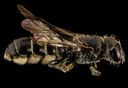
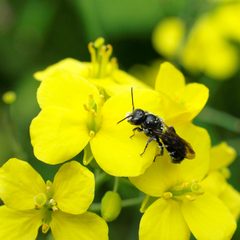
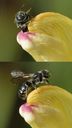
Chelostoma rapunculi is a solitary in the subgenus Gyrodromella ( Megachilidae), commonly known as the Rampion Scissor Bee. It is an oligolectic specialized on Campanula plants, though females occasionally visit non-host plants including Geranium sanguineum and Malva moschata. Nesting occurs in preexisting linear cavities in dead wood or hollow stems, with partitioned using mud and pebbles. The species is native to the Palaearctic region and has been introduced to North America.
Pronunciation
How to pronounce Chelostoma rapunculi: //kəˈlɒstəmə rəˈpʌŋkjʊlaɪ//
These audio files are automatically generated. While they are not always 100% accurate, they are a good starting point.
Identification
Within the subgenus Gyrodromella, C. rapunculi can be distinguished from using the keys provided in Müller (2015). The subgenus contains eight Palaearctic , all oligolectic on Campanula. Specific diagnostic characters for C. rapunculi relative to C. clypeale, C. tonsum, and other Gyrodromella species require examination of morphological features detailed in taxonomic keys.
Images
Habitat
Nests in preexisting linear cavities in dead wood or hollow plant stems. Requires proximity to Campanula plants for foraging. Warm, sheltered nesting sites with available mud for construction.
Distribution
Native to the Palaearctic region (Europe and Northern Asia excluding China). Introduced to North America. Records also from Africa.
Diet
Oligolectic, harvesting pollen almost exclusively from flowers of Campanula and closely related Campanulaceae . may occasionally visit non- plants Malva moschata and Geranium sanguineum for nectar or pollen.
Host Associations
- Campanula - primary pollen Specialized ; all Gyrodromella are oligolectic on Campanula
- Campanulaceae - pollen Possibly includes closely related
- Geranium sanguineum - occasional visitorNon- plant visited by females; olfactory cues attract foraging-naïve bees
- Malva moschata - occasional visitorNon- plant visited by females; lacks spiroacetal host recognition compounds
Behavior
Females construct nests in preexisting cavities, creating partitions and nest plugs using mud partly combined with pebbles. Foraging-naïve individuals are attracted by olfactory cues of non- plants and do not favor Campanula host scent in choice experiments; foraging-experienced bees respond more strongly to visual floral cues. Similar non-host floral traits may represent an initial step toward host expansion, though such shifts are rare in oligolectic bees.
Ecological Role
Specialized of Campanula and related Campanulaceae . Contributes to pollen transfer through loose dry pollen carriage on the body.
Human Relevance
Potential in gardens and urban parks where Campanula are cultivated. Like other solitary bees, does not produce honey or form defensive colonies, making it a peaceful garden visitor.
Similar Taxa
- Chelostoma campanulorumAlso oligolectic on Campanula; distinguished by taxonomic keys in Müller (2015)
- Other Gyrodromella species (C. clypeale, C. tonsum, C. handlirschi)Share Campanula specialization and nesting ; require morphological examination for identification
More Details
Taxonomic history
Chelostoma confusum (Benoist, 1934) and C. proximum Schletterer, 1889 were synonymized with C. rapunculi by Müller (2015). A lectotype was designated for C. handlirschi Schletterer, 1889.
Sensory ecology
Spiroacetals are key olfactory compounds enabling recognition in C. rapunculi. These compounds occur in trace amounts in Geranium sanguineum but were not detected in Malva moschata, suggesting different mechanisms underlie attraction to these non-host plants.
Sources and further reading
- BugGuide
- Wikipedia
- GBIF taxonomy match
- iNaturalist taxon
- NCBI Taxonomy
- Catalogue of Life
- Gardening for Solitary Bees - Buglife Blog - Buglife
- Floral Cues of Non-host Plants Attract Oligolectic Chelostoma rapunculi Bees
- Palaearctic Chelostoma bees of the subgenus Gyrodromella (Megachilidae, Osmiini): biology, taxonomy and key to species