
Aporus hirsutus
(Banks, 1917)
hirsute spider wasp
Aporus hirsutus is a of spider wasp in the Pompilidae, described by Banks in 1917. It belongs to a characterized by a streamlined that slopes gradually toward the , short legs relative to body size, and short, thick . Members of the genus Aporus are known to parasitize trapdoor spiders and other mygalomorph spiders, with females utilizing the 's own burrow as a nest after paralyzing the spider with a sting.
Pronunciation
How to pronounce Aporus hirsutus: /ˈæpərəs hɜːrˈsuːtəs/
These audio files are automatically generated. While they are not always 100% accurate, they are a good starting point.
Identification
Distinguished from other Pompilidae by the combination of: short, thick ; with gradual slope toward (not blocky); proportionately short legs; and small body size. Differs from the unrelated Evagetes, which shares short antennae, by its streamlined rather than blocky thorax. Within the genus Aporus, A. hirsutus is distinguished from by details of and distribution, and subtle structural features of the propodeum and petiole, though precise diagnostic characters require examination.
Images
Appearance
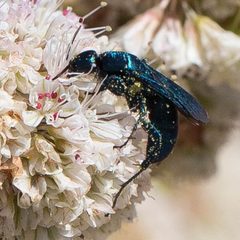
Small spider wasp, 8-15 mm in body length. The slopes gradually toward the , creating a streamlined profile. Legs are proportionately shorter than in other spider wasps. are relatively short and thick. The epithet 'hirsutus' suggests a hairy or setose body covering, though specific details of coloration and pattern require direct examination of specimens.
Habitat
Found in association with flowers of umbelliferous plants including Anne's Lace (Daucus carota), as well as buckwheat (Eriogonum spp.), rabbitbrush (Chrysothamnus spp.), gumweed (Grindelia spp.), spurge (Euphorbia spp.), and various other flowering plants. Also visits extrafloral of sunflower (Helianthus annuus), honeydew from aphids, and gall exudates on oak. The requires supporting both floral resources for and mygalomorph spider for larval development.
Distribution
Western North America. Ranges from central British Columbia south to central Baja California, eastward to western Idaho, Utah, and most of Arizona. One record from Montezuma County, Colorado.
Seasonality
active primarily May through October, with peak activity during summer months. Single per year in most of range; possibly two generations in southernmost latitudes.
Host Associations
- Aptostichus sp. - wafer-lid trapdoor spider, Euctenizidae; male reared from this
Life Cycle
female stings spider into paralysis, then utilizes the spider's own burrow as a nest. A single is deposited on the paralyzed spider. Larva feeds on the paralyzed host. Typically one annually, with some indication of partial second generation in southern areas where some females may oviposit in spring producing summer larvae.
Behavior
frequently visit flowers for nectar, particularly umbelliferous blossoms. Constantly moving even while feeding, making them challenging photography subjects. Females hunt mygalomorph spiders, sting them into paralysis, and usurp their burrows for nesting. Males have been reared from spiders, indicating successful larval development.
Ecological Role
Human Relevance
Not known to be of direct economic importance. Like other spider wasps, poses minimal stinging risk to humans due to small size and non-aggressive nature. Potential interest for research given its specialized , though no applied uses have been documented.
Similar Taxa
- Evagetes spp.Shares short, thick but differs in having blocky rather than streamlined ; unrelated in Pompilidae
- Other Aporus speciesRequire detailed examination of , propodeal structure, and petiole proportions for definitive identification; A. hirsutus distinguished by denser hairiness per epithet
- Other small PompilinaeDistinguished by the unique combination of short legs, short thick , and sloping profile characteristic of Aporus
More Details
Etymology
The specific epithet 'hirsutus' (Latin for 'hairy' or 'bristly') refers to the presumably dense setation characteristic of this .
Taxonomic history
Described by Nathan Banks in 1917. The has received limited study compared to better-known such as A. luxus.
Research needs
Detailed redescriptions of both sexes, range documentation beyond the single Aptostichus record, and studies are needed. The is poorly represented in collections relative to more frequently encountered .