
Priocnemini
Genus Guides
3- Caliadurgus
- Priocnemis(spider wasp)
- Priocnessus
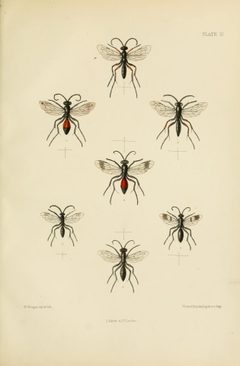
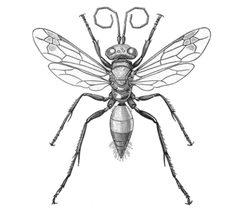
Priocnemini is a tribe of spider wasps within the Pompilidae, Ctenocerinae. Members are distinguished by elongated, slender bodies and long legs adapted for pursuing spider prey. The tribe includes numerous distributed across tropical and subtropical regions worldwide. These are solitary hunters that paralyze spiders to provision nests for their larvae.

Pronunciation
How to pronounce Priocnemini: //ˌpraɪ.əʊˈkniːmɪnaɪ//
These audio files are automatically generated. While they are not always 100% accurate, they are a good starting point.
Identification
Distinguished from other Pompilidae tribes by: elongated, gracile body form with disproportionately long legs; placement in Ctenocerinae; reduced wing venation with characteristic patterns; and absence of dense pilosity common in Pepsinae. Differs from Ctenocerini by generally more slender build and different antennal proportions. Identification to requires examination of tarsal claw structure, clypeal shape, and wing venation details.
Images
Appearance
Elongate, slender body with exceptionally long legs relative to body size. Long, thread-like . Often dark coloration with metallic blue, green, or black reflections. Wings typically clear or lightly tinted with reduced venation compared to other pompilid groups. Body length ranges from approximately 10–25 mm depending on .
Habitat
Primarily tropical and subtropical forests, including rainforest understory, forest edges, and savanna-woodland mosaics. Some occupy arid scrub and semi-desert regions. are often found on vegetation or ground surfaces where active hunting spiders occur.
Distribution
Pantropical and warm temperate distribution. Strongly represented in the Neotropics, Afrotropics, and Indo-Malayan region. Present but less diverse in the Palearctic and Nearctic regions, where occurrence is largely restricted to southern latitudes.
Seasonality
activity generally coincides with warm, dry periods in seasonal climates. In tropical regions, activity occurs year-round with peaks during drier seasons. Temperate zone active primarily from late spring through early autumn.
Diet
feed on nectar from flowers and honeydew. Larvae are obligate of spiders, feeding on paralyzed prey provided by the female parent.
Host Associations
- Spiders (Araneae) - -Females hunt, sting, and paralyze spiders; the specific spider targeted vary by and size class. Large priocnemines may pursue tarantulas and other mygalomorphs, while smaller target spiders such as wolf spiders (Lycosidae) and nursery web spiders (Pisauridae).
Life Cycle
Solitary nesting. Female constructs nest in soil, pre-existing cavities, or sometimes in vegetation. Hunts and paralyzes spider prey, transports it to the nest, and oviposits on the immobilized . Larva feeds externally or internally on the living but paralyzed spider, eventually pupating within the nest. Typically , though multivoltine patterns occur in tropical regions.
Behavior
hunters that actively pursue spiders rather than ambushing them. Some exhibit leaping to capture fast-running prey. Females may dig temporary burrows or use pre-existing holes for nesting. Males often perch on vegetation and engage in territorial disputes. Spider transport involves dragging, carrying in , or, in some species, amputating spider legs to reduce weight.
Ecological Role
Significant control of spiders, particularly active-hunting . Contributes to nutrient cycling through subterranean nesting activities. Serves as prey for larger arthropods, birds, and some reptiles. May influence spider structure and foraging through pressure.
Human Relevance
Generally beneficial due to spider , though individual stings can be painful if handled. Occasionally encountered by arachnologists and entomologists in field settings. No significant economic impact; not known to damage crops or structures.
Similar Taxa
- CtenoceriniAlso in Ctenocerinae; distinguished by generally more robust body, shorter legs relative to body, and different wing venation patterns. Ctenocerini often have more pronounced facial projections.
- PepsiniIn Pepsinae; distinguished by denser body pilosity, different wing venation with more complete , and often more robust hind legs with modified spination for digging.
- AgenielliniIn Pepsinae; distinguished by compact body form, shorter , and different nesting including mud construction or use of hollow stems.
More Details
Taxonomic History
Priocnemini has undergone significant taxonomic revision; boundaries with related tribes have been repeatedly adjusted based on morphological and molecular data. Some formerly placed here have been transferred to Ctenocerini or recognized as distinct tribes.
Molecular Phylogenetics
Recent phylogenetic studies support monophyly of Priocnemini within Ctenocerinae, though relationships among constituent remain partially unresolved. The tribe appears to have diversified primarily during the Cenozoic, coinciding with expansion of tropical forests.