
Pseudomethoca frigida
(Smith, 1855)
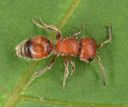
Pseudomethoca frigida is a of velvet ant in the Mutillidae, a group of solitary known for their aposematic coloration and powerful stings. The Pseudomethoca contains species that are often considered models for mimicry complexes, particularly for checkered beetles (Cleridae) such as Enoclerus ichneumoneus. Like other mutillids, females are wingless and males are winged, with the sexes exhibiting pronounced . The species was described by Smith in 1855 and is part of the diverse North American velvet ant fauna.
Pronunciation
How to pronounce Pseudomethoca frigida: //ˌsjuːdoʊməˈθoʊkə ˈfrɪdʒɪdə//
These audio files are automatically generated. While they are not always 100% accurate, they are a good starting point.
Identification
Pseudomethoca frigida can be distinguished from similar mutillid by its specific coloration and patterning, though detailed diagnostic features require examination of morphological characters such as antennal structure, mandibular , and patterns. The Pseudomethoca is characterized by females with dense, often brightly colored pubescence and males with well-developed wings. Accurate identification to species level typically requires comparison with or expert determination, as many mutillid species exhibit convergent color patterns.
Images
Habitat
Sandy or dry soil , particularly in areas with sparse vegetation. The has been associated with dry sand deposits along river systems, such as those found in the Mississippi River lowlands.
Distribution
North America. Specific records include Missouri and other central United States locations. The Pseudomethoca has broader distribution across North America, with occurring in various regions including the eastern and central United States.
Life Cycle
As with other Mutillidae, P. frigida likely exhibits the typical velvet ant : winged males search for flightless females using , mating occurs, and females lay in the nests of ground-nesting bees or . The larvae are ectoparasitoids, feeding on the 's stages. However, specific life cycle details for this have not been documented.
Behavior
Females are active runners on the ground surface, moving in rapid, zigzag patterns when disturbed. They are and often difficult to photograph due to their constant motion. Males are capable of and are attracted to females via .
Ecological Role
Potential model for Müllerian mimicry complexes, with its aposematic coloration serving as a warning signal to . The species may contribute to of ground-nesting Hymenoptera through its larval stage.
Human Relevance
Females possess a powerful sting and should be handled with caution. The is of interest to entomologists studying mimicry systems and velvet ant .
Similar Taxa
- Pseudomethoca simillimaClosely related congeneric with similar appearance and ; both have been implicated as potential models for clerid mimicry.
- Dasymutilla quadriguttataAnother mutillid with similar coloration that has been suggested as a possible model for Enoclerus ichneumoneus mimicry; differs in size and specific pattern details.
- Enoclerus ichneumoneusNot a similar but a frequent associate in mimicry discussions—this checkered beetle (Cleridae) has been proposed to mimic Pseudomethoca species based on shared orange and black banding patterns.