
Pseudomethoca athamas
(Fox, 1899)
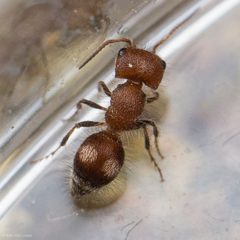
Pseudomethoca athamas is a of velvet ant in the Mutillidae. The species is found in western North America, specifically in California, Oregon, and Baja California. Like other mutillids, females are wingless and males are winged. The Pseudomethoca includes species that have been proposed as models for mimicry by checkered beetles (family Cleridae), particularly the orange-banded checkered beetle Enoclerus ichneumoneus.
Pronunciation
How to pronounce Pseudomethoca athamas: //ˌsjuːdoʊməˈθoʊkə ˈæθəmæs//
These audio files are automatically generated. While they are not always 100% accurate, they are a good starting point.
Identification
Pseudomethoca athamas can be distinguished from other Pseudomethoca by examination of specific morphological features, though detailed diagnostic characters are not well-documented in available sources. Females are wingless with a velvety appearance due to dense setae; males possess wings. The species shares the general mutillid body plan with a robust, -like form.
Images
Distribution
Known from California and Oregon in the United States, and Baja California in Mexico. Records are relatively sparse, with 46 observations documented on iNaturalist.
Behavior
Females are active on the ground surface and are known for rapid, erratic movement patterns that make them difficult to photograph. Like other mutillids, females are solitary and do not construct nests; they deposit in the nests of other hymenopterans, particularly bees and , where their larvae develop as .
Ecological Role
As a , the likely plays a role in regulating of its bees or . The bright coloration of mutillids, including this species, may serve as aposematic warning coloration due to their painful sting.
Human Relevance
The has been proposed as a potential model for by the checkered beetle Enoclerus ichneumoneus, though this relationship remains speculative. Like other velvet ants, females can deliver a painful sting if handled, earning the the nickname 'cow killers.'
Similar Taxa
- Pseudomethoca simillimaSimilar orange and black coloration; both have been proposed as potential models for mimicry by Enoclerus ichneumoneus. P. simillima occurs in the eastern and central United States (including Missouri), whereas P. athamas is western in distribution.
- Dasymutilla quadriguttataAlso proposed as a potential model for E. ichneumoneus mimicry; larger in size than P. athamas and more commonly encountered in some regions.