
Timulla oajaca
Timulla oajaca is a of velvet ant in the Mutillidae, a group of wingless known for their potent sting and aposematic coloration. The Timulla is frequently cited as a model for Müllerian mimicry complexes in North America, with spiders in the genus Sergiolus (Gnaphosidae) among their documented visual mimics. Like all mutillids, females are wingless while males possess wings. The species name refers to Oaxaca, Mexico, suggesting a geographic association with this region.
Pronunciation
How to pronounce Timulla oajaca: /tɪˈmʌlə oʊəˈhɑːkə/
These audio files are automatically generated. While they are not always 100% accurate, they are a good starting point.
Identification
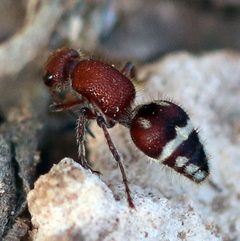
As a Timulla , T. oajaca likely exhibits the characteristic velvet ant : densely hairy (velvety) with striking aposematic coloration typically combining red, black, and white or yellow patterns. Females are wingless with a robust, -like appearance; males have wings. Definitive identification to species level requires examination of genitalic structures and other subtle morphological features not reliably distinguishable from field observations alone. The species is distinguished from by subtle differences in pilosity patterns, coloration details, and male genitalia.
Images
Habitat
Based on -level patterns and the etymology of the name, T. oajaca is associated with dry to mesic in Mexico, likely including sun-dappled forest floors, open woodlands, and semi-arid scrublands where nesting sites for their lifestyle would be available.
Distribution
The specific epithet "oajaca" (referring to Oaxaca, Mexico) indicates this is documented from Oaxaca state in southern Mexico. The Timulla has broader distribution across the southwestern United States, Mexico, and Central America, but T. oajaca appears to have a more restricted Mexican range.
Diet
are nectarivorous, feeding on floral nectar. Larvae are ectoparasitoids of other insects, typically stages of ground-nesting bees and (Hymenoptera) or occasionally beetles (Coleoptera), though specific records for T. oajaca are not documented in the provided sources.
Life Cycle
Mutillids exhibit complete with a lifestyle. Females enter nests and deposit on or near host larvae. The mutillid larva consumes the host, eventually pupating within the nest. Males emerge and fly to locate females for mating. Specific developmental timing for T. oajaca is not documented.
Behavior
Females are solitary and ground-active, frequently encountered running rapidly across open ground when disturbed— that contributes to their "velvet ant" despite being . Both sexes are capable of delivering a painful sting; females cannot fly and rely on their sting and aposematic coloration for defense. Males fly and are less frequently observed.
Ecological Role
As , mutillids regulate of ground-nesting Hymenoptera. Their aposematic coloration contributes to Müllerian mimicry rings, providing mutual protection with other unpalatable including spiders that visually mimic them.
Human Relevance
Females are known for their extremely painful sting, earning mutillids the nickname "cow killers" in North American folklore, though this is exaggeration. The Timulla serves as the model for documented cases of spider mimicry (Sergiolus capulatus), contributing to understanding of evolutionary mimicry. T. oajaca itself has limited direct human interaction due to its Mexican distribution.
Similar Taxa
- Sergiolus capulatusThis ground spider (Gnaphosidae) exhibits striking visual mimicry of Timulla velvet ants, including similar red-and-black banding. The spider lacks wings (both sexes), has eight legs, and possesses the cylindrical characteristic of Gnaphosidae. Unlike the , it does not sting and has two body segments rather than three.
- Other Timulla species share the general velvet ant bauplan and aposematic coloration. -level identification requires examination of male genitalia, female sting apparatus , and subtle differences in patterns and coloration details.
More Details
Mimicry complex
Timulla , including T. oajaca, are central to documented Müllerian mimicry rings in North America. The spider Sergiolus capulatus has been specifically noted to bear "uncanny resemblance" to Timulla species, including T. oajaca's likely , though whether S. capulatus specifically mimics T. oajaca or a sympatric Timulla species depends on geographic overlap.
Taxonomic note
The epithet "oajaca" uses the historical spelling "Oajaca" for the Mexican state of Oaxaca, reflecting older orthographic conventions in taxonomic .