
Pergidae
pergid sawflies
Genus Guides
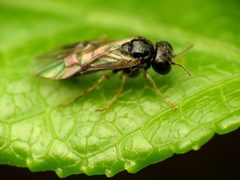
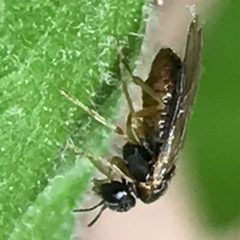
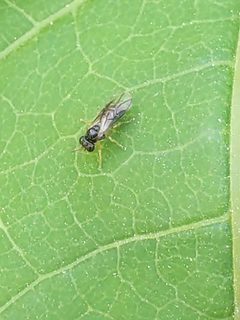
1is the third-largest of (Hymenoptera: ), with approximately 450 described . The family is distributed primarily in the Australasian and Neotropical regions, with South America and Australia representing the greatest diversity. Members exhibit considerable morphological variation in structure, ranging from simple to pectinate or bipectinate forms, and frequently display . Several species are economically significant as agricultural pests or livestock toxins, while others have been evaluated as agents.
Pronunciation
How to pronounce Pergidae: //ˈpɜːrɡɪdiː//
These audio files are automatically generated. While they are not always 100% accurate, they are a good starting point.
Identification
vary considerably in segment number and form, from simple to serrate, pectinate, or bipectinate. is common, with differences in antennae type, coloration, and size between sexes. Some are ( Cladomacra in Papua New Guinea and Indonesia) or have brachypterous females (Clarissa tasbates in Tasmania).
Images
Habitat
Diverse across Australasian and Neotropical regions. Many Australian associated with Eucalyptus forests. Some Euryinae are ground-dwelling, saprophagous, and or . Larvae of some species occur in pastures and grazing lands.
Distribution
Western Hemisphere from southeastern Canada through eastern United States to southern Chile, with greatest diversity in the Neotropics. Australasian Region including Australia (including Tasmania), New Guinea, New Britain, Sulawesi, and Indonesia. One introduced (Phylacteophaga froggatti) in New Zealand and New Caledonia.
Seasonality
activity and larval occurrence vary by region and . Tequus schrottkyi has several between March and July in Uruguay. Perreyia flavipes larvae appear between June and September in southern Brazil. Phylacteophaga froggatti discovered in New Zealand in March 1985.
Diet
Extremely diverse food plants. Many Australian feed on Eucalyptus species. Other food plants include dead or dying leaves, aquatic ferns, fungi, Solanum species, Nothofagus, Psidium (guava), oaks, hickories, Melaleuca quinquenervia, and Schinus terebinthifolius. Some Euryinae are saprophagous. Most are external leaf feeders; some are shoot borers or leaf miners.
Life Cycle
Complete : , larva (several instars), pupa, and . Phylacteophaga froggatti has four feeding instars in males and five in females, followed by a non-feeding . Tequus schrottkyi larvae spin silk cocoons in soil for . Eggs laid individually in leaf margins into leaf tissue in some .
Behavior
Gregarious common in larvae. Larvae of Perreyia travel in groups on the ground, forming tight-knit masses crawling over each other, and locate group sites. Perga larvae exhibit periodic halts with abdominal raising and lowering to communicate movement initiation within groups. Perga dorsalis larvae show situational leadership in collective foraging. Lophyrotoma larvae cut leaf midveins before feeding, with some species severing petioles when leaving. Some Australian species in Perginae, Philomastiginae, and South American Syzygoniinae exhibit maternal care.
Ecological Role
Herbivores contributing to leaf damage and nutrient cycling. Some sequester plant defensive compounds, rendering larvae unpalatable to . Potential agents for weeds including Melaleuca quinquenervia and Schinus terebinthifolius. include Braconidae and Eulophidae.
Human Relevance
Agricultural pests: of Tequus on potatoes in Peru and Bolivia; Cerospastus volupis defoliates Nothofagus in Chile and Argentina; numerous species damage Eucalyptus in Australia; Phylacteophaga leafminers introduced to New Zealand and New Caledonia; Haplostegus, Enjijus, and Sutwanus on guava in Central and South America; Acordulecera on oaks and hickories in eastern North America. Livestock : larvae of Perreyia flavipes and related species cause acute hepatic and death in sheep, goats, and pigs when ingested, with substantial financial losses in Brazil, Uruguay, and Australia. potential: Lophyrotoma zonalis evaluated for Melaleuca quinquenervia control in Florida; Heteroperreyia hubrichi for Brazilian peppertree control.
Similar Taxa
- TenthredinidaeLargest ; distinguished from by generally simpler without the extreme variation in segment number and pectinate forms found in Pergidae
- ArgidaeSecond-largest ; Argidae larvae often display alternate appearances between instars, whereas typically maintain consistent larval coloration; both families produce defensive but differ in evolutionary patterns of gregariousness and conspicuousness
More Details
Defensive chemistry
Larvae of Argidae and produce potent defensive chemicals de novo, including toxic . This chemical defense has influenced evolutionary relationships between larval appearance and gregariousness, with most Pergidae being conspicuous-gregarious. Perreyia flavipes larvae contain D--containing peptides responsible for livestock toxicosis.
Feeding adaptations
Some Eremophila-visiting have maxillary palpi modified into a tube for nectar-feeding, analogous to the tube formed by enlarged maxillary palpi in some Australian Colletidae bees. Perga affinis affinis larvae store at least 80% of ingested sideroxylonal-A in the , with less than 1% excreted, without apparent feeding inhibition.
Fossil record
Baladi warru, a Miocene fossil from McGraths Flat, New South Wales, represents the first Australian pergid fossil and belongs to Perginae. Ancestral character reconstruction indicates four independent adaptations to toxic Myrtaceae as plants.
Sources and further reading
- BugGuide
- Wikipedia
- GBIF taxonomy match
- NCBI Taxonomy
- Catalogue of Life
- Journal of Hymenoptera Research 64th issue | Blog
- Biology of the Pergidae Family (Insecta: Hymenoptera)
- Leadership Behaviour in Sawfly Larvae Perga dorsalis (Hymenoptera: Pergidae)
- Spontaneous poisoning by larvae of Perreyia flavipes (Pergidae) in sheep
- Feeding behaviour in Australian gregarious Lophyrotoma sawflies (Hymenoptera: Pergidae)
- Endogenous toxins and the coupling of gregariousness to conspicuousness in Argidae and Pergidae sawflies
- Biology, distribution and host-range of the sawfly,Lophyrotoma zonalis (Hym. pergidae), a potential biological control agent for the paperbark tree,Melaleuca quinquenervia Biologie, distribution et gamme d’hôtes deLophyrotoma zonalis (Hym. : Pergidae), agent potentiel de lutte biologique contreMelaleuca quinquenervia
- First report of Tequus schrottkyi (Konow) (Hymenoptera: Pergidae) in Uruguay, and information about its host plant and biology
- Some Aspects of the Biology of the Eucalypt-Mining Sawfly Phylacteophaga Froggatti Riek (Hymenoptera: Pergidae).
- The effect of sideroxylonal-A on feeding of steelblue sawfly, Perga affinis affinis Kirby (Hymenoptera : Pergidae), larvae
- Chemical detoxification vs mechanical removal of host plant toxins in Eucalyptus feeding sawfly larvae (Hymenoptera: Pergidae)
- Host Specificity ofHeteroperreyia hubrichiMalaise (Hymenoptera: Pergidae), a Potential Biological Control Agent of Brazilian Peppertree (Schinus terebinthifoliusRaddi)
- AN EXTRAORDINARY NEW BEE AND ADAPTATION OF PALPI FOR NECTAR‐FEEDING IN SOME AUSTRALIAN COLLETIDAE AND PERGIDAE (HYMENOPTERA)
- A new exceptionally preserved sawfly fossil (Hymenoptera: Pergidae) and an evaluation of its utility for divergence time estimation and biogeography
- Experimental intoxication by larvae of Perreyia flavipes Konow, 1899 (Hymenoptera: Pergidae) in pigs and some aspects on its biology
- TWO NEW AUSTRALIAN SPECIES OF BRACON F. (HYMENOPTERA: BRACONIDAE) PARASITIC ON PHYLACTEOPHAGA SPP. (HYMENOPTERA: PERGIDAE)