
Cephalcia
Panzer, 1803
spruce web-spinning sawflies
Species Guides
4Cephalcia is a of web-spinning sawflies in the Pamphiliidae, established by Panzer in 1803. are distributed across Europe, North America, and Asia. Larvae feed primarily on conifer needles, particularly spruce (Picea) and larch (Larix), and construct silk webs for protection while feeding. Several species are significant forest pests capable of causing defoliation during . The genus exhibits complex with variable voltinism, often involving extended in soil-dwelling prepupal stages.
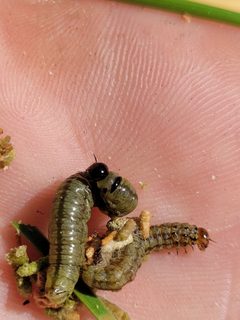
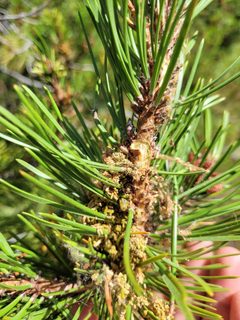
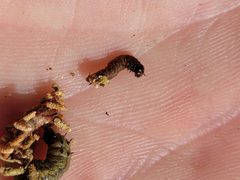
Pronunciation
How to pronounce Cephalcia: /sɛˈfælʃə/
These audio files are automatically generated. While they are not always 100% accurate, they are a good starting point.
Images
Habitat
Coniferous forests, particularly spruce (Picea) and larch (Larix) stands. Larvae feed in the tree , while and pupae occur in soil chambers.
Distribution
Europe, North America, and Asia (including Japan, China, and Siberia). Specific distribution varies by : C. abietis occurs in Central Europe (Germany, Austria), C. arvensis in Europe, C. fascipennis in North America, C. isshikii in Japan, C. lariciphila across Europe and parts of Asia, and C. variegata in Japan.
Seasonality
typically occurs in spring to early summer. Larval feeding period varies by and climate. Development duration ranges from (1 year) to 2–4 years or longer due to variable in prepupal stages; temperature is the primary factor controlling development timing.
Diet
Larvae feed on conifer needles. Documented plants include spruce (Picea abies, P. pumila), larch (Larix decidua, L. sibirica, L. kaempferi, L. marschlinsii), and potentially other conifers. Specific host associations vary by .
Host Associations
- Picea abies - larval food plantprimary for C. abietis, C. arvensis, C. fascipennis, C. isshikii
- Picea pumila - larval food plant for C. variegata
- Larix decidua - larval food plant for C. lariciphila
- Larix sibirica - larval food plant for C. lariciphila
- Larix kaempferi - larval food plant for C. lariciphila
- Larix marschlinsii - larval food plant for C. lariciphila
Life Cycle
Holometabolous. laid on foliage. Larvae feed gregariously in silk webs, then descend to soil to form earth-walled chambers. Prepupal stage exhibits complex : eonymphs (early ) may remain in diapause for extended periods, transforming to pronymphs before . Development duration highly variable (1–4+ years) depending on temperature and diapause length. Pupation occurs after winter chilling period.
Behavior
Larvae construct silk webs on branches for protection while feeding. Mature larvae drop from trees and burrow into soil to form chambers. females climb tree trunks to reach foliage for oviposition. Developmental synchronization observed in some , with mass events following extended .
Ecological Role
Defoliator of coniferous forests. Functions as a primary consumer, transferring energy from trees to higher . Serves as host for diverse complexes including ichneumonid wasps and tachinid flies, which can exert significant control during .
Human Relevance
Several are forest pests capable of causing significant defoliation and economic damage to spruce and larch stands during (gradations). Cephalcia abietis caused major outbreaks in Central Europe from the late 1970s through 1990s. Monitoring and prediction of outbreaks is complicated by variable duration. Subject to research focusing on conservation and .
Similar Taxa
- GilpiniaBoth are conifer-feeding in related (Pamphiliidae vs. Diprionidae). Gilpinia larvae do not construct silk webs, unlike Cephalcia.
- DiprionBoth are defoliators of conifers. Diprion lack the web-spinning larval characteristic of Cephalcia and have different capsule .
Sources and further reading
- BugGuide
- Wikipedia
- GBIF taxonomy match
- iNaturalist taxon
- NCBI Taxonomy
- Cephalcia lariciphila . [Distribution map].
- Untersuchungen über die Fichtengespinstblattwespen Cephalcia spp. Panz. (Hym., Pamphiliidae)
- Über das Auftreten parasitischer Insekten von Cephalcia abietis L. im Waldviertel (Niederösterreich) Studies on the parasitoids of Cephalcia abietis L. in Lower Austria (Waldviertel)
- INJURY TO PINUS PUMILA REGEL BY THE LARVAE OF CEPHALCIA VARIEGATA TAKEUCHI AND GILPINIA DAISETUSANA TAKEUCHI IN JAPAN, WITH A DESCRIPTION OF THE LARVAE AND LIFE HISTORY OF CEPHALCIA VARIEGATA (HYMENOPTERA: DIPRIONIDAE, PAMPHILIIDAE)
- Untersuchungen über die Fichtengespinstblattwespen Cephalcia spp. Panz. (Hym., Pamphiliidae)1
- Untersuchungen über die Fichtengespinstblattwespen Cephalcia spp. Panz. (Hym., Pamphiliidae) IV. Massenwechsel von Cephalcia abietis L. im oberschwäbischen Forstrevier Erolzheim (Fbz. Ochsenhausen) *
- Interspecific correlation between Cephalcia kunyushanica and host plant in natural forest in Kunyushan Mountains, China
- The Life History of a Web-spinning Sawfly of Spruce, Cephalcia fascipennis (Cresson) (Hymenoptera: Pamphiliidae)
- Untersuchungen zur Temperaturabhängigkeit der Eonymphen‐Pronymphen Umwandlung bei der Fichtengespinstblattwespe Cephalcia abietis L. (Hym., Pamphiliidae)
- Voltinism and diapause in the spruce web‐spinning sawfly Cephalcia arvensis
- Inter‐tree distribution of the spruce web‐spinning sawfly, Cephalcia abietis , at endemic density
- Untersuchungen zur Entwicklungszeit der Erdlarven von Cephalcia abietis L. (Hym., Pamphiliidae)1
- Two-year Life Cycle of the Red-headed Spruce Web-spinning Sawfly, Cephalcia isshikii(Hymenoptera:Pamphiliidae)
- Analysis of Toxic Components in Secondary Metabolites of Entomopathogenic Fungi Clonostachys rosea (Hipocreales: Bionectriaceae) from Cephalcia chuxiongica (Hymenoptera: Pamphiliidae).
- Toxicity Assay and Pathogenic Process Analysis of Clonostachys rogersoniana Infecting Cephalcia chuxiongica.