
Rhyssella
Rohwer, 1920
Species Guides
2Rhyssella is a of ichneumon wasps in the Ichneumonidae, containing approximately 10 described . The genus was established by Rohwer in 1920. Species in this genus are of wood-boring insects, with documented associations to wood- in the genus Xiphydria. The genus has a Holarctic distribution, with records from North America, Europe, and Asia.
Pronunciation
How to pronounce Rhyssella: /rɪˈsɛlə/
These audio files are automatically generated. While they are not always 100% accurate, they are a good starting point.
Identification
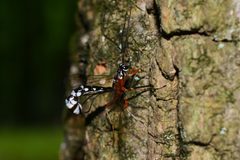
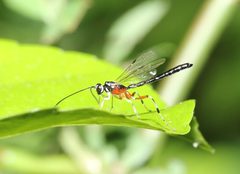
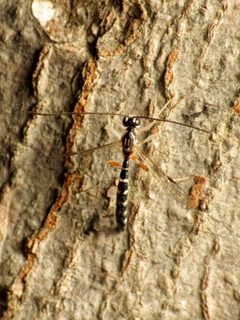
within Rhyssella possess the characteristic long ovipositor typical of many ichneumonid wasps that attack wood-boring . Rhyssella nitida has been specifically noted as a species, distinguishing it from ichneumonids such as Ophion species that may occur at the same blacklight traps. Detailed morphological characters distinguishing Rhyssella from related are not documented in available sources.
Images
Habitat
Associated with forested environments containing dead wood and logs, which serve as for their wood-boring . The presence of Rhyssella nitida at a blacklight in a residential backyard in Kansas suggests some for disturbed or edge habitats where host trees occur.
Distribution
Holarctic distribution. Documented from North America (including the United States, with specific records from Kansas), Europe (Denmark, Norway, Sweden), and Asia (China, with multiple described from Jilin and other provinces). GBIF records indicate presence in Denmark, Norway, and Sweden.
Seasonality
Rhyssella nitida has been observed in early spring (March 31 in Kansas, 2024). This timing aligns with the activity period of its wood- , which develop in dead wood.
Host Associations
- Xiphydria - Wood- in this serve as ; female Rhyssella uses long ovipositor to drill into logs and dead trees to reach host larvae
Life Cycle
Females drill into logs and dead trees using their long ovipositor to access larvae. A single is laid on the host . The resulting larva feeds as an external , eventually killing the host. Specific details of and timing are not documented.
Behavior
activity pattern documented for at least one (Rhyssella nitida), contrasting with relatives. Females actively seek wood-boring larvae by drilling through wood with their ovipositor.
Ecological Role
Acts as a agent of wood-boring , potentially limiting of Xiphydria that develop in dead and decaying wood. Contributes to nutrient cycling in forest by regulating wood-boring insect populations.
Human Relevance
No direct economic importance documented. May incidentally benefit forestry by parasitizing wood-, though this has not been quantified. Occasionally attracted to blacklights, making it observable by entomologists and naturalists.
Similar Taxa
- OphionAlso ichneumonid wasps attracted to blacklights, but rather than ; belong to different (Ophioninae vs. Rhyssella in uncertain subfamily placement)
- MegarhyssaLarge ichneumonids with extremely long ovipositors that also attack wood-boring ; distinguished by larger size and different host associations (primarily horntails in Siricidae)
More Details
Taxonomic history
The was established by S.A. Rohwer in 1920. Multiple have been described from China by Wang & Hu (1992) and Hu & Yao (1998), suggesting the Asian fauna remains incompletely documented.
Observation note
Rhyssella nitida was described as 'beautiful' in a field observation from Kansas, suggesting distinctive coloration or structural features, though specific descriptions are not provided in available sources.