
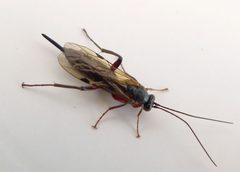
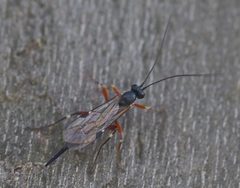
Pimpla turionellae
(Linnaeus, 1758)
Pimpla turionellae is a solitary idiobiont endoparasitoid in the Ichneumonidae. Females parasitize the larvae and pupae of lepidopteran , particularly Galleria mellonella, by injecting venom that suppresses host immune responses before oviposition. The has been extensively studied as a laboratory model organism due to its pharmacologically significant venom, which exhibits cytotoxic, immunomodulatory, and potential anticancer properties. It is widely distributed across Europe and has been introduced to other regions including the Azores.

Pronunciation
How to pronounce Pimpla turionellae: /ˈpɪm.plə ˌtjʊr.i.oʊˈnɛl.i.i/
These audio files are automatically generated. While they are not always 100% accurate, they are a good starting point.
Images
Habitat
Occurs in diverse environments where lepidopteran larvae are found, including , stored product facilities, and natural supporting . Laboratory rearing typically conducted at 25±3°C with 60±3% relative humidity and 12-hour light-dark cycles.
Distribution
Native to Europe with records from Belgium, including Brussels-Capital and Flemish regions. Introduced to the Azores (Faial and Pico islands). Specific native range boundaries not well documented in available sources.
Diet
feed on honey and other sources. Larvae develop as endoparasitoids within tissues, consuming host and tissues.
Host Associations
- Galleria mellonella - primary Larvae and pupae; major laboratory and pest
- Lepidoptera - orderMultiple lepidopteran documented as , though specific beyond G. mellonella not detailed in sources
Life Cycle
Solitary idiobiont endoparasitoid. Females locate pupae and inject venom along with calyx fluid to suppress host immune defenses before depositing . Eggs are oval, approximately 0.5 mm in length. Embryonic development proceeds through superficial cleavage with formation of , germ band, and extraembryonic ( and amnion). Larvae develop within host, eventually killing it. Development is haplodiploid: males arise from unfertilized eggs, females from fertilized eggs. Parasitized host pupae fail to emerge as within 24 hours of parasitization.
Behavior
Females employ vibrational sounding to locate within concealed environments such as cocoons or pupal . Venom injection precedes oviposition and is essential for suppressing host -mediated immune responses. The venom alone can kill hosts through cytotoxicity, though presence is required for . longevity varies with environmental conditions and host quality.
Ecological Role
agent of lepidopteran pests, particularly Galleria mellonella, a significant pest of honeybee colonies and stored products. As a , contributes to regulation of in both natural and agricultural .
Human Relevance
Laboratory model organism for studies of - interactions, venom biochemistry, and immunology. Venom constituents show pharmaceutical potential including anticancer activity against glioblastoma , immunomodulatory effects, and possible applications as anticoagulant, , antiviral, or painkiller agents. Used extensively in research on oxidative stress, genotoxicity, and epigenetic mechanisms. industry benefits from of wax pests.
Similar Taxa
- Pimpla sanguinipesSimilar and as congeneric , though distinguished by distribution (western North America), orange leg coloration, and specific associations including tent caterpillars and tussock moths
- Coccygomimus spp.Formerly treated as synonym of Pimpla; some historically confused with P. turionellae but distinguished by punctation patterns and preferences
Sources and further reading
- BugGuide
- Wikipedia
- GBIF taxonomy match
- iNaturalist taxon
- NCBI Taxonomy
- Catalogue of Life
- Bug Eric: Wasp Wednesday: Pimpla sanguinipes
- EMBRYOLOGY OF PIMPLA TURIONELLAE (L.) (HYMENOPTERA: ICHNEUMONIDAE)
- CYTOTOXICITY OF VENOM FROM ENDOPARASITOID PIMPLA TURIONELLAE L. (HYMENOPTERA: ICHNEUMONIDAE) ON GLIOBLASTOMA CELLS Endoparazitoid Pimpla turionellae L. (Hymenoptera: Ichneumonidae) venomunun glioblastoma hücreleri üzerindeki sitotoksisitesi
- Oxidative, Genotoxic and Epigenotoxic Effects of Pimpla turionellae Venom at Pharmacological Perspective
- Efficiency of vibrational sounding in the parasitoid Pimpla turionellae is affected by female size
- Effects of Some Antibiotics on Survival and Development of the Endoparasitoid Pimpla turionellae L. (Hymenoptera: Ichneumonidae)
- The Effect of Neomycin on Survival and Development of Pimpla turionellae L. (Hymenoptera: Ichneumonidae) Reared on a Natural Host
- Cytotoxic effects of parasitism and application of venom from the endoparasitoid Pimpla turionellae on hemocytes of the host Galleria mellonella
- Effects of Gyrase Inhibitors on the Total Protein Content of Pimpla turionellae L. Reared on an Artificial Diet
- Anti-oxidative, genotoxic and mutagenic effects of idiobiont, endoparasitoid, Pimpla turionellae L. (Hymenoptera: Ichneumonidae) venom on its host Galleria mellonella L. (Lepidoptera: Pyralidae)
- Effects of Indol-3-Acetic Acid on the biology of Galleria mellonella and its endoparasitoid Pimpla turionellae
- Evaluation of the Potential Anti-inflammatory Effects of Endoparasitoid Pimpla turionellae L. (Hymenoptera: Ichneumonidae) venom on Mammalian Cell Lines
- Testosterone, progesterone, and FSH levels in Pimpla turionellae L. (Hymenoptera: Ichneumonidae) and its host Galleria mellonella L. (Lepidoptera: Pyralidae)
- Effects of Cypermethrin Exposed to Host on the Developmental Biology of Pimpla turionellae (Hymenoptera: Ichneumonidae)
- Alterations Induced by Nano-Polystyrene Administration in Biological Parameters of Host-Endoparasitoids (Galleria mellonella and Pimpla turionellae) and Host Hemocyte Counts
- The Effect of Parasitization by Pimpla turionellae (L.) on the Emergence from the Pupal Case of its Host, Galleria mellonella (L.)