
Ichneumon centrator
Say, 1825
centrator wasp
Ichneumon centrator is a North American endoparasitic ichneumonid first described by Thomas Say in 1825. The exhibits pronounced in coloration and is notable for its highly specialized relationship with a single caterpillar species. Females overwinter as and require the sperm stored from autumn matings to fertilize laid the following spring.
Pronunciation
How to pronounce Ichneumon centrator: /ɪkˈnjuːmɒn sɛnˈtreɪtɔːr/
These audio files are automatically generated. While they are not always 100% accurate, they are a good starting point.
Identification
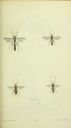
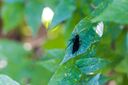
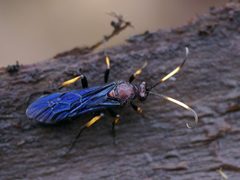
Females distinguished by rust-colored and contrasting with black , and bicolored . Males resemble Gnamptopelta obsidianator but are substantially smaller; G. obsidianator is a much larger . The violet-blue wing coloration is characteristic. No other North American ichneumon wasp is known to share the specific combination of rust-and-black female coloration with this specialization.
Images
Habitat
Associated with supporting its caterpillar, including open areas and edges where Isabella tiger moth larvae occur. Females select hibernation sites under bark of fallen trees in humid areas with stable temperatures.
Distribution
Native to North America. Concentrated in northeastern United States and southeastern Canada. Additional records from British Columbia, Alberta, Washington, Oregon, and Texas.
Seasonality
activity primarily March through August. Females overwinter as adults; males die in autumn.
Host Associations
- Pyrrharctia isabella - endoparasitoidIsabella tiger moth; woolly bear caterpillar. Sole known . deposited into living caterpillar larvae; larvae develop internally and emerge from host pupae.
Life Cycle
Koinobiont endoparasitoid. Female deposits into late-stage larvae of Pyrrharctia isabella using ovipositor. larvae develop internally within living , allowing host to continue development until . emerge from host pupae. Females overwinter as adults, already fertilized via sperm stored in spermatheca; males die in autumn. In spring, females fertilize eggs and seek hosts that have simultaneously emerged from hibernation.
Behavior
Females exhibit site fidelity in hibernation, selecting specific microhabitats under bark on fallen trees with stable humidity and temperature. Clustering of hibernating females has been observed, with evidence suggesting -mediated to suitable sites. Mating occurs in autumn prior to female hibernation.
Ecological Role
regulator of Isabella tiger moth through . Specialized maintaining narrow -specific interaction. Hibernation site selection may facilitate mate-finding and information transfer about suitable microhabitats.
Human Relevance
Subject of entomological study due to extreme specificity and . No documented economic importance; neither beneficial nor pest status established.
Similar Taxa
- Gnamptopelta obsidianatorMales of I. centrator strikingly similar in all-black coloration with pale , but G. obsidianator is substantially larger; females of the two readily distinguished by rust coloration unique to I. centrator
More Details
Hibernation Biology
Female I. centrator is one of relatively few ichneumonids known to overwinter as a fertilized rather than as a larva or pupa. The requirement for autumn mating and sperm storage, followed by spring , creates tight phenological synchronization with caterpillar .
Host Specificity
The exclusive association with Pyrrharctia isabella represents one of the most specialized relationships documented in the Ichneumonidae. No alternative hosts have been recorded despite extensive collecting in the ' range.
Sources and further reading
- BugGuide
- Wikipedia
- GBIF taxonomy match
- iNaturalist taxon
- Catalogue of Life
- Bug Eric: Ichneumon Wasp: Ceratogastra ornata
- Pseudomethoca simillima – a model for Enoclerus ichneumoneus? | Beetles In The Bush
- Bug Eric: A Potential New Host Record for Calliephialtes grapholithae (Hymenoptera: Ichneumonidae) from a Paper Wasp nest (Hymenoptera: Vespidae: Polistes metricus)
- Bug Eric: Strange Behavior Explained (Sort of)
- Bug Eric: Wasp Wednesday: Pachysomoides fulvus
- Bug Eric: Wasp Wednesday: Podoschistus