
Gnamptopelta obsidianator
(Brullé, 1846)
bent-shielded besieger wasp
Gnamptopelta obsidianator is a large ichneumonid and the sole in its . It is distinguished by a concave , a trait reflected in its genus name derived from Greek words for 'bent' and 'shield.' The species is an ectoparasitoid of sphinx moth caterpillars (Macroglossinae) feeding on grapevines. are active in spring across eastern North America.
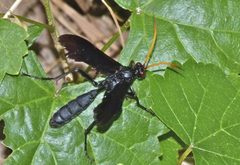
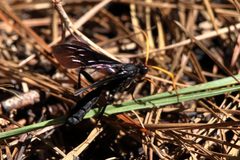
Pronunciation
How to pronounce Gnamptopelta obsidianator: /ˌnæmp.toʊˈpɛl.tə ˌɒb.sɪ.diˈeɪ.nə.tɔr/
These audio files are automatically generated. While they are not always 100% accurate, they are a good starting point.
Identification
Distinguished from allied by the concave . Similar to Conocalma brullei but lacks an elevated structure on the abdominal petiole and differs in clypeal shape.
Images
Habitat
Associated with grapevine (Vitis aestivalis). Specific microhabitat preferences beyond plant association are not documented.
Distribution
Eastern North America: Quebec south to Florida, west to Manitoba and New Mexico.
Seasonality
active March through May.
Host Associations
- Darapsa myron - Macroglossinae caterpillar on Vitis aestivalis
- Amphion floridensis - Macroglossinae caterpillar on Vitis aestivalis
- Eumorpha achemon - Macroglossinae caterpillar on Vitis aestivalis
Life Cycle
laid inside third through fifth instar caterpillars. Developmental details beyond oviposition stage are not documented.
Behavior
Females actively search grapevines for caterpillars. Oviposition targets late-instar larvae.
Ecological Role
Primary of Macroglossinae caterpillars; control agent for sphinx moths in vine . Subject to hyperparasitism by the braconid Aleiodes texanus.
Human Relevance
Potential agent for sphinx moth pests in viticulture, though no documented applied use.
Similar Taxa
- Conocalma brulleiVery similar overall appearance; distinguished by presence of elevated petiole structure and different clypeal shape
More Details
Taxonomic history
Originally described as Trogus obsidianator (1846). Southern ferruginous form described as Trogus austrinus (1868). Gnamptopelta erected (1939) based on clypeal structure. synonymized by Sime & Wahl (1998).