
Amphion floridensis
Clark, 1920
Nessus sphinx
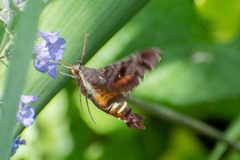
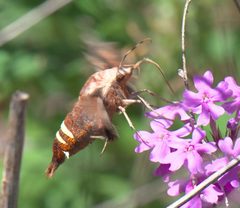
Amphion floridensis, commonly known as the Nessus sphinx, is a day-flying in the Sphingidae. It is the sole member of the Amphion. The is widespread in eastern North America and is frequently encountered due to its activity. It is easily recognized by two bright yellow bands across the .
Pronunciation
How to pronounce Amphion floridensis: //ˈæm.fi.ən ˌflɔr.ɪˈdɛn.sɪs//
These audio files are automatically generated. While they are not always 100% accurate, they are a good starting point.
Identification
The two bright yellow bands across the are diagnostic and readily separate this from other eastern North American sphingids. Day-flying further aids recognition. Resembles clearwing moths (Sesiidae) in general appearance but lacks transparent wing areas. Has been suggested as a possible mimic of the Eastern Cicada Killer (Sphecius speciosus), which shares similar coloration and size.
Images
Appearance
Medium-sized with wingspan of 37–55 mm. bears two conspicuous bright yellow transverse bands. Body otherwise dark. Wings typically brownish with patterning typical of sphingid moths. not prominently described in sources.
Habitat
Occurs in diverse environments throughout eastern North America. frequent flowering plants for nectar. Larvae develop on plants including grape and related vines.
Distribution
Eastern United States and Canada, west to the continental divide. Occurs from southern Canada (Alberta, Manitoba, Vermont) through the eastern United States, with occasional records south into Mexico. One of the more commonly encountered day-flying in this region.
Seasonality
active April to July. Single in northern part of range; two generations in southern part of range. Peak activity during daylight hours, with increased activity at dusk.
Diet
feed on nectar of various flowers including Syringa vulgaris (lilac), Geranium robertianum (herb robert), Kolkwitzia amabilis (beauty bush), Philadelphus coronarius (mock orange), and Phlox . Larvae feed on leaves of Vitis (grape), Ampelopsis (peppervine), and Capsicum (pepper) species.
Host Associations
- Syringa vulgaris - nectar source
- Geranium robertianum - nectar source
- Kolkwitzia amabilis - nectar source
- Philadelphus coronarius - nectar source
- Phlox - nectar source
- Vitis - larval
- Ampelopsis - larval
- Capsicum - larval
Life Cycle
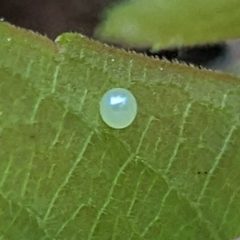
Holometabolous. Larval stage feeds on leaves of plants. presumably in soil or leaf litter, though specific details not documented in sources. emerge in spring (April in south, progressing northward), with period extending through July.
Behavior
activity, unusual among Sphingidae. hover at flowers while feeding on nectar, typical of hawkmoths. Flight has been described as distinctive—slower or less direct than that of similar-sized , which initially suggested to at least one observer that an individual might not be a hymenopteran.
Ecological Role
function as of diverse flowering plants. Larvae act as herbivores on grape and related vines. The participates in mimicry complexes, potentially gaining protection from through resemblance to stinging .
Human Relevance
Larvae feed on grape (Vitis), which could constitute minor agricultural concern in viticultural areas, though not documented as significant pest. are conspicuous and frequently photographed by naturalists due to day-flying habit. Subject of public interest during National Week and similar events focused on Lepidoptera diversity.
Similar Taxa
- Clearwing moths (Sesiidae)Share activity and -like appearance; distinguished by transparent or partially transparent wings, which A. floridensis lacks
- Eastern Cicada Killer Wasp (Sphecius speciosus)Suggested mimic; distinguished by wing structure (two pairs of membranous wings in wasp vs. scaled wings in ), , and form
- Other SphingidaeMost are ; distinguished by activity period and lack of yellow-banded pattern
More Details
Nomenclatural history
Originally described as Sphinx nessus by Pieter Cramer in 1777, but this name was invalid due to prior use by Dru Drury for Theretra nessus (1773). Benjamin Preston Clark published the replacement name Amphion floridensis in 1920. The Amphion was erected by Jacob Hübner in 1819 and remains .
Mimicry
Has been proposed as a possible Batesian mimic of the Eastern Cicada Killer based on shared coloration, activity, and hovering at flowers, though this hypothesis has not been formally tested.