
Heteropelma
Wesmael, 1849
Species Guides
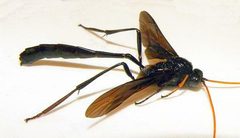
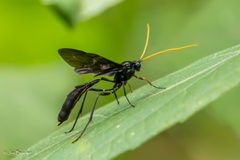
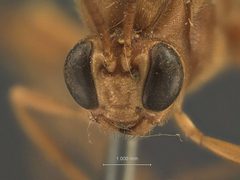
1Heteropelma is a of ichneumonid wasps in the Anomaloninae. are approximately 25 mm in length and are koinobiont endoparasitoids of caterpillars, primarily in the Erebidae and Noctuidae. Females use their long legs and metasoma to jab caterpillars with the ovipositor from a distance. The genus has been investigated for mass rearing in programs against agricultural pests such as Helicoverpa species.
Pronunciation
How to pronounce Heteropelma: //ˌhɛtərəʊˈpɛlmə//
These audio files are automatically generated. While they are not always 100% accurate, they are a good starting point.
Images
Habitat
Open areas with shrubs and bushes; observed flying slowly over vegetation in late summer and autumn.
Distribution
Widespread from Britain across Europe and Asia to Indonesia. Specific records include Wytham Woods, Oxfordshire, UK.
Seasonality
active in late summer and autumn.
Host Associations
- Erebidae - larval caterpillars
- Noctuidae - larval caterpillars; includes Helicoverpa spp.
Life Cycle
Female oviposits into larva; larva completes development within host pupa. possess an equatorial disc and caudal stalk, an thought to attach to the host . Solitary . Historical reports suggest larvae may be protected within a trophamnion.
Behavior
Slow, deliberate over bushes and shrubs. Males are observed more frequently, presumably searching for females. Females use long legs and metasoma to swing beneath the body and jab caterpillars with the ovipositor without full contact.
Ecological Role
Koinobiont endoparasitoid that regulates of caterpillars. Investigated as a agent for of agricultural pests.
Human Relevance
Studied for mass rearing and field release in programs, particularly against Helicoverpa armigera. Mass rearing efforts have encountered challenges including low rates (19% in one study) and male-biased sex ratios.
Similar Taxa
- Netelia productaAlso a larval of Helicoverpa spp. used in ; easier to culture than Heteropelma scaposum with higher rates (29% vs. 19%).
More Details
Genome sequencing
Heteropelma amictum: assembly 226.4 Mb, scaffolded into 10 chromosomal pseudomolecules with 20.65 kb mitochondrial genome. First published genome for Anomaloninae.
Sex ratio bias in culture
Mass rearing of H. scaposum produced male-biased sex ratios, possibly due to single-locus complementary sex determination (CSD) causing homozygotic males in inbred ; requires further confirmation.
Egg morphology
described as resembling a cartoon oil lamp (Aladdin style) due to equatorial disc and caudal stalk structure.
Sources and further reading
- BugGuide
- Wikipedia
- iNaturalist taxon
- NCBI Taxonomy
- Catalogue of Life
- Mass rearing of two larval parasitoids of Helicoverpa spp. (Lepidoptera: Noctuidae): Netelia producta (Brullé) and Heteropelma scaposum (Morley) (Hymenoptera: Ichneumonidae) for field release
- The genome sequence of an ichneumonid wasp, Heteropelma amictum (Fabricius, 1775).