
Acaenitinae
Förster, 1869
Genus Guides
3Acaenitinae is a of within Ichneumonidae, comprising 28 distributed across all continents except Antarctica. The subfamily is poorly known biologically, with only one (Acaenitus dubitator) reared to confirm its as a koinobiont endoparasitoid of weevil larvae. Females possess a distinctive large triangular projecting genital plate, a key diagnostic feature. Traditional tribal classification into Acaenitini and Coleocentrini remains debated, with molecular studies challenging the monophyly of Coleocentrini.
Pronunciation
How to pronounce Acaenitinae: /ˌæk.iːˈnaɪ.tɪ.niː/
These audio files are automatically generated. While they are not always 100% accurate, they are a good starting point.
Identification
The projecting triangular genital plate in females is diagnostic for Acaenitinae among Ichneumonidae. Reduced wing venation, particularly a small or absent areolet, helps distinguish Acaenitinae from related such as Tryphoninae and Banchinae. Specimens may be confused with Diplazontinae or other slender ichneumonids, but the genital plate structure and specific wing patterns separate them. Identification to requires examination of detailed morphological characters including propodeal , ovipositor length, and antennal segment proportions.
Images
Appearance
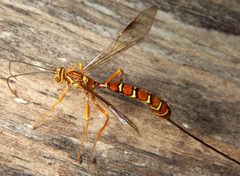
Medium-sized ichneumonid wasps with typical slender body form. Females possess a large, triangular, projecting genital plate that extends conspicuously from the —this is the most distinctive morphological feature of the . long and multi-segmented. Wing venation reduced compared to some other ichneumonid subfamilies, with reduced areolet or absent in some . Coloration variable, ranging from black and yellow to entirely dark or reddish-brown depending on genus and .
Habitat
Associated with woody environments; are believed to be larvae of wood-boring beetles. Specific associations include stalks of grasses such as Miscanthus sinensis for some (observed for Ishigakia exetasea in Japan).
Distribution
distribution on all continents except Antarctica. Documented from: Europe (including Britain, widespread across continent), Asia (Japan, Vietnam, Iran, Türkiye, China, mainland Southeast Asia), Africa (South Africa, with disjunct noted for some ), North America, and Australia. Only one specimen ( Arotes) recorded from South America, indicating rarity or undercollection in that region.
Host Associations
- Cleonis piger (Scopoli) (Curculionidae) - koinobiont endoparasitoidConfirmed for Acaenitus dubitator; larval of endophytic larva
- Miscanthus sinensis (Japanese silvergrass) - oviposition siteObserved for Ishigakia exetasea; antennal tapping and oviposition documented on stalks, but specific insect within plant not identified
Life Cycle
Koinobiont endoparasitoid development confirmed for Acaenitus dubitator. occurs in cocoon with two : mature larvae may remain unaltered and delay development for one or more years, or transform to in late summer to pupate and emerge as the following season. This flexible strategy appears adapted to unpredictable environments. and larval instars (first, second, and final) described for A. dubitator; final instar larva with revised interpretation of cephalic .
Behavior
Females exhibit antennal tapping during location, observed in Ishigakia exetasea while searching stalks of Miscanthus sinensis. This behavior likely functions in detecting host vibrations or chemical cues within plant stems.
Ecological Role
of wood-boring larvae, primarily within Curculionidae based on limited rearing records. As koinobiont endoparasitoids, they allow development to continue while feeding internally, eventually killing the host. -level impacts on host beetles unknown due to scarcity of biological data.
Human Relevance
No direct economic importance documented. Potential agents for wood-boring weevil pests, though insufficient biological knowledge prevents practical application. Presence in agricultural and forest indicated by collection records.
Similar Taxa
- TryphoninaeSimilar slender body form and reduced wing venation; distinguished by female genital structure (Tryphoninae lack projecting triangular genital plate) and details of ovipositor
- BanchinaeOverlapping in general ichneumonid ; Banchinae typically have different propodeal patterns and lack the diagnostic genital plate of Acaenitinae
- DiplazontinaeSimilar appearance and sometimes reduced wing venation; separated by genital plate structure and details of wing configuration
More Details
Tribal classification
Traditional division into tribes Acaenitini and Coleocentrini is disputed. Wahl and Gauld (1998) considered Coleocentrini and favored abandoning tribal structure. Klopfstein et al. and Bennett et al. (2019) found Acaenitini monophyletic but Coleocentrus (type of Coleocentrini) not sister to Acaenitini, undermining tribal validity.
Biological knowledge gaps
Of 28 , only Acaenitus dubitator has been reared to confirm relationships and . The statement that hosts are 'believed to be Coleoptera larvae in wood' reflects inference from this single confirmed record and collection , not broad empirical documentation.
Sources and further reading
- BugGuide
- Wikipedia
- iNaturalist taxon
- NCBI Taxonomy
- The biology, egg and larvae of Acaenitus dubitator (Panzer) (Hymenoptera, Ichneumonidae: Acaenitinae)
- Revision of Ishigakia Uchida (Hymenoptera: Ichneumonidae: Acaenitinae) from Japan, with a new species having a close relative in South Africa
- The Iranian fauna of the subfamilies Acaenitinae, Banchinae, Campopleginae, Ophioninae and Tryphoninae (Hymenoptera: Ichneumonidae) with some new records
- First record of the genus Yezoceryx Uchida (Ichneumonidae: Acaenitinae) from Vietnam, with descriptions of nine new species
- Contribution to the Knowledge of the Acaenitinae and Diplazontinae (Hymenoptera: Ichneumonidae) fauna of Elazığ Province in Eastern Türkiye