
Diplazontinae
Hover Fly Parasitoid Wasps
Genus Guides
7Diplazontinae is a of ichneumonid wasps comprising approximately 19 , with highest diversity in the Holarctic region. Members are specialized koinobiont endoparasitoids of hover flies (Syrphidae), with oviposition into or larvae and from the . The subfamily exhibits distinctive morphological features including three-toothed and a box-like first abdominal tergite. Several genera have undergone recent taxonomic revision, with Syrphoctonus split into multiple genera to restore monophyly.
Pronunciation
How to pronounce Diplazontinae: //dɪˌplæzɒnˈtɪni//
These audio files are automatically generated. While they are not always 100% accurate, they are a good starting point.
Identification
Distinguished from other ichneumonid by the combination of three-toothed and box-like first abdominal tergite. Tyloids on male are diagnostic for many . Separation from similar requires examination of wing venation, propodeal structure, and genitalic characters. Keys to European and Japanese are available.
Images
Appearance
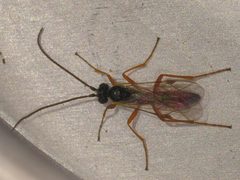
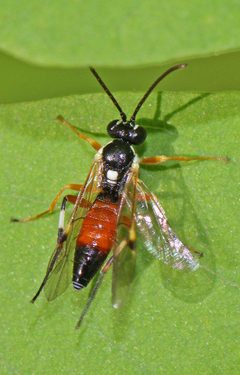
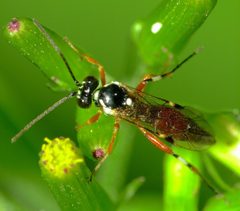
Medium-sized ichneumonid wasps with characteristic three-toothed . The first abdominal tergite is distinctly box-like in shape. Males of many possess tyloids—specialized antennal structures involved in courtship—with ultrastructure showing large variability across the . Body form generally slender with typical ichneumonid proportions.
Habitat
Found in diverse including agricultural environments, with collections documented from agricultural habitats in France. Distribution spans multiple biogeographic regions with showing broad ecological .
Distribution
Worldwide distribution with majority of concentrated in the Holarctic region. Documented from Mongolia, Japan, Kuril Islands, France, and Türkiye. Many species exhibit multiregional or Holarctic distribution patterns; approximately 65% of species in some regional show broad geographic ranges.
Host Associations
- Syrphidae - koinobiont endoparasitoidOviposition into or larva; from
Life Cycle
Koinobiont endoparasitoid development: females oviposit into or larval stage; larva develops internally while host continues to feed and grow; occurs from host .
Behavior
Males perform antennal courtship using specialized tyloid structures to contact females during mating rituals. This has evolved within the and shows structural correlation with tyloid .
Ecological Role
agents of hover fly . As specialized of Syrphidae, they regulate populations of hover flies, which are themselves important and .
Human Relevance
Potential value in programs due to association with agricultural . Presence in agricultural environments documented in France, suggesting role in managed .
Similar Taxa
- Other Ichneumonidae subfamiliesDistinguished by three-toothed and box-like first abdominal tergite; most other ichneumonids lack this combination
- BraconidaeSimilar lifestyle but separated by wing venation, areolet presence, and tooth number
More Details
Taxonomic instability
The Syrphoctonus has been split into three genera (including Fossatyloides gen. n.) based on molecular and morphological phylogenetic analysis to restore monophyly.
Tyloid variability
Scanning electron microscopy reveals large ultrastructural variability in tyloids across , with functional implications for antennal courtship .
Sources and further reading
- BugGuide
- Wikipedia
- iNaturalist taxon
- NCBI Taxonomy
- Molecular and morphological phylogeny of Diplazontinae (Hymenoptera, Ichneumonidae)
- A review of the Diplazontinae of Mongolia (Hymenoptera: Ichneumonidae)
- Review of the genus Diplazon Nees, 1819 (Hymenoptera: Ichneumonidae: Diplazontinae) from Japan
- The evolution of antennal courtship in diplazontine parasitoid wasps (Hymenoptera, Ichneumonidae, Diplazontinae)
- Review of the genera Homotropus Förster and Syrphoctonus Förster (Hymenoptera, Ichneumonidae, Diplazontinae) from Japan
- Antennal courtship and functional morphology of tyloids in the parasitoid wasp Syrphoctonus tarsatorius (Hymenoptera: Ichneumonidae: Diplazontinae)
- Review of the Diplazontinae (Hymenoptera, Ichneumonidae) of the Kuril islands, with descriptions of two new species
- Contribution to the Knowledge of the Acaenitinae and Diplazontinae (Hymenoptera: Ichneumonidae) fauna of Elazığ Province in Eastern Türkiye
- Sur des collectes de Diplazontinae de milieux agricoles, avec la première mention en France de six espèces (Hymenoptera, Ichneumonidae)