
Rhysipolis
Förster, 1862
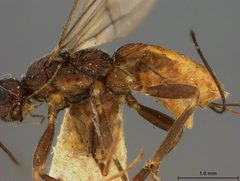
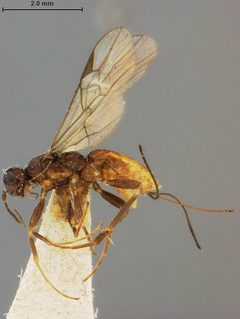
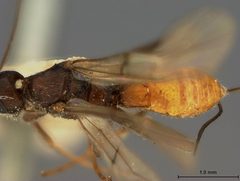
Rhysipolis is a of in the Rhysipolinae (Braconidae), comprising approximately 22 described . Species are small, with body lengths of 2.5–4.0 mm and fore wing lengths of 2.2–4.0 mm. The genus is distributed across the East Palaearctic and Oriental regions, with records from China, Russia, Taiwan, Hong Kong, and parts of Europe. Members are koinobiont ectoparasitoids of lepidopteran larvae, with documented including bagworm moths (Psychidae) and snout moths (Pyralidae).
Pronunciation
How to pronounce Rhysipolis: //ˈrɪsɪpɔlɪs//
These audio files are automatically generated. While they are not always 100% accurate, they are a good starting point.
Identification
with 28–34 segments. Ovipositor 0.6–0.7× as long as metasoma. Body dark brown to blackish brown with variable yellowish brown pattern. Fore wing length 2.2–4.0 mm. Specific identification requires reference to the key provided in Zhang et al. (2016) for East Palaearctic and Oriental , which distinguishes species based on morphological characters including ovipositor length, antennal segment count, and coloration patterns.
Images
Habitat
collected on woody legumes including Caragana korshinskii (Leguminosae) and Nitraria sp. (Zygophyllaceae). Cocoons of at least one (R. taiwanicus) found on upper surface of leaves of Rhaphiolepis indica.
Distribution
East Palaearctic and northern Oriental regions. Documented from China (Inner Mongolia Autonomous Region, Qinghai Province, Hong Kong), Taiwan, Far East Russia. GBIF records indicate additional presence in Denmark, Norway, Sweden, and Vermont (USA).
Host Associations
- Taleporia sp. - Psychidae; reared from in Inner Mongolia, China
- Bazaria turensis - Pyralidae; reared from in Qinghai Province, China
- Caragana korshinskii - associated plant plant where parasitized larvae were collected
- Nitraria sp. - associated plant plant where parasitized larvae were collected
- Rhaphiolepis indica - associated plantsubstrate for cocoons of R. taiwanicus
Life Cycle
Mature larvae collected and maintained in laboratory conditions until . Parasitoid larvae and pupae kept individually in glass tubes. Cocoon stage described for at least one ; cocoons positioned on upper leaf surfaces.
Behavior
Koinobiont ectoparasitoid: allows to continue development while feeding externally. from host pupae. Constructs exposed cocoons on leaf surfaces rather than concealed locations.
Ecological Role
Human Relevance
Potential agent for pest lepidopterans. Laboratory rearing methods established for research purposes.
Similar Taxa
- Other Rhysipolinae generaDistinguished by combination of antennal segment count (28–34), ovipositor length relative to metasoma, and specific wing venation patterns; see Zhang et al. (2016) key
- Other Braconidae subfamiliesRhysipolinae characterized by reduced wing venation and specific tarsal claw structure; molecular and morphological required
Sources and further reading
- BugGuide
- GBIF taxonomy match
- iNaturalist taxon
- NCBI Taxonomy
- Catalogue of Life
- Biological notes on Rhysipolis taiwanicus Belokobylskij (Hymenoptera, Braconidae, Rhysipolinae)
- A key to the East Palaearctic and Oriental species of the genus Rhysipolis Foerster, and the first host records of Rhysipolis longicaudatus Belokobylskij (Hymenoptera: Braconidae: Rhysipolinae)
- Figure 2b from: Zhang Y, Xiong Z, van Achterberg K, Li T (2016) A key to the East Palaearctic and Oriental species of the genus Rhysipolis Foerster, and the first host records of Rhysipolis longicaudatus Belokobylskij (Hymenoptera: Braconidae: Rhysipolinae). Biodiversity Data Journal 4: e7944. https://doi.org/10.3897/BDJ.4.e7944
- Figure 3 from: Zhang Y, Xiong Z, van Achterberg K, Li T (2016) A key to the East Palaearctic and Oriental species of the genus Rhysipolis Foerster, and the first host records of Rhysipolis longicaudatus Belokobylskij (Hymenoptera: Braconidae: Rhysipolinae). Biodiversity Data Journal 4: e7944. https://doi.org/10.3897/BDJ.4.e7944
- Figure 4a from: Zhang Y, Xiong Z, van Achterberg K, Li T (2016) A key to the East Palaearctic and Oriental species of the genus Rhysipolis Foerster, and the first host records of Rhysipolis longicaudatus Belokobylskij (Hymenoptera: Braconidae: Rhysipolinae). Biodiversity Data Journal 4: e7944. https://doi.org/10.3897/BDJ.4.e7944
- Figure 5a from: Zhang Y, Xiong Z, van Achterberg K, Li T (2016) A key to the East Palaearctic and Oriental species of the genus Rhysipolis Foerster, and the first host records of Rhysipolis longicaudatus Belokobylskij (Hymenoptera: Braconidae: Rhysipolinae). Biodiversity Data Journal 4: e7944. https://doi.org/10.3897/BDJ.4.e7944
- Figure 2a from: Zhang Y, Xiong Z, van Achterberg K, Li T (2016) A key to the East Palaearctic and Oriental species of the genus Rhysipolis Foerster, and the first host records of Rhysipolis longicaudatus Belokobylskij (Hymenoptera: Braconidae: Rhysipolinae). Biodiversity Data Journal 4: e7944. https://doi.org/10.3897/BDJ.4.e7944
- Figure 4b from: Zhang Y, Xiong Z, van Achterberg K, Li T (2016) A key to the East Palaearctic and Oriental species of the genus Rhysipolis Foerster, and the first host records of Rhysipolis longicaudatus Belokobylskij (Hymenoptera: Braconidae: Rhysipolinae). Biodiversity Data Journal 4: e7944. https://doi.org/10.3897/BDJ.4.e7944
- Figure 5b from: Zhang Y, Xiong Z, van Achterberg K, Li T (2016) A key to the East Palaearctic and Oriental species of the genus Rhysipolis Foerster, and the first host records of Rhysipolis longicaudatus Belokobylskij (Hymenoptera: Braconidae: Rhysipolinae). Biodiversity Data Journal 4: e7944. https://doi.org/10.3897/BDJ.4.e7944
- Figure 6b from: Zhang Y, Xiong Z, van Achterberg K, Li T (2016) A key to the East Palaearctic and Oriental species of the genus Rhysipolis Foerster, and the first host records of Rhysipolis longicaudatus Belokobylskij (Hymenoptera: Braconidae: Rhysipolinae). Biodiversity Data Journal 4: e7944. https://doi.org/10.3897/BDJ.4.e7944
- Figure 1 from: Zhang Y, Xiong Z, van Achterberg K, Li T (2016) A key to the East Palaearctic and Oriental species of the genus Rhysipolis Foerster, and the first host records of Rhysipolis longicaudatus Belokobylskij (Hymenoptera: Braconidae: Rhysipolinae). Biodiversity Data Journal 4: e7944. https://doi.org/10.3897/BDJ.4.e7944
- Figure 6a from: Zhang Y, Xiong Z, van Achterberg K, Li T (2016) A key to the East Palaearctic and Oriental species of the genus Rhysipolis Foerster, and the first host records of Rhysipolis longicaudatus Belokobylskij (Hymenoptera: Braconidae: Rhysipolinae). Biodiversity Data Journal 4: e7944. https://doi.org/10.3897/BDJ.4.e7944