
Lasioglossum leucozonium
(Schrank, 1781)
White-banded Sweat Bee
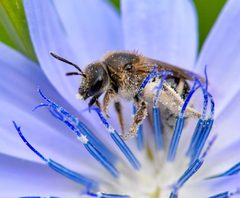
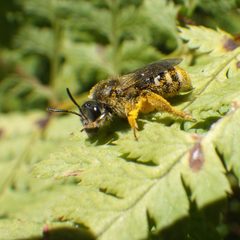
Lasioglossum leucozonium is a solitary, ground-nesting sweat bee in the Halictidae. Native to the Palearctic, it has been introduced to North America where genetic evidence indicates establishment from a single founder female. The is now widespread across multiple continents including Europe, Asia, northern Africa, and North America. It produces one per year and is a frequently associated with yellow-flowered Asteraceae.
Pronunciation
How to pronounce Lasioglossum leucozonium: //ˌlæsiəʊˈɡlɒsəm ˌluːkəʊˈzoʊniəm//
These audio files are automatically generated. While they are not always 100% accurate, they are a good starting point.
Identification
Best distinguished from L. zonulum by pronotal angle projecting less obtusely and more protruding, grainy supraclypeal area. The divided horizontal stripes on the propodeal surface are diagnostic for females in eastern North America but require careful separation from L. zonulum. Males identified by combination of yellow hind , wrinkled propodeal dorsal surface, and distinctive sternal hair patches.
Images
Habitat
Open on sandy or chalky soil; less commonly on heavy clay. Nests constructed in flat to slightly inclined light soil in sparsely vegetated areas or short grass.
Distribution
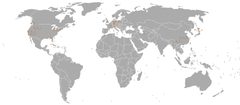
Holarctic distribution: native to Europe, Asia, and northern Africa; introduced and established in North America from Wisconsin to New Jersey north to Cape Breton Island. Present in western Europe as part of the L. leucozonium -group.
Seasonality
In North America, active from early May to mid-August. Females most active in early June; males most active in late July and August. Single per year.
Diet
pollen and nectar feeder. and larvae feed on pollen from various flowers. Documented visiting yellow-flowered Asteraceae including Hieracium caespitosum, Krigia biflora, Rudbeckia hirta; also Cirsium arvense, Campanula, Rosa, Cornus alternifolia, apple trees, and lowbush blueberries. Males commonly found on Melilotus.
Life Cycle
(one per year). Nests contain 8-15 per female. Sexual produced within same year cells are created. After maturation, offspring mate and enter hibernation. Two exits of females: first at beginning of season for nest construction and mating, second after brood .
Behavior
. Solitary ground-nesting ; occasionally nests in . Hibernates underground during winter. Females singly-mated. When two females cooperate in nest construction, they work communally rather than socially, doubling work . Fast requiring reliance on for orientation and foraging in bright light.
Ecological Role
of open- plants. Contributes to pollination of agricultural crops including apples and blueberries. Serves as for Sphecodes ephippius (a blood bee) and prey for Philanthus .
Human Relevance
Important native in Palearctic; introduced pollinator in North America. Subject of genetic studies demonstrating single-founder introduction event. Frequently captured in bowl traps used for monitoring, potentially skewing diversity estimates.
Similar Taxa
- Lasioglossum zonulumShares diagnostic divided propodeal stripes; differs in pronotal angle projection and supraclypeal protrusion
- Lasioglossum callizonumClose phylogenetic relative in Old World series; requires detailed morphological examination
- Lasioglossum majusClose phylogenetic relative; differences in size and punctation
More Details
Introduction history
genetic analysis indicates North American population founded by single female, making this a well-documented case of successful long-distance and establishment
Eye morphology
contains over 3,000 with maximum diameter of 20 μm; 41-μm-thick with convex inner and outer surfaces; slightly developed corneal bulges; lamina without branching; only L2 and L4 fiber types spread laterally
Nesting biology
Main tunnel descends vertically with at ends of short side tunnels; nests sometimes found in despite solitary nature
Sources and further reading
- BugGuide
- Wikipedia
- GBIF taxonomy match
- iNaturalist taxon
- NCBI Taxonomy
- Catalogue of Life
- Just inTime for Pollinator Week | Bug Squad
- Bug Eric: Don't Sweat 'em
- Back-Seat Driver: The Parasite That Makes Bees Drop Off Its Babies
- Building a Better Bee Trap: Researchers Say Bee Bowls Are Overused
- Bug Eric: White Prairie Clover: An Awesome Blossom
- Not-so Solitary Bees - Buglife Blog - Buglife
- A phylogenetic analysis of western European species of the Lasioglossum leucozonium species-group (Hymenoptera: Halictidae): sociobiological and taxonomic implications