
Lasioglossum zonulum
(Smith, 1848)
Sweat bee
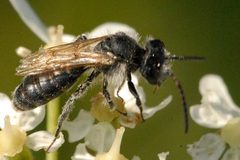
Lasioglossum zonulum is a small sweat bee in the Halictidae, native to Europe and introduced to North America. It belongs to the subgenus Dialictus, one of the most -rich groups of bees globally. Like other Lasioglossum species, it is a ground-nesting that visits flowers for pollen and nectar. The species is notable for being frequently captured in bowl traps used for bee monitoring, a trait common to many small halictid bees.
Pronunciation
How to pronounce Lasioglossum zonulum: /ˌlæsi.oʊˈɡlɒsəm ˈzɒn.jʊləm/
These audio files are automatically generated. While they are not always 100% accurate, they are a good starting point.
Identification
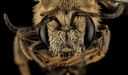
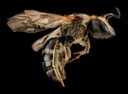
Lasioglossum zonulum is a small , typical of the Lasioglossum (subgenus Dialictus). in this subgenus are notoriously difficult to identify without microscopic examination. L. zonulum can be distinguished from native North American Dialictus by subtle morphological features including specific punctation patterns on the mesoscutum and metasomal . Accurate identification requires reference to specialized taxonomic keys for the subgenus Dialictus. Males and females differ in antennal structure and facial markings.
Images
Habitat
In its native European range, found in various open including grasslands, meadows, and disturbed areas. In North America, has been recorded in anthropogenic habitats and natural areas. As a ground-nesting , requires suitable soil substrates for nest excavation.
Distribution
Native to Europe; introduced and established in North America. GBIF records indicate presence in Europe & Northern Asia (excluding China), North America, and Southern Asia. Specific North American records include the northeastern United States and adjacent Canada.
Seasonality
Active during the typical season for temperate sweat bees, generally late spring through summer. Exact varies by geographic location.
Diet
Collects pollen and nectar from flowers. Specific plant associations are not well documented for this , but as a forager likely visits a variety of flowering plants.
Life Cycle
Ground-nesting solitary or weakly social . Females excavate burrows in soil and provision individual with pollen and nectar for larval development. Like other Halictidae, undergoes complete with , larval, pupal, and stages.
Behavior
Frequently attracted to bowl traps used in monitoring studies, a trait that has contributed to its detection in North America. This trap susceptibility is shared with many small halictid and can result in disproportionate representation in trap relative to actual abundance on flowers.
Ecological Role
Contributes to pollination of flowering plants through pollen and nectar collection. As a common and widespread in its introduced range, may provide consistent pollination services in open .
Human Relevance
No documented direct economic importance. Occasionally encountered by humans due to its attraction to sweat, a trait common to Halictidae. Sting is mild if provoked. Frequently captured in bowl traps used for scientific monitoring, which has facilitated documentation of its introduced range in North America.
Similar Taxa
- Lasioglossum (Dialictus) speciesThe subgenus Dialictus contains over 500 globally, many of which are morphologically similar and require expert identification. L. zonulum is distinguished from native North American species by subtle morphological features.
- Lasioglossum calceatumAnother European Lasioglossum with which L. zonulum may co-occur; both are ground-nesting sweat bees with similar size and general appearance.
- Halictus speciesMedium-sized brown or blackish sweat bees with white abdominal bands; distinguished from Lasioglossum by broader and different wing venation.
More Details
Invasive status in North America
Lasioglossum zonulum is considered an introduced in North America, having been detected in the northeastern United States and Canada. Its presence was likely facilitated by human transport, and its establishment demonstrates the capacity of small, bees to colonize new regions. The species is now regularly captured in monitoring programs in its introduced range.
Monitoring bias
Research on monitoring methods has highlighted that bowl traps frequently capture disproportionate numbers of Lasioglossum and other small Halictidae, potentially skewing diversity estimates and abundance measurements. L. zonulum exemplifies this pattern, being readily captured in traps despite potentially modest local abundance on flowers.
Sources and further reading
- BugGuide
- GBIF taxonomy match
- NCBI Taxonomy
- Catalogue of Life
- Just inTime for Pollinator Week | Bug Squad
- Bug Eric: Don't Sweat 'em
- Back-Seat Driver: The Parasite That Makes Bees Drop Off Its Babies
- Building a Better Bee Trap: Researchers Say Bee Bowls Are Overused
- Bug Eric: White Prairie Clover: An Awesome Blossom
- Not-so Solitary Bees - Buglife Blog - Buglife