
Halictus rubicundus
(Christ, 1791)
Orange-legged Furrow Bee
Halictus rubicundus, the orange-legged furrow , is a ground-nesting sweat bee with one of the widest natural distributions of any bee , occurring throughout temperate regions of the Holarctic. The species is notable for its socially polymorphic : are eusocial in warmer, lower-elevation regions with longer growing seasons, producing multiple with offspring, while populations at higher latitudes or elevations are solitary, producing only a single brood. This environmental plasticity in social organization has made the species a key model for studying the evolution of social behavior. Females excavate burrows in soil, typically on south-facing slopes to maximize thermal conditions for larval development.


Pronunciation
How to pronounce Halictus rubicundus: //həˈlɪktəs ruːbɪˈkʌndəs//
These audio files are automatically generated. While they are not always 100% accurate, they are a good starting point.
Identification
Distinguished from similar Halictus by the combination of non-metallic brown coloration, white abdominal banding, and orange legs in females. Males are identified by the absence of an hair band on the terminal abdominal segment. The species can be separated from metallic green sweat bees (Agapostemon) and other Lasioglossum species by its lack of metallic coloration and specific leg coloration.
Images
Appearance
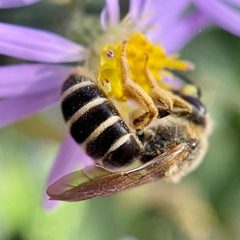
Females are approximately 10 mm in body length, brown in coloration with fine white bands across the apices of the abdominal segments, and distinctive rusty-orange legs. Males are more slender with longer and yellow markings on the and legs; they lack the hair band on the terminal abdominal segment present in some similar . The species is non-metallic, distinguishing it from many other halictid bees.
Habitat
Nests are excavated in ground substrates, typically in loam soils with south-facing slope orientation to maximize solar heating. Nesting sites often feature stones or sparse vegetation near entrances for thermal regulation. The tolerates a wide range of soil hardness but prefers softer soils where nest permits. Well-drained soils are selected to avoid waterlogging while maintaining adequate humidity to prevent desiccation.
Distribution
Throughout temperate regions of the Holarctic, including Europe, Asia, and North America. In North America, found from Alaska and Canada through the United States; social occur in warmer regions such as Kansas, while solitary populations occur in cooler regions including Colorado, Scotland, and Alaska. Intermediate regions such as New York and southern Ontario exhibit both social forms.
Seasonality
Foundress females emerge from hibernation in spring, with timing varying by latitude and elevation. In social , nesting begins earlier ( one to two months before solitary populations); solitary populations begin nesting in late May or June. First emerges in June in social populations, with second brood following; solitary populations produce single broods emerging at approximately the same time as social populations' final broods. Colony cycle concludes by end of season with male and foundress death, and new entering winter .
Diet
forage for nectar and pollen from diverse flowering plants. Pollen and nectar masses are provisioned in as larval food.
Host Associations
- Leucophora sp. - Diptera: Anthomyiidae; principal cause of mortality
- Sphecodes - kleptoparasitekleptoparasitic bees
- Bombyliidae - parasitic flies
- Anthomyiidae - parasitic flies
Life Cycle
colony cycle with winter . Foundress females mate prior to hibernation, then emerge in spring to establish nests. Each offspring is provisioned in an individual underground with a pollen-nectar ball, upon which a single is laid; cells are sealed progressively deeper in the soil. Nest depth reaches up to 120 mm. In social , first-brood females typically remain as to assist in rearing a second brood; in solitary populations, all offspring disperse to establish own nests the following season. from final brood mate, disperse to sites, and emerge as foundresses the following spring.
Behavior
Exhibits socially polymorphic determined by environmental conditions: eusocial with cooperative care and in favorable thermal environments with extended seasons, solitary in marginal environments with short active seasons. Nest-site selection involves thermal assessment through substrate basking and test excavations; strong philopatry results in nest establishment within centimeters of natal nest location. Females nest in dense due to limited suitable substrate, philopatry, and potential dilution effects against . Division of labor in social colonies involves foundress queens, worker daughters, and replacement queens; caste determination occurs behaviorally in early adulthood based on mating timing rather than predetermined morphological differences.
Ecological Role
of diverse flowering plants. Ground-nesting activity contributes to soil aeration and nutrient cycling. Serves as for multiple parasitic including kleptoparasitic bees and parasitic flies, supporting complexity.
Human Relevance
Occasionally attracted to human perspiration for salt acquisition; capable of stinging if handled roughly but generally not aggressive. Studied extensively as a model organism for social evolution and environmental plasticity in social organization.
Similar Taxa
- Lasioglossum zephyrusSimilar ground-nesting halictid, but L. zephyrus builds nests in much denser and is more tolerant of close nest spacing; H. rubicundus maintains greater nearest-neighbor distances and has higher soil hardness
- Halictus ligatusCongeneric sweat bee with similar social plasticity, but H. rubicundus distinguished by orange leg coloration and specific abdominal banding pattern; H. ligatus often shows more consistent social across
- Agapostemon speciesBoth are halictid sweat bees, but Agapostemon are metallic green or blue in coloration while H. rubicundus is non-metallic brown with orange legs
Misconceptions
The 'sweat bee' for the Halictidae is sometimes mistakenly applied to syrphid flies (hover flies), which also visit perspiration but are dipterans, not bees. Halictus rubicundus is a true (Hymenoptera) and not closely related to these flies.
More Details
Thermal Dependence of Sociality
The strictly solitary phenotype at high elevations and latitudes is expressed because the active season is insufficiently long to produce two , eliminating the benefit of . This represents environmental control of social organization rather than genetic determination.
Caste Chemical Signatures
Research indicates common compounds are overproduced in queens compared to across both European and North American , suggesting a potentially conserved signal for reproductive regulation, though the degree of -specific chemical dissimilarity varies between continents.
Invasion History
The entered North America from Eurasia via the Bering land bridge during Pleistocene periods of low sea level, representing one of two main Halictus subgeneric invasions of the continent.
Sources and further reading
- BugGuide
- Wikipedia
- GBIF taxonomy match
- iNaturalist taxon
- NCBI Taxonomy
- Catalogue of Life
- Are Honeybees the Most Effective Pollinators? | Bug Squad
- 'Bee' One in a Million | Bug Squad
- Going Native: Do You Know the Native Bees of California? | Bug Squad
- Strathmore B-Lines: Surveying Grasslands and Pollinating Insects in the Strathmore Valley - Buglife Blog - Buglife
- Bug Eric: Don't Sweat 'em
- Sweet times for sweat bees: Sweat bees, Halictus ligatus and Agapostemon virescens — Bug of the Week
- Solitary behavior in a high-altitude population of the social sweat bee Halictus rubicundus (Hymenoptera: Halictidae)
- Abiotic and biotic factors influencing nest‐site selection by Halictus rubicundus , a ground‐nesting halictine bee
- Nesting Biology and Socially Polymorphic Behavior of the Sweat Bee <I>Halictus rubicundus</I> (Hymenoptera: Halictidae)
- Chemical Variation among Castes, Female Life Stages and Populations of the Facultative Eusocial Sweat Bee Halictus rubicundus (Hymenoptera: Halictidae)