
Neoponera villosa
(Fabricius, 1804)
hairy panther ant, greater Texas bullet ant, giant hunting ant
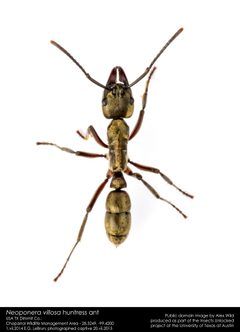
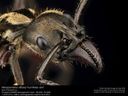
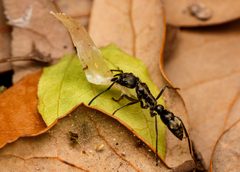
Neoponera villosa is a large predatory in the Ponerinae, commonly known as the hairy panther ant or greater Texas . It inhabits Neotropical regions where it nests in both arboreal and ground-dwelling situations. The possesses a complex venom containing over 500 with documented antimicrobial, cytolytic, and insecticidal properties. Venom composition exhibits substantial plasticity, varying significantly with season and nesting .
Pronunciation
How to pronounce Neoponera villosa: /niːoʊˈpɒnərə vɪˈloʊsə/
These audio files are automatically generated. While they are not always 100% accurate, they are a good starting point.
Images
Habitat
Arboreal (tree trunks) and ground-dwelling nests in Neotropical regions; specimens documented from Panga Natural Reserve, Uberlândia, Minas Gerais, Brazil. Ground-dwelling colonies show more complex venom profiles than arboreal colonies.
Distribution
Neotropical regions; documented from Brazil (Minas Gerais State), Colombia (Valle del Cauca, Leticia, Parque Nacional Natural Serranía de Chiribiquete), and elsewhere in South America. GBIF records indicate presence in Distrito Regional de Manejo Integrado Laguna de Sonso and Aguas Claras, Colombia.
Seasonality
Venom composition varies seasonally: winter venom contains 988 versus summer's 785 peptides, with only 15% peptide overlap between seasons. Seasonal shifts in foraging have been observed, linked to climate-driven changes in prey availability and presence.
Behavior
Venom deployed for defense against and intruders, , and social communication. Seasonal shifts in foraging occur in response to environmental conditions.
Ecological Role
Venom functions include colony defense, prey subduing, and antimicrobial protection. Cytolytic, hemolytic, and insecticidal activities prevent within colonies. The represents a potential source for and therapeutic agent development.
More Details
Venom Peptide Diversity
Venom contains ponericins (antimicrobial ), dinoponeratoxins, pandinin-2, and protonectin. Ground-dwelling ants showed 1378 peptides versus 936 in arboreal ants, suggesting -driven venom diversification.
Taxonomic Note
Some sources list this under the Pachycondyla (as Pachycondyla villosa), reflecting historical taxonomic revisions within the Ponerinae.
Sources and further reading
- BugGuide
- Wikipedia
- GBIF taxonomy match
- iNaturalist taxon
- NCBI Taxonomy
- Catalogue of Life
- Grasshoppers of Colorado
- Grasshoppers of Colorado
- The Big 43: The California Native Plants, Plus One, Studied in UC Davis Research | Bug Squad
- Spotlighting Bumble Bee Research in the Neal Williams' Lab | Bug Squad
- Kate Frey: How to Attract Pollinators | Bug Squad
- Botanizing at St. Joe State Park | Beetles In The Bush
- Peptidomic investigation of Neoponera villosa venom by high-resolution mass spectrometry: seasonal and nesting habitat variations