
Aphaenogaster picea
(Wheeler, 1908)
Pitch-black Collared Ant
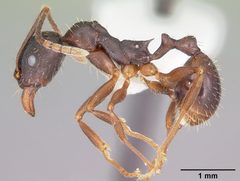
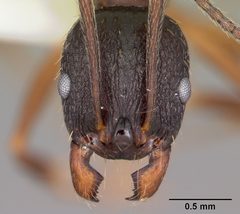
Aphaenogaster picea is a of in the Formicidae. It is known for its gut microbiome composition, which has been studied in relation to task and refuse pile interactions. The species is found at higher elevations in the eastern United States, particularly in Virginia, where it has been documented at 900–1000 meters above sea level. Workers exhibit task specialization without morphological subcastes, including nurse, forager, and refuse pile interaction roles.
Pronunciation
How to pronounce Aphaenogaster picea: //æfˌiːnoʊˈɡæstər ˈpɪsiə//
These audio files are automatically generated. While they are not always 100% accurate, they are a good starting point.
Identification
Lighter coloration in the last four antennal segments distinguishes Aphaenogaster picea from the similar Aphaenogaster rudis; the latter is more common at lower elevations while A. picea predominates above 900 meters elevation.
Images
Habitat
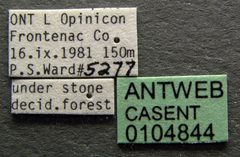
Collected at 900–1000 meters above sea level in Greene and Page Counties, Virginia, USA. Laboratory colonies maintained at 20°C, 50–80% humidity, with constant light exposure.
Distribution
Eastern United States; documented in Vermont and Virginia. More common at higher elevations (>900 masl) than Aphaenogaster rudis.
Diet
omnivore: scavenges other insects and consumes nutritious elaiosomes attached to seeds. Laboratory colonies fed artificial diet ( powder, whey protein, calcium caseinate, sucrose, vitamins, agar) supplemented with sucrose water.
Life Cycle
Colonies consist of 100–300 with healthy queens and observable larvae. Workers exhibit behavioral task specialization without morphological subcastes: nurse workers (feeding larvae, intranidal), foragers (foraging outside nest, extranidal), and (performing both tasks).
Behavior
do not perform (fluid food transfer between individuals). No specialized filter present. Workers marked with paint for individual identification in studies; time outside nest used to classify worker types: nurses (<25% extranidal), (25–75%), foragers (>75%). Interaction with refuse piles and fecal matter influences gut composition independent of worker type.
Ecological Role
Seed through elaiosome consumption. Refuse pile interaction influences gut composition.
Similar Taxa
- Aphaenogaster rudisSimilar but distinguished by darker coloration in last four antennal segments; A. picea predominates at higher elevations (>900 masl) while A. rudis is more common at lower elevations.
- Aphaenogaster mariaeBoth in Aphaenogaster but A. mariae is arboreal, nesting in dead branches and tree holes, whereas A. picea is ground-nesting.
Sources and further reading
- BugGuide
- Wikipedia
- GBIF taxonomy match
- iNaturalist taxon
- NCBI Taxonomy
- Catalogue of Life
- Colony of Red Ants Roams the Bohart Museum of Entomology | Bug Squad
- Hiding Above Our Heads: Rare Ant Species Found in NC Treetops
- Unusual Galls Trigger National Survey of Adelgids and Their Predators in Bhutan Forests
- The Pest Management Methods That Deliver Picture-Perfect Christmas Trees
- A winter longhorned beetle | Beetles In The Bush
- Bug Eric: Anteater Scarab Beetles
- Interaction with refuse piles drives co-occurrence of core gut microbiota in workers of the ant Aphaenogaster picea
- Interaction with refuse piles is associated with co-occurrence of core gut microbiota in workers of the ant Aphaenogaster picea
- Interaction with refuse piles is associated with co-occurrence of core gut microbiota in workers of the ant Aphaenogaster picea
- Interaction with refuse piles is associated with co-occurrence of core gut microbiota in workers of the ant Aphaenogaster picea