
Aphaenogaster mariae
Forel, 1886
Mary's Collared Ant
Aphaenogaster mariae is a rarely collected arboreal to the eastern United States. First described in 1886 from specimens collected in Florida by Mary Treat, it remained poorly known until 2021 when the first complete nest was documented in North Carolina. Unlike most that nest in soil or rotting logs, this species inhabits dead branches and under live bark of mature hardwoods, particularly oaks. The first males were photographed and described in 2023, enabling a complete taxonomic redescription of the .

Pronunciation
How to pronounce Aphaenogaster mariae: //əˌfiːnoʊˈɡæstər məˈraɪ//
These audio files are automatically generated. While they are not always 100% accurate, they are a good starting point.
Identification
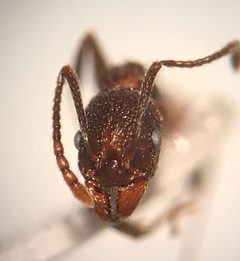
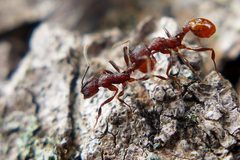
Distinguished from other Aphaenogaster by the radiating lines on the originating from the postpetiole. Most are ground-nesting, making arboreal a strong indicator. The species is most likely to be encountered in dead oak branches or under bark of live mature hardwoods in the eastern United States.
Images
Appearance
possess a distinctive abdominal pattern with lines radiating outward from the postpetiole across the , serving as the primary diagnostic feature. The exhibits typical Aphaenogaster with a two-segmented petiole and well-developed . Males were first photographed in 2021; previous descriptions relied on a single specimen that has since been lost.
Habitat
Strictly arboreal: nests in dead branches, tree holes, and beneath live bark of mature hardwood trees, particularly white oak (Quercus alba). Nests have been found in very dry, decayed wood approximately 2 feet long and 5 inches in diameter. Occasionally occupies standing dead trees. Found at heights up to 17 meters above ground.
Distribution
Eastern United States only. Documented from Florida (type locality) and North Carolina (first complete nest collection in Wake County, 2021). Fewer than 200 collections recorded since 1886 despite occurring in densely populated regions.
Host Associations
- Quercus alba - nesting substrateFirst documented nest found in dead branch 17 meters high in white oak
Life Cycle
Colony structure documented from single nest: contained over 1,000 individuals including , females, males, juveniles, and intercastes ( with features of both queens and workers). Reproductive strategy hypothesized but unconfirmed: may be a temporary social of ground-nesting Aphaenogaster , with newly mated queens infiltrating colonies before ascending to establish arboreal nests.
Behavior
Arboreal nesting represents a significant behavioral departure from . occur in low, localized densities. The ' arboreal lifestyle places it out of reach of standard ground-based collecting methods, contributing to its rarity in collections.
Ecological Role
Part of temperate forest . As a potential temporary social , may influence of Aphaenogaster . The 2021 study documented more than 35 ant species using the temperate canopy as a resource, highlighting underappreciated arboreal biodiversity.
Human Relevance
Named in honor of Mary Treat, a pioneering naturalist who collected the original specimens in Florida. The 2021 rediscovery by a North Carolina State University graduate student demonstrated that significant biodiversity discoveries remain possible in well-studied, densely populated regions. No documented economic or medical importance.
Similar Taxa
- Aphaenogaster spp.Most nest in soil, under rocks, or in rotting logs on the ground; A. mariae is distinguished by its strictly arboreal nesting habit and abdominal line pattern
More Details
Etymology
Named after Mary Treat (1830-1923), American naturalist and entomologist who collected the original specimens in Florida and sent them to Auguste Forel for description.
Historical collection context
Prior to 2021, males were known from only two specimens, both subsequently lost. The 2021 collection of over 250 males enabled the first photographic documentation and taxonomic redescription of the male .
Research significance
The first complete nest collection, 135 years after the description, highlights the underexplored nature of temperate forest compared to tropical systems. The colony was found in a small forest fragment adjacent to a major highway.
Sources and further reading
- BugGuide
- Wikipedia
- GBIF taxonomy match
- iNaturalist taxon
- NCBI Taxonomy
- Catalogue of Life
- Colony of Red Ants Roams the Bohart Museum of Entomology | Bug Squad
- Aphaenogaster mariae, male - Entomology Today
- Aphaenogaster mariae, worker - Entomology Today
- Aphaenogaster mariae Archives - Entomology Today
- Hiding Above Our Heads: Rare Ant Species Found in NC Treetops
- Bug Eric: Anteater Scarab Beetles