
Aphaenogaster rudis
Wesson & Wesson, 1940
Winnow Ant
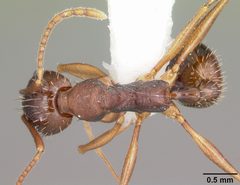
Aphaenogaster rudis is a common woodland in eastern North American hardwood forests, known for its distinctive seed and frequent colony relocations. Colonies are moderate in size and nest in soil under stones or logs. The exhibits tool use through debris dropping during foraging, a specialized task performed by subsets of . A. rudis is an ecologically forest ant with generalized seasonal activity and no strong food preferences, allowing it to maintain broad temporal and spatial in sympatry with other ant species.

Pronunciation
How to pronounce Aphaenogaster rudis: /æˌfiːnəʊˈɡæstər ˈruːdɪs/
These audio files are automatically generated. While they are not always 100% accurate, they are a good starting point.
Identification
Aphaenogaster rudis can be distinguished from sympatric forest ants by its intermediate behavioral characteristics: less aggressive than Prenolepis imparis but more assertive than Paratrechina melanderi. It lacks the pronounced seasonal retreat of P. imparis and shows more generalized foraging patterns than P. melanderi. are medium-sized ants within the Aphaenogaster; precise external diagnostic features require examination beyond the provided sources.
Images
Habitat
Hardwood forests of eastern North America, particularly in Maryland, Vermont, and surrounding regions. Nests occur in soil under stones, logs, or other cover objects. Nest densities reach 0.5–1.3 nests per square meter in suitable forest .
Distribution
Eastern North America, from Georgia north to New Jersey and Vermont, throughout the Appalachian and surrounding temperate forest regions.
Seasonality
Generalized seasonal activity pattern with extended foraging throughout the year; most active during spring through fall. peaks in midsummer, with shade-induced relocation most pronounced in early summer.
Diet
forager with no significant preference for protein-fat versus food sources based on baiting trials. Collects seeds of myrmecochorous plants, functioning as a keystone seed disperser. Also scavenges dead insects and other food resources.
Life Cycle
Colonies are monogynous, consisting of a single, once-mated and her progeny. Colony size averages 266–613 workers. New worker production, , and nest follow an cycle tracking seasonal changes. Colonies exhibit high rates of relocation to new nest sites even without disturbance.
Behavior
Exhibits tool use through debris dropping and retrieval during foraging, performed by specialized subsets of rather than all foragers. Debris dropping at food sources discourages competing from colonizing baits. Frequently relocates nests in response to shade and competition; rate increases dramatically with reduced nest isolation and when nests are invaded by competing ant species. Foraging activity shows weak circadian periodicity compared to sympatric species.
Ecological Role
Keystone seed disperser for myrmecochorous plants in eastern deciduous forests. Influences soil structure and nutrient cycling through nest construction and relocation. Acts as an ecologically competitor that can suppress foraging success of subordinate through interference competition and tool use .
Similar Taxa
- Aphaenogaster mariaeBoth are arboreal or semi-arboreal Aphaenogaster , but A. mariae nests exclusively in tree branches and standing dead wood while A. rudis is ground-nesting
- Prenolepis imparisSympatric forest with contrasting : P. imparis is highly aggressive, forms large mobilizations, prefers protein-fat food, and retreats from surface activity in midsummer
- Paratrechina melanderiSympatric forest with contrasting : P. melanderi is timid, forms small mobilizations, prefers food, and peaks in warm-season activity
More Details
Colony Structure
Genetic studies confirm colonies consist of a single, once-mated and her progeny. Queens show heterozygote excess at malate dehydrogenase loci not observed in workers, suggesting differential selection between .
Research Significance
A. rudis has become a model for studying , tool use, and ecological partitioning in temperate forest due to its abundance and behavioral flexibility.
Sources and further reading
- BugGuide
- GBIF taxonomy match
- iNaturalist taxon
- NCBI Taxonomy
- Catalogue of Life
- Colony of Red Ants Roams the Bohart Museum of Entomology | Bug Squad
- Hiding Above Our Heads: Rare Ant Species Found in NC Treetops
- Bug Eric: Fly Day Friday: Cluster Flies
- Bug Eric: Anteater Scarab Beetles
- Bug Eric: Fungus Party-y-y!
- Bug Eric: January 2013
- The Biology and Natural History ofAphaenogaster rudis
- Tool use by the forest ant Aphaenogaster rudis: Ecology and task allocation
- The Effect of Shade and Competition on Emigration Rate in the Ant Aphaenogaster Rudis
- Sex ratios and the distribution of elaiosomes in colonies of the ant, Aphaenogaster rudis
- Behavioral Interactions Between Aphaenogaster rudis (Hymenoptera: Formicidae) and Reticulitermes flavipes (Isoptera: Rhinotermitidae): The Importance of Physical Barriers
- APPARENT DIFFERENTIAL SELECTION AT AN ISOZYME LOCUS BETWEEN QUEENS AND WORKERS OF THE ANT APHAENOGASTER RUDIS
- Foraging patterns in three sympatric forest ant species, Prenolepis imparis, Paratrechina melanderi and Aphaenogaster rudis (Hymenoptera: Formicidae)