
Prenolepis imparis
(Say, 1836)
winter ant, false honey ant, false honeypot ant, American Winter Ant
Prenolepis imparis is a cold-adapted widespread across North America, notable for being active during winter and early spring when most other ants are . The species exhibits distinctive thermal physiology, with foraging at near-freezing temperatures and colonies undergoing summer . Workers are small (3-4 mm), brown, with shiny gasters. The species produces specialized workers that store fat and nutrients as living energy reserves. Five highly divergent genetic lineages occur across the continent, with limited between them. occur unusually early, from February through April.
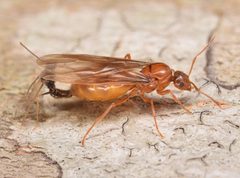
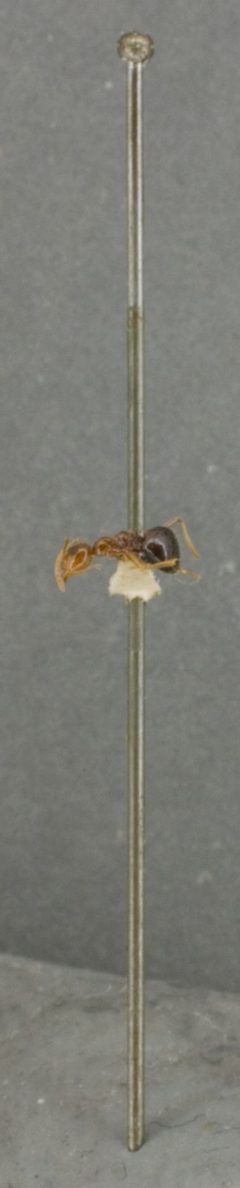
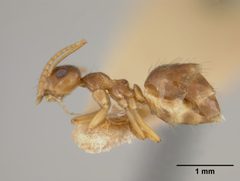
Pronunciation
How to pronounce Prenolepis imparis: //prɛˈnoʊlɪpɪs ɪmˈpɛərɪs//
These audio files are automatically generated. While they are not always 100% accurate, they are a good starting point.
Identification
Distinguished from other North American ants by its winter activity period, small size (3-4 mm), and shiny . Separated from true honeypot ants (Myrmecocystus) by its smaller size, lack of extremely enlarged , and different thermal . Differs from the Argentine ant (Linepithema humile) by its seasonal activity pattern, native status, and defensive chemistry. The combination of cold-weather foraging and brown coloration with shiny gaster is diagnostic in most of its range.
Images
Habitat
Ground-nesting found in cool, shady, and moist microhabitats. Colonies occur in woodlands, frequently associated with oak trees. Nests are deep in the soil, often in well-drained but moist soils. Elevation range extends from sea level to 8,000 feet. In California, found in Santa Clara County and other localities with suitable cool, moist conditions.
Distribution
Throughout most of continental North America, from Canada (limited to far southeastern portion) to Mexico. Five well-supported, genetically isolated clades: 1) basal lineage in Florida, 2) southern United States, 3) midwestern and northeastern United States, 4) western United States, 5) southwestern Arizona and Mexico. No evidence of contemporary between these major clades. In Canada, distribution limited by soil freezing depth and frost-free season length.
Seasonality
Active outside the nest primarily during winter and early spring, with foraging at temperatures near freezing. Retreats to underground nests during summer, entering a hibernation-like state of . occur from February through April, triggered by sunny days with temperatures above 65°F (approximately 18°C) and moist soil conditions. Earliest recorded : February 11 in New Jersey. Flights typically mid to late afternoon, with males swarming low to ground and females flying ploddingly through swarms.
Diet
have been observed tending plant-sucking insects including aphids and scale insects. Baiting studies indicate apparent preference for protein-fat food sources over . Foragers collect dead arthropods and earthworms. Workers also collect sweet sap from wounds in trees, particularly from sapsucker damage, and honeydew from tended insects. ants consume liquid food carried in the crop; solid food is fed to larvae.
Host Associations
Life Cycle
production during warm months. Queens found colonies individually after . New queens break off wings, dig burrows, seal themselves in, and raise initial brood on food produced from their own body reserves. Colonies produce male offspring. workers develop as specialized that stores fat and nutrients as whitish body fat, later converted to glandular secretions that feed developing larvae. These repletes act as living energy reserves during the annual brood-rearing cycle. overwinter in the nest before spring .
Behavior
Highly aggressive that forms large mobilizations at rich food sources. Defends food resources against competitors, including behaviorally subordinate species whose foraging rates are reduced in its presence. Foraging activity shows weak circadian periodicity, with extended seasonal activity pattern. secrete an opaque white defensive liquid from the derived from the , containing alkanes and alkenes including hexadecene, octadecene, tetradecene, octylcyclohexane, and hexadecane. These secretions are lethal to Argentine ant (Linepithema humile) workers. Males are attracted to citronellol, a compound present in mandibular glands.
Ecological Role
competitor in cool-season , with relatively low overlap with sympatric warm-active . Suppresses damage by skeletonizing insects on plants by approximately 50%. Influences community structure of insect herbivores on willow trees through and competition. Serves as prey for various including water striders (Gerridae) that capture fallen . May facilitate nutrient cycling through transport of organic materials to nests.
Human Relevance
Subject of scientific research as a model organism for thermal physiology and climate change impacts due to its specialized cold . sequenced (327.3 Mb assembly, 96.5% BUSCO completeness) to study genetic basis of thermal adaptation. Potential for research given its competitive ability against . Not considered a significant household pest. Attracted to citronellol, which may have applications in monitoring or study.
Similar Taxa
- Linepithema humile (Argentine ant)Both small brown ants in similar , but P. imparis is native, cold-active, and possesses defensive secretions lethal to ; L. humile is , warm-active, and lacks these defenses
- Myrmecocystus spp. (true honeypot ants)Both called 'honey ants' and have , but Myrmecocystus are larger, have extremely enlarged repletes, and are active in warm seasons; P. imparis is smaller, has moderately enlarged repletes storing fat rather than liquid sugar, and is cold-active
- Lasius spp.Similar size and some have early , but Lasius flights typically occur in fall rather than late winter/early spring, and Lasius lacks the extreme cold- of P. imparis
Misconceptions
The 'false honey ant' or 'false honeypot ant' reflects confusion with true honeypot ants (Myrmecocystus). While P. imparis does have , these store fat and nutrients converted to glandular secretions, not liquid honeydew or nectar as in Myrmecocystus. The 'winter honeypot ant' name is partially misleading as the repletes are 'fat pots' rather than ''.
More Details
Thermal Physiology
Exhibits exceptional cold with showing intraspecific variation in thermal acclimation. High-elevation populations display increased cold tolerance and greater plasticity. Heat tolerance is not associated with altitude but correlates with plasticity at higher temperatures. Over 600 genes are differentially expressed in response to heat shock versus only 7 genes for cold shock, indicating evolutionary fine-tuning for cold environments.
Genetic Structure
Five deeply divergent lineages across North America reflect in situ diversification influenced by Quaternary glacial cycles. Lack of between major clades suggests long-term isolation. A possible microgyne social is known from a single California collection, representing potential undescribed social in the .
Defensive Chemistry
The secretion contains specific compounds: hexadecene, octadecene, tetradecene, octylcyclohexane, and hexadecane. This chemical defense appears effective against competitors, potentially contributing to its persistence in invaded by .
Sources and further reading
- BugGuide
- Wikipedia
- GBIF taxonomy match
- iNaturalist taxon
- NCBI Taxonomy
- Catalogue of Life
- Ants and Moths: Think Noon and Night! | Bug Squad
- The Inexorable March of Spring! | Beetles In The Bush
- Midget male meloid mates with mega mama | Beetles In The Bush
- Ants invade Beetles in the Bush! | Beetles In The Bush
- CITRONELLOL ATTRACTS MALE PRENOLEPIS IMPARIS (HYMENOPTERA: FORMICIDAE)
- Genome assembly of the winter ant, Prenolepis imparis
- Phylogeography and population genetics of a widespread cold-adapted ant, Prenolepis imparis
- Winter Ant, False Honey Ant Prenolepis imparis (Say) (Insecta: Hymenoptera: Formicidae: Formicinae)
- Seasonal life history and nest architecture of a winter-active ant,Prenolepis imparis Lebenszyklus und Nestbau einer kryophilen AmeisePrenolepsis imparis
- Intraspecific variation in thermal acclimation and tolerance between populations of the winter ant, Prenolepis imparis
- Foraging patterns in three sympatric forest ant species, Prenolepis imparis, Paratrechina melanderi and Aphaenogaster rudis (Hymenoptera: Formicidae)
- The effects of the invasive Argentine ant ( Linepithema humile ) and the native ant Prenolepis imparis on the structure of insect herbivore communities on willow trees ( Salix lasiolepis )