
Solenopsis pergandei
Forel, 1901
Pergande's Thief Ant
Solenopsis pergandei is a small thief ant in the Solenopsis, described by Forel in 1901. It is native to North America and belongs to a genus that includes both native species and the highly (). Unlike its notorious , S. pergandei is not considered a significant pest species. The species is part of a diverse group of Solenopsis ants commonly known as thief ants due to their habit of nesting near other colonies and stealing their .
Pronunciation
How to pronounce Solenopsis pergandei: /ˌsoʊləˈnɒpsɪs ˌpərˈɡændaɪ/
These audio files are automatically generated. While they are not always 100% accurate, they are a good starting point.
Identification
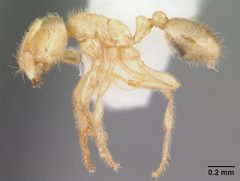
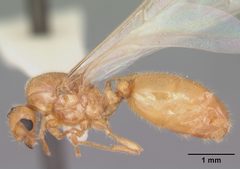
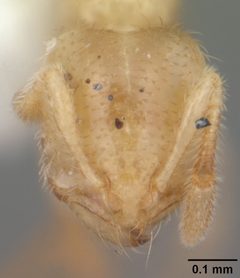
Solenopsis pergandei is a small , typical of the thief ant group within Solenopsis. are minute, usually less than 2 mm in length, with a pale yellowish to light brown coloration. The possesses the characteristic 10-segmented with a 2-segmented club found in Solenopsis. Accurate identification to species level requires examination of microscopic features and is difficult without specialized taxonomic keys. It can be distinguished from the by its smaller size, paler color, and less aggressive . S. pergandei lacks the prominent sting and robust seen in fire ant workers.
Images
Distribution
Eastern and central North America, with records from the United States. The occurs in regions where it overlaps with the ranges of various native species that may serve as for its thieving .
Behavior
As a thief ant, S. pergandei has been observed nesting in close proximity to other colonies, from which it steals and food resources. This kleptoparasitic is characteristic of the Solenopsis thief ant group, though specific behavioral observations for S. pergandei are limited in the available literature.
Human Relevance
Not considered a significant pest . Unlike the congeneric (), S. pergandei does not pose substantial threats to human health, agriculture, or . It may occasionally enter structures but lacks the aggressive stinging and large colony sizes that make fire ants problematic.
Similar Taxa
- Solenopsis invictaThe is larger, more robust, reddish-brown to dark brown in color, highly aggressive, and possesses a painful sting. S. pergandei is smaller, paler, and lacks these defensive characteristics.
- Solenopsis molestaAnother common thief ant that shares similar size, coloration, and habits. Differentiation requires careful morphological examination of specimens.
- Other Solenopsis thief ant speciesMany native Solenopsis are morphologically similar small yellow ants. Species-level identification typically requires examination of or molecular analysis.
More Details
Taxonomic Note
Solenopsis pergandei is one of numerous native North American in a that has received extensive study due to the economic importance of the . The specific epithet honors Theodore Pergande, an important early American entomologist.
Research Context
Most available literature on Solenopsis focuses on S. invicta and S. richteri, with native like S. pergandei receiving comparatively limited research attention. The species is occasionally referenced in broader studies of North American fauna.
Sources and further reading
- BugGuide
- GBIF taxonomy match
- iNaturalist taxon
- NCBI Taxonomy
- Catalogue of Life
- Oh, oh, oh, I'm on fire - Red Imported fire ant, Solenopsis invicata — Bug of the Week
- In a warming world, here comes the red imported fire ant, Solenopsis invicata — Bug of the Week
- Bug Eric: OrThoptera Thursday: Eastern Ant Cricket
- Fire ant winged reproductives: male and female | Beetles In The Bush
- How Entomologists are Battling Invasive Ants to Protect a Texas Cave Ecosystem
- Non-Repellent Insecticide Prevents Fire Ant Infestations in Nursery Plant Root Balls