
Myrmecocystus semirufus
Emery, 1893
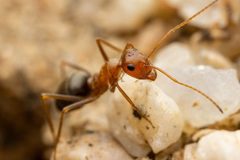
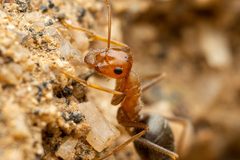
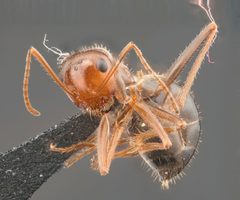
Myrmecocystus semirufus is a of honeypot ant in the Formicinae, native to arid and semi-arid regions of western North America. As a member of the Myrmecocystus, this species possesses the characteristic —specialized that store liquid food in their distended . The species was described by Carlo Emery in 1893 and occurs from the western United States through Baja California and Sonora, Mexico.
Pronunciation
How to pronounce Myrmecocystus semirufus: /mɪrmɛkoʊˈsɪstəs semɪˈruːfəs/
These audio files are automatically generated. While they are not always 100% accurate, they are a good starting point.
Images
Habitat
Arid and semi-arid environments including desert scrub, chaparral, and dry grasslands. Nests are typically constructed in soil, often with a small mound or crater-like entrance.
Distribution
Western United States, Baja California (Mexico), and Sonora (Mexico).
Diet
Forages for nectar, honeydew from homopterans, and other liquid sources. Prey items and scavenged parts provide protein. store liquid food for colony consumption during resource-scarce periods.
Host Associations
- Cremastocheilus - Known for anteater scarab beetles (Cremastocheilus), which feed on larvae and pupae within the nest.
Ecological Role
As a honeypot ant, serves as a food storage for the colony. The functions as a for specialized myrmecophilous beetles, contributing to local biodiversity through these complex host- interactions.
Similar Taxa
- Myrmecocystus mexicanusOverlapping geographic range in southwestern North America; distinguished by differences in coloration and pronotal structure, though precise field identification requires examination of or detailed morphological analysis.
- Myrmecocystus mimicusSympatric in portions of the southwestern United States; separation based on subtle differences in pilosity and color pattern, with M. semirufus typically showing more extensive coloration as suggested by the specific epithet.
More Details
Etymology
The specific epithet 'semirufus' (Latin: semi- 'half' + rufus 'red') likely refers to the reddish or coloration present on some body regions, distinguishing this from .