
Camponotus laevissimus
Mackay, 2019
giant carpenter ant, Hairy Smooth Carpenter Ant
Camponotus laevissimus is a large carpenter ant native to western North America, ranging from western Canada through the United States to Mexico. are among the largest in the , measuring 7–13 mm. The is notable for its distinctive shiny black coloration with a blue iridescent tint and dense covering of short white hairs. It is primarily and specializes in nesting within redwood trees (Sequoia sempervirens), hollowing out cavities rather than consuming the wood. A documented of western spruce budworm pupae, this species plays a role in forest pest dynamics. Formerly known as C. laevigatus, it was reclassified by Mackay in 2019.
Pronunciation
How to pronounce Camponotus laevissimus: /kæmpəˈnoʊtəs laɪˈvɪsɪməs/
These audio files are automatically generated. While they are not always 100% accurate, they are a good starting point.
Identification
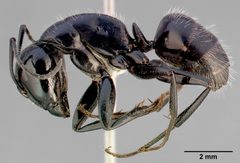
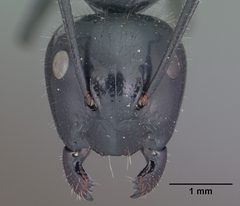
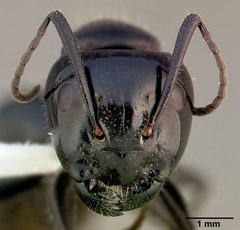
measure 7–13 mm in length, making this one of the largest Camponotus in its range. The is shiny black with a conspicuous blue iridescent tint. Dense, short white hairs () cover the body, creating a distinctive hoary appearance. The mesosoma is robust with a smooth, evenly rounded profile lacking the distinct notch seen in field ants (Formica spp.). The petiole is single-segmented. Major workers exhibit enlarged with powerful . This combination of large size, blue-tinted black coloration, and white pubescence separates it from sympatric carpenter ants such as C. modoc (which lacks the blue tint and dense white hairs) and C. vicinus (which is typically bicolored red and black).
Images
Habitat
Specialized for coastal and montane forests dominated by coast redwood (Sequoia sempervirens), where it excavates nests in living trees, stumps, and fallen logs. Requires moist, decaying wood for colony establishment. Nests are constructed by hollowing out cavities in redwood heartwood; the does not consume wood but uses it for shelter. Primary colonies are typically found in outdoor woody substrates with high ambient moisture.
Distribution
Western North America: western Canada (British Columbia), United States (Pacific coastal states from Washington through Oregon and California, extending inland to montane regions), and Mexico. Distribution corresponds closely with the range of coast redwood forests, though it extends beyond the core redwood zone into adjacent coniferous and mixed forests.
Seasonality
Primarily with activity concentrated during daylight hours. Seasonal activity patterns follow temperature and moisture availability; are most active during spring and summer months. In warmer portions of the range, activity may extend into autumn. Colonies are , with reproductive typically emerging in spring or early summer.
Diet
of western spruce budworm (Choristoneura occidentalis) pupae. Also known to tend aphids and scale insects for honeydew, and to consume other small arthropods, plant exudates, and sources. Foragers establish trails to productive food sources.
Life Cycle
Colonies are established in moist, decaying wood. Development follows the typical pattern: , larva, pupa, and . Colonies contain polymorphic (minors and majors), with major workers specializing in defense and heavy labor. Reproductive are produced seasonally; mating occur during favorable weather conditions. New queens found colonies independently in suitable wood substrates. Colony foundation is claustral, with the rearing the first without external foraging.
Behavior
foraging activity. are known for their distinctive rapid, erratic movement when disturbed. Major workers serve as soldiers, defending the colony with powerful capable of delivering painful bites. The exhibits trail-based foraging, with workers recruiting nestmates to food sources via chemical communication. When threatened, workers may assume a defensive posture with raised and mandibles open.
Ecological Role
of forest lepidopteran pests, particularly western spruce budworm, potentially contributing to natural pest suppression in coniferous forests. As a cavity-nesting , it creates for other organisms in dead and decaying wood, accelerating decomposition processes. Tending of honeydew-producing insects influences local structure.
Human Relevance
Occasionally considered a nuisance pest when colonies establish satellite nests in human structures, particularly where moisture-damaged wood is present. Unlike , does not consume wood and causes less structural damage, though excavation of galleries in structural timbers can weaken them. Control typically involves eliminating moisture sources and removing decaying wood near structures.
Similar Taxa
- Camponotus modocSimilar size and black coloration, but lacks the blue iridescent tint and dense white ; distribution overlaps but C. modoc is more widespread in montane conifer forests beyond the redwood zone.
- Camponotus vicinusOverlapping range in western North America, but C. vicinus is typically bicolored with reddish mesosoma and black , and is smaller ( 6–10 mm).
- Formica spp. (field ants)Similar size and black coloration, but distinguished by the distinct notch or depression in the mesosomal profile (absent in Camponotus) and typically nest in soil rather than wood.
Sources and further reading
- BugGuide
- Wikipedia
- iNaturalist taxon
- NCBI Taxonomy
- Carpenter ants here and there: Camponotus spp. — Bug of the Week
- Ant bodyguards here and there: Odorous house ants, Tapinoma sessile, and carpenter ants, Camponotus — Bug of the Week
- Big black ants in the home: Carpenter ants, Camponotus spp. — Bug of the Week
- The “silky-bellied humpbacked” ant | Beetles In The Bush
- Bichos Argentinos #10 – Friday Formicine | Beetles In The Bush
- These Beetles Withstand Cyanide Blasts to Eat Millipedes