
Camponotus laevigatus
(Smith, 1858)
Hairless Smooth Carpenter Ant
Camponotus laevigatus is a California carpenter ant that nests in dead oak branches, particularly of Quercus wislizeni (interior live oak). It maintains an obligate mutualism with the bacterial endosymbiont Blochmaniella, with which it shows strong codiversification patterns. genetic studies reveal three phylogeographic clusters with the Central Valley acting as a significant barrier to , and Pleistocene climatic cycles have shaped its current distribution.
Pronunciation
How to pronounce Camponotus laevigatus: //ˌkæm.pəˈnoʊ.tus ˌleɪ.vɪˈɡeɪ.təs//
These audio files are automatically generated. While they are not always 100% accurate, they are a good starting point.
Identification
Distinguished from the more widespread Camponotus laevissimus (formerly misidentified as C. laevigatus) by geographic restriction to California and association with oak . Most museum specimens and literature prior to taxonomic revision labeled as C. laevigatus actually refer to C. laevissimus. Accurate identification requires attention to collection locality and plant association.
Images
Appearance
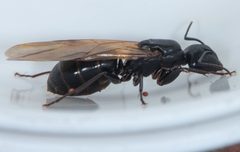
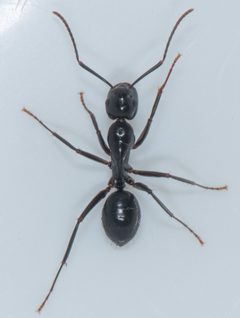
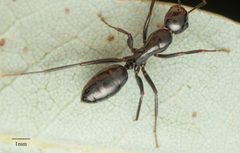
A carpenter ant with smooth, relatively hairless . As a member of the Camponotus, it exhibits the characteristic single node petiole and elbowed typical of formicine ants. The specific epithet 'laevigatus' refers to its smooth, polished appearance.
Habitat
Nests in dead branches of oak trees, specifically Quercus wislizeni (interior live oak). Requires woody substrate for gallery construction.
Distribution
to California, USA. The Central Valley forms a significant biogeographic barrier separating into three phylogeographic clusters.
Host Associations
- Blochmaniella - obligate endosymbiontBacterial endosymbiont transmitted vertically with congruent supporting codiversification
- Quercus wislizeni - nest substrateInterior live oak provides dead branches for nesting
Behavior
Foragers from nearby sampling sites display some shared kinship, suggesting limited . Individuals from the same sampling site typically show full-sister relationships, indicating colony-level kin structure and probable monogynous or oligogynous colony organization.
Similar Taxa
- Camponotus laevissimusFormerly confused with C. laevigatus; most historical literature and museum specimens labeled C. laevigatus actually refer to this more widespread . Distinguished by broader geographic distribution beyond California.
- Camponotus quercicolaSynonym; former name for this before taxonomic revision.
Misconceptions
Most literature and museum specimens historically identified as Camponotus laevigatus actually refer to Camponotus laevissimus. The true C. laevigatus is a narrower restricted to California oak .
More Details
Phylogeography
Whole- sequencing reveals three distinct phylogeographic clusters shaped by Pleistocene climatic cycles. Strong isolation-by-distance pattern with positive correlation between genetic and geographic distance.
Codiversification
Exhibits obligate mutualism with endosymbiont Blochmaniella with and congruent , representing a rare documented case of intraspecific -endosymbiont codiversification in ants.
Sources and further reading
- BugGuide
- Wikipedia
- GBIF taxonomy match
- iNaturalist taxon
- NCBI Taxonomy
- Carpenter ants here and there: Camponotus spp. — Bug of the Week
- Ant bodyguards here and there: Odorous house ants, Tapinoma sessile, and carpenter ants, Camponotus — Bug of the Week
- Big black ants in the home: Carpenter ants, Camponotus spp. — Bug of the Week
- Formicidae | Beetles In The Bush | Page 2
- Bichos Argentinos #10 – Friday Formicine | Beetles In The Bush
- Amped-Up Ants: Caterpillars' Sugary Treats Earn Carpenter Ant Care
- Quaternary climatic changes and biogeographic barriers drove codiversification in the obligate mutualism between Camponotus laevigatus and its endosymbiont Blochmaniella