
Labidus
Jurine, 1807
Labidus Army Ants
Species Guides
1Labidus is a of New World army ants in the Dorylinae. Members are characterized by a subapical tooth on the tarsal claw, distinguishing them from the related genus Neivamyrmex. The genus is widespread from the United States to Argentina, with exhibiting both surface-foraging and subterranean habits. Some species are conspicuous and abundant, playing significant roles as in tropical and subtropical .


Pronunciation
How to pronounce Labidus: /ˈlæbɪdəs/
These audio files are automatically generated. While they are not always 100% accurate, they are a good starting point.
Identification
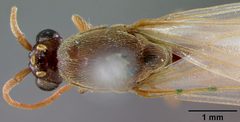
of Labidus possess a subapical tooth on the tarsal claw, a diagnostic character separating them from Neivamyrmex workers, which lack this tooth. Males can be distinguished using genitalic characters. The Labidus sensu stricto (following the reclassification of L. mars to Neivamyrmex) comprises surface-foraging , though at least one species (L. coecus) is subterranean and completely eyeless.
Images
Habitat
varies by : L. coecus is strictly subterranean and commonly nests in caves, a microhabitat that may enable survival in otherwise inhospitable climates. Other Labidus species are surface foragers in tropical and subtropical environments. One colony of L. praedator was observed sheltering under shrub patches following intense rainfall.
Distribution
Essentially continuous range from Buenos Aires, Argentina (~34.6°S) to Oklahoma, United States (~36.6°N). Documented from 20 countries in Central and South America (all except Chile), three West Indian islands (Margarita, Trinidad, and Tobago), and four US states (Arkansas, Louisiana, Oklahoma, and Texas). West Indian represent recent isolates from former land connections during periods of lower sea levels.
Diet
L. praedator is a top . Caterpillars dominate its diet composition. Flowers, diaspores of weeds, and aril and flesh of fruits are also transported to .
Behavior
L. praedator conducts swarm raids in which discrete groups of hundreds of ants may separate under shrub cover during rainfall events. Army ant including Labidus may exhibit chemical opportunism through the reuse of unoccupied trails. Swarm raids of L. praedator are followed by groups of Crotophaginae birds, Sarcophaginae flies, and Polistinae .
Ecological Role
New World army ants including Labidus function as keystone that structure . L. praedator specifically can reduce pest densities in agroecosystems.
Human Relevance
L. praedator has been documented as a beneficial in agroecosystems adjacent to gallery forests, where it contributes to pest suppression. Landscape structure influences of agricultural areas by Ecitoninae army ants.
Similar Taxa
- Neivamyrmex lack the subapical tooth on the tarsal claw that characterizes Labidus; historically confused due to convergent traits in subterranean (e.g., eyelessness in L. coecus and former L. mars, now N. mars)
- EcitonDistinct within the Eciton group; surface-foraging army ants with different morphological and behavioral characteristics
- NomamyrmexFourth of New World army ants; distinguished by morphological and behavioral traits not detailed in available sources
Misconceptions
The Labidus mars was historically misclassified within Labidus based on (eyelessness, subterranean habit, tarsal tooth); phylogenomic analysis revealed it belongs to Neivamyrmex, demonstrating that of subterranean traits obscured true relationships. Sequenced males originally associated with L. mars were found to belong to Labidus sensu stricto and represent distinct species (L. nero and L. denticulatus).
More Details
Taxonomic instability
Generic boundaries in the Eciton group were considered stable for nearly 100 years until phylogenomic analysis revealed polyphyly in Labidus as traditionally defined. The reclassification of L. mars to Neivamyrmex mars (Forel, 1912) required revival of L. nero (Santschi, 1930) from synonymy and elevation of L. denticulatus (Borgmeier, 1955) to species status.
Chemical ecology
Evidence suggests chemical opportunism between army ant through reuse of unoccupied trails, though specific mechanisms in Labidus require further study.
Sources and further reading
- BugGuide
- GBIF taxonomy match
- iNaturalist taxon
- NCBI Taxonomy
- Catalogue of Life
- Geographic distribution of Labidus coecus (Latr.) (Hymenoptera, Formicidae), a subterranean army ant
- Untangling the ant claws: the army ant Labidus mars is a Neivamyrmex (Formicidae: Dorylinae)
- Figure 1 from: Wetterer J, Snelling G (2015) Geographic distribution of Labidus coecus (Latr.) (Hymenoptera, Formicidae), a subterranean army ant. Journal of Hymenoptera Research 44: 31-38. https://doi.org/10.3897/JHR.44.4672
- Chemically based interactions and nutritional ecology of Labidus praedator (Formicidae: Ecitoninae) in an agroecosystem adjacent to a gallery forest