
Dorylinae
Leach, 1815
Army Ants and Allies
Tribe Guides
2- Cerapachyini
- Ecitonini(army ants)
Dorylinae is a diverse comprising approximately 27 distributed across tropical and subtropical regions worldwide. The subfamily was substantially revised in 2014 when Brady et al. synonymized five previously recognized dorylomorph subfamilies (Aenictinae, Aenictogitoninae, Cerapachyinae, Ecitoninae, and Leptanilloidinae) under Dorylinae, and further refined by Borowiec (2016) who resurrected numerous genera. The group includes the classic 'army ants' exhibiting the 'army ant adaptive '—characterized by group foraging, nomadism, and specialized queens—though not all members display these traits. Molecular evidence suggests Dorylinae genera originated between 102 and 74 million years ago, followed by rapid adaptive radiation.

Pronunciation
How to pronounce Dorylinae: /ˌdɔːrɪˈlaɪniː/
These audio files are automatically generated. While they are not always 100% accurate, they are a good starting point.
Identification
Dorylinae can be distinguished from other by the combination of: metatibial gland present (though variable in some ); armed with modified setae or spines; and specific mandibular and clypeal characteristics detailed in Borowiec's (2016) generic revision. Within Formicidae, they are most readily confused with Ponerinae (which includes convergently army-ant-like Leptogenys), but differ in metatibial gland structure and other internal . The subfamily encompasses both army ants (exhibiting group foraging, nomadism, and specialized queens) and non-army forms; the former can be recognized by their mass raiding and -based nesting. Generic identification requires examination of mandibular , clypeal structure, antennal segmentation, and petiolar morphology.
Images
Appearance
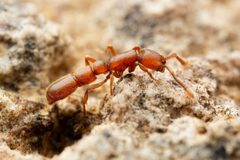
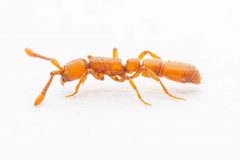
Dorylinae ants exhibit considerable morphological diversity across , reflecting their broad adaptive radiation. range from small to very large, with pronounced in many . Army ant species typically possess large, sickle-shaped in soldiers, adapted for defense and prey dismemberment. The is characterized by the presence of a metatibial gland, considered a synapomorphy for the group, though this trait shows variation (e.g., apparently absent in some Leptanilloides species). Body form varies from slender, elongate species adapted for subterranean or leaf-litter existence to robust, heavily sclerotized forms. are typically 10-12 segmented. Queens are often highly specialized: in army ant species, they are wingless, dichthadiiform (with greatly expanded ), and capable of producing thousands of daily.
Habitat
Dorylinae occupies diverse tropical and subtropical including rainforest floor, leaf litter, soil, and evergreen forests. Army ant are primarily terrestrial, forming temporary in protected locations such as beneath logs or between tree buttress roots. Non-army dorylines include subterranean (e.g., Leptanilloides in Andean leaf litter and soil) and arboreal or ground-dwelling forms. Elevational range extends from lowland tropical forests to high-elevation páramos above 1500 m in the Andes.
Distribution
in tropical and subtropical regions of both Old World and New World. Disjunct distributions occur in some : Syscia is uniquely distributed across Nearctic, Neotropical, and Indomalayan regions. The encompasses 11 genera in the Neotropics, with significant diversity in the Afrotropics, Madagascar, and Oriental realms. The genus Eburopone was recently discovered in Vietnam, representing the first Oriental record for this otherwise Afrotropical/Malagasy genus.
Diet
Predatory, with prey spectrum varying by and . Army ants (e.g., Eciton, Dorylus) are capturing diverse arthropods including insects, spiders, and other small ; some also take small vertebrates. Non-army dorylines prey on other ants or small soil-dwelling invertebrates. Specific dietary details for many genera remain poorly documented.
Life Cycle
Characterized by complex social organization and, in army ants, cyclic colony alternating between nomadic and stationary phases. During nomadic phases, colonies relocate periodically to exploit new foraging areas; during stationary phases, the colony remains fixed while the lays thousands of daily and larvae pupate. Queens are typically highly fecund; in army ants, a single queen may produce up to 30,000 eggs per day during the stationary phase. Colony size ranges from thousands to over one million in some army ant .
Behavior
Army ant exhibit the 'army ant adaptive ': group foraging through mass raids, nomadism with regular colony relocation, and specialized . Raiding columns may extend over 200 yards, with forming living bridges and through leg-to-leg linking. Soldiers defend colonies with powerful . Some non-army dorylines (e.g., Yunodorylus) show intermediate traits suggesting evolutionary stepping stones to the full syndrome. Stylogaster flies have been speculated to associate with army ant raids to capture flushed prey, though this association is not obligatory for all species.
Ecological Role
Army ants function as keystone in tropical , consuming thousands of prey items daily and influencing structure. Their raids create temporary 'hotspots' of disturbance that may affect local composition. Some species serve as for specialized myrmecophiles. The represents a significant component of tropical and diversity.
Human Relevance
Army ants have been used in traditional medicine; folklore describes their use for wound suturing, and the sickle-shaped jaws of soldiers can indeed clamp skin effectively. Eciton and other army ants are subjects of extensive behavioral and ecological research. The has contributed to understanding of social insect evolution, of complex traits, and phylogenetic methods. Some species may cause concern when establish in human structures.
Similar Taxa
- Leptogenys (Ponerinae)Convergently evolved army ant-like traits including swarm raiding, nomadism, and large colony size; distinguished by lack of metatibial gland and different mandibular structure.
- Ponerinae (general)Some ponerines share predatory habits and subterranean ; separated by morphological characters including metatibial gland absence and pygidial structure.
More Details
Taxonomic History
The 2014 revision by Brady et al. fundamentally restructured doryline classification by synonymizing five under Dorylinae, demonstrating that previous classifications did not reflect evolutionary relationships. Borowiec's 2016 generic revision provided the first congruent morphological and molecular classification, resolving long-standing controversies about army ant evolution.
Evolutionary Significance
Dorylinae provides a model system for studying : the army ant evolved independently in New World (Eciton) and Old World (Dorylus) lineages, as demonstrated by Borowiec's phylogenetic work. The also includes transitional forms (e.g., Yunodorylus, Zasphinctus) that illuminate how complex social syndromes assemble gradually.
Sources and further reading
- BugGuide
- Wikipedia
- iNaturalist taxon
- NCBI Taxonomy
- Catalogue of Life
- Marek Borowiec's Awesome Social Insects Award | Bug Squad
- Rainforest raiders: Fierce Leptogenys ants — Bug of the Week
- Conopidae | Beetles In The Bush
- 3D avatars for 3 new ants + the Obama ant | Blog
- Entomology 2021: Attendees Share Early Favorites Among On-Demand Presentations, Posters
- Jaws of the jungle: Leafcutter ants and Army ants — Bug of the Week
- New Records of Syscia Roger, 1861 (Hymenoptera: Formicidae: Dorylinae) in South America
- Microhabitat and elevational patterns in thermal tolerance and thermoregulation of Neotropical army ants (Formicidae: Dorylinae)
- Two new species of Leptanilloides Mann, 1823 (Formicidae: Dorylinae) from the Andes of southern Ecuador
- Trophic Ecology and Adaptation in Tropical Old World Ants of the Subfamily Dorylinae (Hymenoptera: Formicidae)
- First discovery of the ant genus Eburopone Borowiec, 2016 (Hymenoptera, Formicidae, Dorylinae) in the Oriental realm, with description of a new species from Vietnam