
Stylogaster
Macquart, 1835
thick-headed fly, needle-tailed fly
Species Guides
3- Stylogaster beresfordi
- Stylogaster biannulata(thick-headed fly)
- Stylogaster neglecta
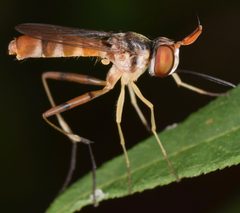
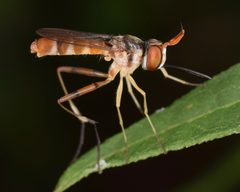
Stylogaster is a of conopid flies distinguished by extreme morphological and biological specializations. possess an elongated exceeding body length when extended, and females have a dramatically elongated folded beneath the body—the 'needle tail' referenced in the generic name. The genus is the sole member of Stylogastrinae and comprises approximately 92 with predominant Neotropical distribution. Unlike other conopids that parasitize Hymenoptera, Stylogaster species are endoparasitoids of orthopteroid insects (crickets, ) with documented associations also including various calyptrate Diptera.
Pronunciation
How to pronounce Stylogaster: /ˌstaɪloʊˈɡæstər/
These audio files are automatically generated. While they are not always 100% accurate, they are a good starting point.
Identification
Distinguished from all other Conopidae by the combination of: extremely elongated longer than body when fully extended; reduced anal in wing venation; and in females, the greatly elongated folded ventrally beneath the body. Antennal proportions differ between —S. neglecta has short 2nd antennomere and highly elongate 3rd antennomere, while S. biannulata has 2nd and 3rd antennomeres nearly equal in length. are uniquely morphologized with rigid barbed tips, unlike the smooth eggs of other conopids.
Images
Habitat
Associated with supporting army ant (Ecitoninae, Dorylinae) raiding columns in Neotropics and Old World tropics, where females exploit -driven prey disturbance. occasionally found at flowers. habitats include ground-dwelling Orthoptera and environments.
Distribution
Widespread across tropical and subtropical regions: Neotropics (69 , predominant center of diversity), Afrotropical region including Madagascar (14 species, with 5 to Madagascar), Australian region (5 species), Oriental region (2 species), and Nearctic region (2 species: S. neglecta and S. biannulata). Absent from Palaearctic region. In North America, recorded from southern Ontario and northeastern United States southward.
Diet
feed on nectar using the elongated . Larvae are endoparasitoids developing within insects.
Host Associations
- Oecanthus nigricornis - confirmed black-horned tree cricket; first confirmed of S. neglecta with successful larval
- Muscidae (various genera) - carrier or including Dichaetomyia, Helina, Phaonia, Stomoxys; attached to but definitive status unconfirmed
- Calliphoridae - carrier or including Bengalia, Tricyclea, Hemigymnochaeta; 24% of Tricyclea specimens in one study bore Stylogaster
- Cockroaches - reported historical records, specific not consistently documented
- Army ants (Ecitoninae, Dorylinae) - ecological associatefemales exploit raiding columns to access flushed prey; not obligate for all as occurs in Madagascar where army ants are absent
Life Cycle
are forcibly jabbed into using the female's elongated ovipositor; barbed egg tips anchor in host tissue. approximately 30 days based on S. neglecta rearing data. Larvae develop as endoparasitoids, eventually emerging to pupate; host death follows larval . Multiple has been documented.
Behavior
Females exhibit specialized oviposition : hovering over army ant raiding columns, then diving to jab into prey insects flushed by activity. This high-risk strategy results in significant egg loss when ants capture post-oviposition. Oviposition involves a stabbing motion with the ovipositor thrust forward between the legs. Some may operate independently of army ants.
Ecological Role
Similar Taxa
- Other ConopidaeOther conopid parasitize Hymenoptera (, bees, ants) rather than orthopteroids; lack the elongated and needle-like female ; have smooth without barbed tips
- Mydidae (mydas flies)Large size and -mimicry in some may cause confusion; distinguished by elongate clubbed versus short antennae of Stylogaster
Sources and further reading
- BugGuide
- Wikipedia
- GBIF taxonomy match
- iNaturalist taxon
- NCBI Taxonomy
- Catalogue of Life
- Diptera | Beetles In The Bush | Page 8
- BitB Best of 2009 | Beetles In The Bush
- Stylogaster Macquart, 1835 (Diptera: Conopidae) from Northeastern Brazil: new records and two new species
- NEW Stylogaster AND RANGES OF CONOPIDAE (DIPTERA) FROM THE BRAZILIAN AND BOLIVIAN AMAZONIA
- Diptera hosts of Stylogaster Macquart (Diptera, Conopidae) from Madagascar and South Africa
- New Muscidae (Diptera) Hosts ofStylogasterMacquart (Diptera: Conopidae) from the Afrotropical Region
- Stylogaster eggs on blow flies attracted to millipede defence secretions in Tanzania, with a stab at summarising their biology (Diptera: Conopidae & Calliphoridae)
- Figure 1 from: Jensen AR, Odgaard F, Cerretti P, Pape T (2020) Stylogaster eggs on blow flies attracted to millipede defence secretions in Tanzania, with a stab at summarising their biology (Diptera: Conopidae & Calliphoridae). Biodiversity Data Journal 8: e54808. https://doi.org/10.3897/BDJ.8.e54808
- Oecanthus nigricornis(Orthoptera: Gryllidae) as the first known host ofStylogaster neglecta(Diptera: Conopidae)
- Figure 4 from: Jensen AR, Odgaard F, Cerretti P, Pape T (2020) Stylogaster eggs on blow flies attracted to millipede defence secretions in Tanzania, with a stab at summarising their biology (Diptera: Conopidae & Calliphoridae). Biodiversity Data Journal 8: e54808. https://doi.org/10.3897/BDJ.8.e54808
- Figure 2 from: Jensen AR, Odgaard F, Cerretti P, Pape T (2020) Stylogaster eggs on blow flies attracted to millipede defence secretions in Tanzania, with a stab at summarising their biology (Diptera: Conopidae & Calliphoridae). Biodiversity Data Journal 8: e54808. https://doi.org/10.3897/BDJ.8.e54808
- The biology and taxonomy of the genus Stylogaster Macquart, 1835 (Diptera: Conopidae, Stylogasterinae) in the Ethiopian and Malagasy regions
- Supplementary material 1 from: Jensen AR, Odgaard F, Cerretti P, Pape T (2020) Stylogaster eggs on blow flies attracted to millipede defence secretions in Tanzania, with a stab at summarising their biology (Diptera: Conopidae & Calliphoridae). Biodiversity Data Journal 8: e54808. https://doi.org/10.3897/BDJ.8.e54808
- Further data on the oviposition by the genus Stylogaster Macquart (Diptera: Conopidae, Stylogasterinae) upon adult calyptrate Diptera associated with ants and animal dung
- Figure 3 from: Jensen AR, Odgaard F, Cerretti P, Pape T (2020) Stylogaster eggs on blow flies attracted to millipede defence secretions in Tanzania, with a stab at summarising their biology (Diptera: Conopidae & Calliphoridae). Biodiversity Data Journal 8: e54808. https://doi.org/10.3897/BDJ.8.e54808
- The first <i>Stylogaster</i> Macquart, 1835 (Diptera: Conopidae) fossil, from Oligo-Miocene Dominican amber, and some phylogenetic and biogeographic considerations