
Dolichoderus taschenbergi
(Mayr, 1866)
Taschenberg's Odorous Ant
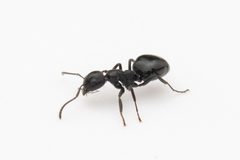
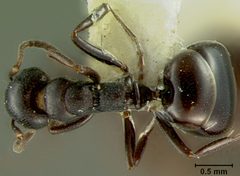
Dolichoderus taschenbergi is a North American in the odorous ant Dolichoderinae. Described by Mayr in 1866, it is to Canada and the United States. The species exhibits sporadic patterns and has been studied for its mutualistic relationships with honeydew-producing hemipterans. Colony structure may include polygynous nesting patterns, though this requires further research.
Pronunciation
How to pronounce Dolichoderus taschenbergi: //ˌdɒlɪˈkoʊdərəs ˌtæʃənˈbɜrɡaɪ//
These audio files are automatically generated. While they are not always 100% accurate, they are a good starting point.
Images
Habitat
Found in forested environments in southwestern Pennsylvania, where it has been studied extensively. Specific microhabitat preferences beyond general woodland settings are not well documented.
Distribution
to Canada and the United States. Documented in southwestern Pennsylvania; broader distribution details within its North American range are sparse.
Diet
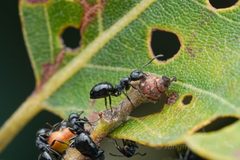
Collects honeydew from tuliptree (Toumeyella liriodendri) and pine aphids; also exploits less abundant honeydew sources. The is a specialized trophobiont, actively tending these hemipteran partners.
Host Associations
- Toumeyella liriodendri - mutualisttuliptree scale; ants increase survival from 8.2% to 46.8% by interfering with and
- pine aphids - mutualisthoneydew source; specific not identified in available sources
Behavior
Uses well-defined, persistent foraging trails. Actively tends honeydew-producing insects, providing protection from natural enemies in exchange for resources. Displays protective that significantly enhances survival rates of tended scale insects. Colony founding mechanism remains unclear; may exhibit polygynous nesting patterns.
Ecological Role
Acts as a protective mutualist with hemipteran honeydew producers. By interfering with and , the substantially increases survival of tended , potentially influencing local structure and forest pest dynamics.
Sources and further reading
- BugGuide
- Wikipedia
- GBIF taxonomy match
- iNaturalist taxon
- NCBI Taxonomy
- Catalogue of Life
- A Gathering of Entomologists; UC Davis Graduate Students Are Major Important Part | Bug Squad
- Dolichoderus quadripiunctatus Archives - Entomology Today
- Video Shows U.S. Customs Agents Screening for Invasive Insect Pests
- THE FORAGING AND TENDING BEHAVIOR OF DOLICHODERUS TASCHENBERGI (HYMENOPTERA: FORMICIDAE)