
Gasteruption
Latreille, 1796
carrot wasps
Species Guides
8- Gasteruption assectator(wild carrot wasp)
- Gasteruption barnstoni(Carrot wasp)
- Gasteruption floridanum(Carrot Wasp)
- Gasteruption kaweahense
- Gasteruption kirbii
- Gasteruption striatum
- Gasteruption tarsatorium(Carrot Wasp)
- Gasteruption visaliae(Carrot Wasp)
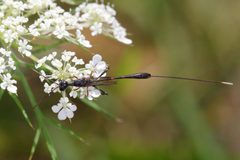
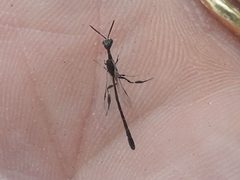
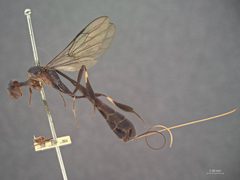
Gasteruption is a of commonly known as "carrot wasps" due to their slender, elongated bodies and frequent association with umbelliferous flowers. The genus comprises approximately 64 worldwide, with 21 species recorded in Central Europe and at least 15 in North America. are characterized by a pronounced "neck" between the and , an attached high on the thorax, and enlarged hind tibiae that function in dynamics and vibrational sensing. Females possess long ovipositors for accessing nests. Larvae are - in the nests of solitary bees and wasps.
Pronunciation
How to pronounce Gasteruption: /ɡæsˈtɛrʌpˌʃən/
These audio files are automatically generated. While they are not always 100% accurate, they are a good starting point.
Identification
Distinguished from similar by: pronounced elongated "neck" (petiole) between and ; attached high on thorax rather than between hind legs; enlarged, swollen hind tibiae (described as "leg warmer" appearance); long, slender body form (13–40 mm); females with extremely long ovipositor. have 13 segments (males) or 14 segments (females), far fewer than ichneumon wasps. Ovipositor sometimes with white tip. -level identification often requires examination of thoracic texture and color pattern.
Images
Habitat
preferences vary by : wetlands (G. phragmiticola), forest habitats at higher altitudes (G. subtile), lower altitudes 100–500 m a.s.l. (most species), steppic habitats on southern hill slopes, semi-open or forest habitats, steppic grasslands, open sandy habitats, and alpine forest margins. Species show ecological plasticity and may expand into new habitats to follow distribution.
Distribution
Worldwide distribution with approximately 64 . Central Europe: 21 species. Czech Republic and Slovakia: 21 species recorded. North America: at least 15 species, with 5 in eastern U.S. and Canada. Australia: at least one described species. GBIF records from Denmark, Norway, and Sweden.
Seasonality
active May through September with main period June–August. Some regional variation: G. merceti activates earlier (May–June). North American records indicate peak activity in late spring (latter half of May) and/or mid-summer (July).
Host Associations
- solitary bees - -primary ; larvae feed on pollen, nectar, or prey stores intended for host larvae rather than host larvae themselves
- solitary wasps - -secondary ; fewer records and some lack sufficient data for confidence
Life Cycle
Females use long ovipositor to deposit in nests, accessing cavities in twigs, borings in wood, or ground nests. Larvae hatch and feed on provisions stored for host larvae (pollen, nectar, or prey). Parasitization rates in host nests are low: approximately 4–7%.
Behavior
includes distinctive vertical and horizontal swaying of legs near nests, possibly to tune into vibrational signals through the air. Enlarged hind tibiae filled with may amplify vibrational signals detected by the subgenual organ for locating hosts. frequently visit flowers, especially umbelliferous blooms (Apiaceae).
Ecological Role
Parasitic of solitary bees and . Conservation of Gasteruption is connected with conservation of their regionally endangered types and . Some species are considered very endangered due to habitat loss, particularly thermophilous species of loess walls and steppe habitats.
Human Relevance
Do not sting and are harmless to humans. May benefit from mimicry of stinging (ichneumonids, sphecids). Potential for conservation due to specific habitat requirements and dependencies.
Similar Taxa
- Ichneumonidaesimilar slender body and long ovipositor; distinguished by far more antennal segments and lack of pronounced "neck"
- Ammophila (Sphecidae)similar body form; distinguished by different abdominal attachment point and antennal segment count
Sources and further reading
- BugGuide
- Wikipedia
- GBIF taxonomy match
- iNaturalist taxon
- NCBI Taxonomy
- Gasteruption longipleurale - Entomology Today
- Balance, Hearing, and More: Why Some Wasps Have Fat Lower Legs
- Bug Eric: Wasp Wednesday: Carrot Wasps
- The genome sequence of a parasitoid wasp, Gasteruption jaculator (Linnaeus, 1758)
- Habitat preferences and phenology of carrot wasps (Hymenoptera: Gasteruptiidae, Gasteruption) in Central Europe
- Review of the biology and host associations of the wasp genus Gasteruption (Evanioidea: Gasteruptiidae)
- A new species of Gasteruption (Hymenoptera: Gasteruptiidae) with a host association from Northern Australia
- Entering behavior of Gasteruption brachychaetum Schrottky (Hymenoptera, Gasteruptiidae) into a nest of Hylaeus Fabricius (Hymenoptera, Colletidae)
- The genus Gasteruption Latreille, 1796 (Hymenoptera: Gasteruptiidae) in the Czech Republic and Slovakia: distribution, checklist, ecology, and conservation status