
Gasteruption kirbii
Gasteruption kirbii is a of in the Gasteruptiidae, commonly known as "carrot wasps." Members of this are characterized by an elongated neck between the and , a high abdominal attachment point, and notably enlarged hind tibiae. The species is one of at least fifteen Gasteruption species in North America, with five occurring in the eastern United States and Canada. Like other gasteruptiids, it is presumed to parasitize larvae of solitary bees nesting in twigs or wood borings.
Pronunciation
How to pronounce Gasteruption kirbii: /ɡæstɛˈɹʌpʃən ˈkɜːrbiːaɪ/
These audio files are automatically generated. While they are not always 100% accurate, they are a good starting point.
Identification
Easily distinguished from ichneumon wasps by the reduced antennal segment count (13–14 versus many more in ichneumons). Differs from sphecid in the Ammophila by the high abdominal attachment point and swollen hind tibiae. Within Gasteruption, identification often requires examination of thoracic texture and, to a lesser degree, color pattern. The combination of elongated neck, high abdominal insertion, and enlarged hind tibiae is diagnostic for the Gasteruptiidae.
Images
Appearance
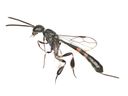
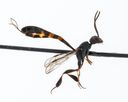
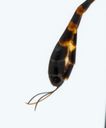
Slender, elongate with a pronounced "neck" (constricted petiole) between and . attached high on the thorax, not between the hind legs. Hind tibiae distinctly swollen, giving a "leg warmer" appearance. with 14 segments in females, 13 in males—substantially fewer than ichneumon wasps. Females possess a long ovipositor, sometimes with a white tip. Body size ranges 13–40 mm, with much of the length due to the ovipositor in females. Overall appearance has been described as "flying needle" due to extreme slenderness.
Habitat
Associated with supporting solitary bees that nest in twigs or wood borings. frequently observed at flowers, particularly umbelliferous blooms (Apiaceae), as well as White Sweet Clover (Melilotus alba), Desert Broom (Baccharis sarothroides), and Leafy Spurge (Euphorbia esula).
Distribution
Eastern United States and Canada. One of five Gasteruption recorded from this region.
Seasonality
activity peaks in late spring (latter half of May) and/or mid-summer (July).
Host Associations
- solitary bees - Larvae parasitize nests of solitary bees in twigs or wood borings. The gasteruptiid larva typically feeds on the pollen, nectar, or prey provisions stored for the larva, rather than consuming the host larva directly.
Behavior
Females engage in vertical and horizontal leg-swaying while in near nests, hypothesized to tune into vibrational signals from host larvae through the air. The enlarged hind tibiae, filled with tissue adjacent to the subgenual organ, appear to function in amplifying vibrational signals for host detection. The legs may also contribute to flight dynamics and balance during maneuvering.
Ecological Role
of solitary bees, potentially regulating of native . The unusual of the hind legs represents an evolutionary innovation for location via vibrational sensing.
Human Relevance
Does not sting; may benefit from mimicry of stinging . visit flowers and may contribute to pollination. Of interest to entomologists studying the evolution of morphological novelties and sensory .
Similar Taxa
- IchneumonidaeSimilar slender body form, but distinguished by many more antennal segments and lack of swollen hind tibiae.
- Ammophila (Sphecidae)Similar appearance and , but differs in abdominal attachment point and lacks the diagnostic neck and leg structure of Gasteruptiidae.
More Details
Hind leg morphology
Research on related (G. longipleurale) has demonstrated that the enlarged hind tibiae contain tissue—an organ normally restricted to the —located adjacent to the subgenual organ. This arrangement appears to amplify vibrational signals for detection. The tibial tissue also contains oenocytes (lipid-processing and detoxification ) and expresses genes linked to detoxification, lipid synthesis, and mechanoreception.
Research history
The of North American Gasteruption remains poorly known. records are sparse, and trap-nesting studies could substantially improve understanding of host associations.