
Gasteruption kaweahense
Gasteruption kaweahense is a of in the Gasteruptiidae, commonly known as carrot wasps. Like , it possesses the family's distinctive enlarged hind tibiae and elongated neck. The species is known from limited observations. As with other gasteruptiids, females likely parasitize larvae of solitary bees by depositing into nests using a long ovipositor.
Pronunciation
How to pronounce Gasteruption kaweahense: /ɡæstəˈɹʌpʃən kæwiˈæhɛnsɛ/
These audio files are automatically generated. While they are not always 100% accurate, they are a good starting point.
Identification
Distinguished from ichneumon wasps by fewer antennal segments (13-14 vs. many more). Separated from sphecid such as Ammophila by high abdominal attachment on and swollen hind tibiae. -level identification relies on thorax texture and color pattern. Distinguished from other Gasteruption species by specific thoracic sculpturing details (exact characters require examination).
Images
Appearance
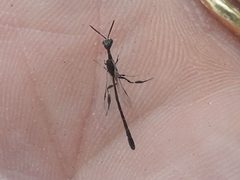
Slender with elongated body. Pronounced neck between and . attached high on thorax, not between hind legs. Hind tibiae distinctly swollen. with 14 segments in females, 13 in males. Ovipositor long, sometimes with white tip. Size range typical for : approximately 13-40 mm including ovipositor.
Habitat
Associated with supporting solitary . Likely found in areas with twig-nesting or wood-boring bee . observed at flowers, particularly umbelliferous blooms.
Distribution
Specific distribution details for G. kaweahense are not well documented. The Gasteruption occurs across North America with multiple in eastern and western regions.
Seasonality
activity likely peaks in late spring (latter half of May) and mid-summer (July), based on .
Host Associations
- Solitary bees - Specific records for G. kaweahense not documented; generally parasitizes larvae of solitary bees in twig or wood-boring nests
Life Cycle
Females deposit into nests using long ovipositor. Larvae feed on pollen, nectar, or prey stores intended for host larvae rather than consuming the host larva directly. Developmental details otherwise poorly known.
Behavior
Females exhibit vertical and horizontal leg swaying during near nests, possibly to detect vibrational signals from hosts. Enlarged hind tibiae filled with tissue adjacent to subgenual organ may amplify vibrational detection.
Ecological Role
of solitary bees; regulates of soil-nesting and twig-nesting .
Human Relevance
Non-stinging; visit flowers and may contribute to pollination. Mimicry of stinging may confer protection from .
Similar Taxa
- Ichneumon waspsSimilar slender build but distinguished by antennal segment count and abdominal attachment point
- Ammophila (Sphecidae)Similar overall form but lacks swollen hind tibiae and high abdominal attachment
- Other Gasteruption speciesRequire examination of thoracic sculpturing and coloration for separation
More Details
Leg structure
Enlarged hind tibiae contain tissue and oenocytes, structures normally found in . Highly expressed genes in tibiae linked to detoxification, lipid synthesis, and mechanoreception.
Vibrational detection
in tibiae positioned adjacent to subgenual organ, suggesting amplification of vibrational signals from larvae in nests.