
Gasteruption tarsatorium
(Say, 1824)
Carrot Wasp
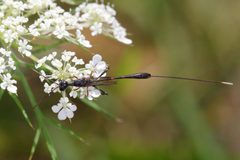
Gasteruption tarsatorium is a of carrot wasp in the Gasteruptiidae. It is characterized by an extremely slender body, elongated neck, and enlarged hind tibiae that function in dynamics and vibrational sensing. The species is a of solitary bees and that nest in twigs or wood borings. Females possess a long ovipositor to access nests.
Pronunciation
How to pronounce Gasteruption tarsatorium: /ˌɡæstəˈɹʌpʃən tɑːsəˈtɔːriəm/
These audio files are automatically generated. While they are not always 100% accurate, they are a good starting point.
Identification
The combination of a pronounced neck, attached high on the , and swollen hind tibiae distinguishes Gasteruption from similar . It may be mistaken for ichneumon wasps or sphecid wasps in the Ammophila, but differs in having fewer antennal segments (13-14 vs. many more in ichneumons) and the unique hind tibial swelling. -level identification within Gasteruption relies primarily on thoracic texture and secondarily on color pattern.
Images
Habitat
Associated with supporting solitary bees and that nest in twigs or wood borings. frequently visit flowers, particularly umbelliferous plants in the parsley .
Distribution
Eastern United States and Canada. One of at least fifteen Gasteruption in North America, with five species occurring in the eastern U.S. and Canada.
Seasonality
activity peaks in late spring (latter half of May) and mid-summer (July).
Host Associations
- Solitary bees - that nest in twigs or wood borings
- Solitary wasps - that nest in twigs or wood borings
Life Cycle
Females use their long ovipositor to deposit in nests. The larval feeds on the pollen, nectar, or prey provisions stored for the host larva, rather than consuming the host larva directly. Developmental details beyond this are poorly documented.
Behavior
In , the exhibits vertical and horizontal swaying of its hind legs. This leg-swaying may function to tune into vibrational signals from nests through the air. The enlarged hind tibiae, filled with tissue adjacent to the subgenual organ, are used to amplify vibrational signals from prey. The hind legs dangle conspicuously during flight and play a role in balance and maneuvering.
Ecological Role
of solitary bees and , potentially influencing of these and . The unique morphological adaptations for vibrational sensing represent a specialized exploitation of nesting signals.
Human Relevance
Non-stinging that may benefit from mimicry of stinging wasp . visit flowers and may contribute to pollination. The species is of interest to entomologists studying the evolution of novel morphological structures and their physiological functions.
Similar Taxa
- Ichneumon wasps (Ichneumonidae)Similar slender body and long ovipositor, but distinguished by far more antennal segments and lack of swollen hind tibiae.
- Ammophila (Sphecidae)Similar overall appearance and , but distinguished by thoracic structure, antennal segment count, and lack of the characteristic neck and tibial swelling.
More Details
Fat body in hind legs
The enlarged hind tibiae contain insect —an organ typically restricted to the . This tissue is located adjacent to the subgenual organ (used for detecting minute vibrations) and may amplify vibrational signals. The tibial fat body also contains oenocytes ( for lipid processing and detoxification) and shows high expression of genes linked to detoxification, lipid synthesis, and mechanoreceptors—functions unexpected in a typical leg.
Flight mechanics
Research by Mikó et al. (2019) demonstrated that removal of the hind tibiae affects balance and maneuvering, confirming their role in flight dynamics beyond sensory functions.