
Coptera
Say, 1836
Coptera is a of parasitic in the Diapriidae. Females are known to search for and attack of fruit flies (family Tephritidae). The genus has been documented on multiple continents and is recognized for its potential as a agent against pest fruit flies. Several have been described, with some showing strict specificity.
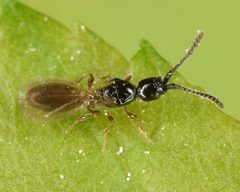
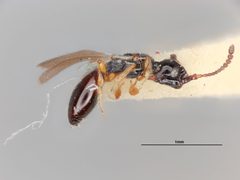
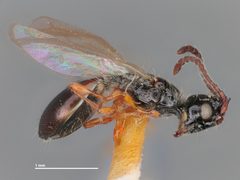
Pronunciation
How to pronounce Coptera: /kɒpˈtɛrə/
These audio files are automatically generated. While they are not always 100% accurate, they are a good starting point.
Identification
-level identification requires examination of morphological characters including scutellar puncture spacing, male proportions, and antennal coloration. Molecular identification via has been used to distinguish cryptic species before formal morphological description. Revised keys for Nearctic species are available.
Images
Habitat
Soils where pupae are buried; collected under or near host plants including Juniperus trees. also captured in yellow pan traps.
Distribution
Southeast Asia, Europe, Central and Southern Africa, North America, and South America. -level distributions vary: C. tonic is documented from Iowa and Michigan, USA.
Seasonality
activity corresponds with . For C. tonic, adults captured or emerged from pupae between late July and early October.
Host Associations
- Anastrepha obliqua - discriminated by C. haywardi females; fungus-treated puparia avoided
- Anastrepha ludens - for C. haywardi; females prefer unparasitized pupae, will hyperparasitize when host availability is low
- Rhagoletis juniperina - Confirmed for C. tonic; strict host specificity demonstrated
- Ceratitis capitata - for C. occidentalis; metal accumulation from host to documented
Life Cycle
Attack occurs during the 's pupal stage. For C. tonic, emerge from soil-collected pupae rather than larvae from cones, indicating attack after the fly has left the fruit and pupated in soil. Development time and specific instar details not documented.
Behavior
Females search for using chemical cues, including larval trails left by fruit flies before . C. haywardi females can discriminate between unparasitized and parasitized host pupae, and between healthy pupae and those treated with fungus bassiana. When unparasitized hosts are scarce, C. haywardi will compete with or hyperparasitize early stages of other such as Diachasmimorpha longicaudata. C. tonic females may use plant volatiles from male Juniperus as indicators for host searching.
Ecological Role
Pupal of tephritid fruit flies. Functions as a agent, with potential for augmentative release against pest fruit fly . Contributes to of fruit flies in natural and agricultural .
Human Relevance
Explored and used as a agent against pest fruit flies including Anastrepha and Ceratitis . Mass-rearing protocols have been developed; artificial selection has been applied to maintain discriminatory capacity in colonies. Simultaneous use with other natural enemies such as fungi or other requires careful planning to avoid antagonistic interactions.
Similar Taxa
- Pachycrepoideus vindemiaeAlso a pupal of tephritid fruit flies; compared in performance studies under different environmental soil conditions
- Diachasmimorpha longicaudataLarval-pupal of same fruit fly ; interacts with Coptera haywardi through competition and hyperparasitism
More Details
Host discrimination selection
Artificial selection over four increased C. haywardi's capacity to discriminate parasitized from unparasitized , with selected females showing reduced host searching and foraging time and increased .
Metal accumulation
C. occidentalis accumulates metals from contaminated but possesses efficient regulatory mechanisms; only 0.3-5.6% of host metal content transfers to the , with no impairment of vitality or .
Sources and further reading
- BugGuide
- Wikipedia
- GBIF taxonomy match
- iNaturalist taxon
- NCBI Taxonomy
- Description of the new species Coptera tonic (Hymenoptera, Diapriidae), a pupal parasitoid of Rhagoletis juniperina Marcovitch (Diptera, Tephritidae), and revised partial keys to Nearctic Coptera Say
- Parasitoids are choosy: increase in the capacity to discriminate parasitised tephritid pupae by Coptera haywardi
- Coptera haywardi females discriminate puparia of Anastrepha obliqua treated with Beauveria bassiana
- Metal accumulation byCeratitis capitata(Diptera) and transfer to the parasitic waspCoptera occidentalis(Hymenoptera)
- Mechanical sorting of young Anastrepha ludens Tapachula-7 pupae, a host for Coptera haywardi, negatively affects sterile male quality
- Female pupae of the genetic sexing strain “Tap-7” of Anastrepha ludens as hosts of Coptera haywardi
- Figures 17- 18 from: Ericson HC, Forbes AA (2020) Description of the new species Coptera tonic (Hymenoptera, Diapriidae), a pupal parasitoid of Rhagoletis juniperina Marcovitch (Diptera, Tephritidae), and revised partial keys to Nearctic Coptera Say. ZooKeys 985: 49-60. https://doi.org/10.3897/zookeys.985.56974
- Figures 9-12 from: Ericson HC, Forbes AA (2020) Description of the new species Coptera tonic (Hymenoptera, Diapriidae), a pupal parasitoid of Rhagoletis juniperina Marcovitch (Diptera, Tephritidae), and revised partial keys to Nearctic Coptera Say. ZooKeys 985: 49-60. https://doi.org/10.3897/zookeys.985.56974
- Figures 5-8 from: Ericson HC, Forbes AA (2020) Description of the new species Coptera tonic (Hymenoptera, Diapriidae), a pupal parasitoid of Rhagoletis juniperina Marcovitch (Diptera, Tephritidae), and revised partial keys to Nearctic Coptera Say. ZooKeys 985: 49-60. https://doi.org/10.3897/zookeys.985.56974
- Figures 13-16 from: Ericson HC, Forbes AA (2020) Description of the new species Coptera tonic (Hymenoptera, Diapriidae), a pupal parasitoid of Rhagoletis juniperina Marcovitch (Diptera, Tephritidae), and revised partial keys to Nearctic Coptera Say. ZooKeys 985: 49-60. https://doi.org/10.3897/zookeys.985.56974
- Figures 1-4 from: Ericson HC, Forbes AA (2020) Description of the new species Coptera tonic (Hymenoptera, Diapriidae), a pupal parasitoid of Rhagoletis juniperina Marcovitch (Diptera, Tephritidae), and revised partial keys to Nearctic Coptera Say. ZooKeys 985: 49-60. https://doi.org/10.3897/zookeys.985.56974
- First record of Coptera haywardi Loiácono (Hymenoptera: Diapriidae) as a parasitoid of fruit-infesting Tephritidae (Diptera) in Brazil
- Host availability affects the interaction between pupal parasitoidCoptera haywardi(Hymenoptera: Diiapridae) and larval–pupal parasitoidDiachasmimorpha longicaudata(Hymenoptera: Braconidae)
- Fruit fly larval trail acts as a cue in the host location process of the pupal parasitoid Coptera occidentalis
- Performance of Two Fruit Fly (Diptera: Tephritidae) Pupal Parasitoids (Coptera haywardi [Hymenoptera: Diapriidae] and Pachycrepoideus vindemiae [Hymenoptera: Pteromalidae]) under Different Environmental Soil Conditions