
Diachasmimorpha
Viereck, 1913
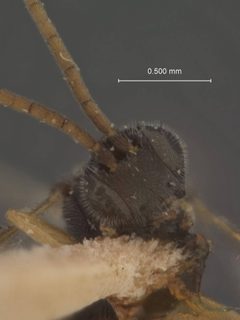
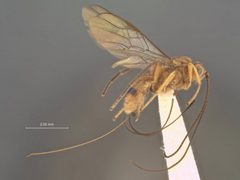
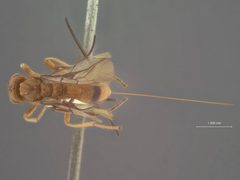
Diachasmimorpha is a of braconid in the Opiinae, established in 1913. The genus is most clearly defined by an sinuate ovipositor, a synapomorphic character that defines a monophyletic lineage. in this genus are solitary endoparasitoids of tephritid fruit fly larvae and are widely used as agents in programs. The genus is relatively small and primarily distributed in subtropical regions, with some species extending into the Nearctic and northern Neotropical regions.
Pronunciation
How to pronounce Diachasmimorpha: //daɪəˌkæzmɪˈmɔrfə//
These audio files are automatically generated. While they are not always 100% accurate, they are a good starting point.
Identification
Images
Habitat
Associated with where tephritid fruit fly larvae occur, including fruit orchards and areas with rotting fruit. Specific microhabitat preferences vary by .
Distribution
Primarily subtropical distribution with in the Nearctic and northern Neotropical regions. Widely introduced to many countries for purposes.
Host Associations
- Tephritidae - primary Larvae of fruit flies in Tephritidae are the primary ; specific associations documented for D. longicaudata include Anastrepha suspensa (Caribbean fruit fly), Anastrepha fraterculus, Anastrepha ludens (Mexican fruit fly), (), and Ceratitis capitata (Mediterranean fruit fly)
Life Cycle
Solitary endoparasitoid development; females oviposit into larvae. For D. longicaudata, late-second and early-third instar fruit fly larvae are preferred hosts. Development occurs within the host .
Behavior
Females locate using complex sensorial mechanisms responding to physical and chemical stimuli. For D. longicaudata, host-seeking involves detection of fly larvae in rotting fruit, with attraction enhanced by fungal fermentation products and chemical compounds from larvae and fruit cues. has been observed as an adaptive strategy under specific conditions, with moderate levels resulting in female-biased sex ratios.
Ecological Role
Natural enemy of tephritid fruit flies; important agent in programs targeting economically significant fruit fly pests.
Human Relevance
Widely used in programs against fruit flies of agricultural importance. Mass-reared for release in fruit-producing regions. Susceptibility to used in fruit fly management programs is a concern; spinosyn-based are compatible with survival while and some are highly toxic.
Similar Taxa
- BiosteresFormerly included now placed in Diachasmimorpha; distinguished by the sinuate ovipositor characteristic of Diachasmimorpha
- OpiusHistorical classification for some now in Diachasmimorpha; reclassified based on ovipitor and phylogenetic analysis
- FopiusAnother opiine used in fruit fly ; differs in ovipositor structure and associations
Misconceptions
was formerly attributed to inability to discriminate parasitized , but is now recognized as an adaptive strategy in D. longicaudata with no detrimental effects on offspring .
More Details
Chemosensory biology
D. longicaudata possesses an expanded repertoire of olfactory genes including odorant-binding proteins (OBPs), chemosensory proteins (CSPs), and odorant receptors (ORs) that enable detection of -specific volatile organic compounds. Female show differential expression of chemosensory genes in response to different fruit scents.
Reproductive biology
in D. longicaudata involves abortive first meiotic division producing an anucleated cytoplasmic bud, followed by equal second division of the nucleated to produce two mature spermatozoa—typical of haplodiploid Hymenoptera.
Sources and further reading
- BugGuide
- Wikipedia
- GBIF taxonomy match
- iNaturalist taxon
- NCBI Taxonomy
- Catalogue of Life
- An Endoparasitic Wasp, Diachasmimorpha longicaudata (Ashmead) (Insecta: Hymenoptera: Braconidae)
- Spermatogenesis in the parasitoid Diachasmimorpha longicaudata (Hymenoptera: Braconidae)
- De Novo Transcriptome Identifies Olfactory Genes in Diachasmimorpha longicaudata (Ashmead)
- Parasitism of Diachasmimorpha longicaudata (Ashmead) on two fruit fly species
- Side effects of toxic bait formulations on Diachasmimorpha longicaudata (Hymenoptera: Braconidae)
- The life cycle, mating behaviour and sexual communication signals of diachasmimorpha Kraussii (Fullaway) (Hymenoptera: Braconidae), a parasitoid of dacine fruit flies (Diptera: Tephritidae)
- Offspring in Response to Parental Female Densities in the Fruit Fly Parasitoid DIACHASMIMORPHA LONGICAUDATA (Hymenoptera: Braconidae: Opiinae)
- The Role of Learning in the Ecology of Diachasmimorpha kraussii (Fullaway) (Hymenoptera: Braconidae: Opiinae), and Implications for Tephritid Pest Management
- Produção em grande escala do parasitoide Diachasmimorpha longicaudata (Hymenoptera: Braconidae) em larvas hospedeiras de Anastrepha fraterculus e Ceratitis capitata (Diptera: Tephritidae) linhagem mutante tsl-V
- The suitability ofAnastrephaspp. andCeratitis capitatalarvae as hosts ofDiachasmimorpha longicaudataandDiachasmimorpha tryoni: Effects of host age and radiation dose and implications for quality control in mass rearing
- Is Host Size an Indicator of Quality in The Mass-Reared Parasitoid Diachasmimorpha longicaudata (Hymenoptera: Braconidae)?
- Mutual interference in the mass-reared fruit fly parasitoid, Diachasmimorpha longicaudata (Hymenoptera: Braconidae)
- Forced-contact mating: A technique for crossing experiments with the fruit fly parasitoid, Diachasmimorpha longicaudata (Ashmead) (Hymenoptera: Braconidae)
- Identification of candidate genes associated with host-seeking behavior in the parasitoid wasp Diachasmimorpha longicaudata
- Superparasitism in the Fruit Fly Parasitoid Diachasmimorpha longicaudata (Hymenoptera: Braconidae) and the Implications for Mass Rearing and Augmentative Release
- Laboratory and Semi-Field Cage Demography Studies of Diachasmimorpha longicaudata Mass-Reared on Two Ceratitis capitata Strains.