
Biosteres
Förster, 1862
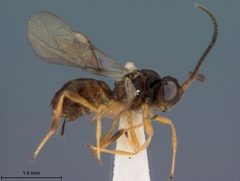
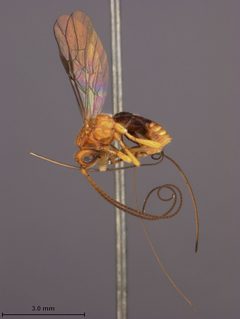
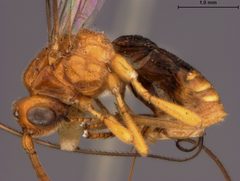
Biosteres is a of in the Braconidae, first described by Förster in 1862. in this genus are solitary or gregarious endoparasitoids, primarily attacking larvae of tephritid fruit flies. Several species, including B. longicaudatus, B. arisanus, and B. tryoni, have been extensively studied for their use in programs against economically important fruit pests. The genus has an almost distribution, with species documented across Europe, Asia, North America, and other regions.
Pronunciation
How to pronounce Biosteres: /biːoʊˈstiːriːz/
These audio files are automatically generated. While they are not always 100% accurate, they are a good starting point.
Images
Habitat
Associated with fruit substrates; larvae develop within fruit fly larvae inside fruit tissue. Specific microhabitat conditions vary by host fruit type and host fly .
Distribution
Almost . Documented in Europe (France, Germany, Ireland, Scandinavia), Asia (Turkey, Iran, Philippines), and North America. GBIF records confirm presence in Denmark, Norway, and Sweden.
Host Associations
- Anastrepha suspensa - primary Caribbean fruit fly; for B. longicaudatus
- Bactrocera dorsalis - primary ; for B. arisanus, B. longicaudatus, and B. persulcatus
- Ceratitis capitata - primary Mediterranean fruit fly; for B. tryoni and B. arisanus
- Pegomya spp. - primary Anthomyiid flies; for B. blandus and B. haemorrhoeus
- Agromyza spp. - primary Leaf-miner flies; for B. blandus
Life Cycle
Solitary endoparasitoid development; females oviposit into larvae. Development is physiologically dependent on host state. Some exhibit -larval (e.g., B. arisanus), where eggs are laid in host eggs but larvae develop after host .
Behavior
Uses vibration and sound as cues for host location; females exhibit non-random search patterns and ovipositor probing in response to substrate vibrations. Response intensity correlates with load—females with more mature eggs show increased host-finding drive. Cannot locate immobile or dead hosts; abandons search after approximately 2 minutes without vibrational cues. Exhibits interference competition among searching females.
Ecological Role
of fruit fly larvae; regulates of tephritid pests in natural and agricultural . Contributes to of economically important fruit flies.
Human Relevance
Used extensively in programs against tephritid fruit flies, including the Mediterranean fruit fly (Ceratitis capitata), (), and Caribbean fruit fly (Anastrepha suspensa). Subject of mass-rearing research for augmentative biocontrol release.
Similar Taxa
- OpiusHistorical synonymy; several Biosteres were formerly classified as Opius (e.g., B. arenarius as O. arenarius, B. blandus as O. blandus). Modern distinguishes Biosteres based on morphological and molecular characters.
- Other opiine braconids (e.g., Diachasmimorpha, Fopius)Share similar as fruit fly and may co-occur in same ; identification requires examination of morphological characters, particularly male genitalia and larval structure.
More Details
Venom apparatus and virus-like particles
B. longicaudatus possesses two distinct virus-like particle types in its poison glands: rod-shaped particles (250–300 nm) in accessory gland filaments, and spherical -like particles (250 nm diameter) with beaded outer . These particles are injected during oviposition and appear in , potentially contributing to host immune suppression or developmental regulation.
Serosal function
The embryonic of B. longicaudatus consists of one to three layers with secretory function. The serosa synthesizes and releases polypeptides (including a ~24 kDa protein) into the , and appears to sequester and degrade host molecules while releasing newly synthesized products.
Host location mechanism
-finding is released specifically by host-generated vibrations from movement and feeding (rasping mouth hooks), not by chemical cues alone. This vibration-mediated search allows location of hosts concealed within fruit tissue.
Sources and further reading
- BugGuide
- Wikipedia
- GBIF taxonomy match
- iNaturalist taxon
- NCBI Taxonomy
- Catalogue of Life
- Biosteres longicaudatus: Developmental dependence on host (Anastrepha suspensa) physiology
- Host vibration ? A cue to host location by the parasite, Biosteres longicaudatus
- Identification of Immatures and Male Adults of the Opiine Parasitoids (Biosteres spp.) of the Oriental Fruit Fly, Bactrocera dorsalis (Hendel)
- Effect of Fruit Substrates on Parasitization of Tephritid Fruit Flies (Diptera) by the Parasitoid Biosteres arisanus (Hymenoptera: Braconidae)
- Interference Competition and Optimal Host Selection in the Parasitic Wasp, Biosteres longicaudatus1
- Demographic framework for parasitoid mass rearing: Case study of Biosteres tryoni, a larval parasitoid of tephritid fruit flies
- Superparasitism of the Caribbean Fruit Fly, Anastrepha suspensa (Diptera: Tephritidae), by Biosteres longicaudatus (Hymenoptera: Braconidae): Implications for Host Regulation
- Developmental and Reproductive Biologies of the Parasitic Wasp, Biosteres Longicaudatus, Reared on Hosts Treated with a Chitin Synthesis Inhibitor
- Reproductive Biology of Biosteres arisanus (Sonan), an Egg Larval Parasitoid of the Oriental Fruit Fly
- Reproductive behavior of Biosteres arisanus (Sonan) (Hymenoptera:Braconidae), an egg-larval parasitoid of the oriental fruit fly
- Virus-like particles from the poison glands of the parasitic wasp Biosteres longicaudatus (Hymenoptera: Braconidae)
- Serosal cells of Biosteres longicaudatus (Hymenoptera: Braconidae): Ultrastructure and release of polypeptides
- Reproductive Biology of Biosteres vandenboschi (Hymenoptera: Braconidae), a Parasitoid of Early-Instar Oriental Fruit Fly
- Suitability ofDacus dorsalis andCeratitis capitata [Diptera: Tephritidae] as hosts of the parasitoid,Biosteres arisanus [Hymenoptera: Braconidae]
- Oviposition Behavior of Biosteres longicaudatus,1 a Parasite of the Caribbean Fruit Fly, Anastrepha suspensa2,3