
Basalys
Westwood, 1833
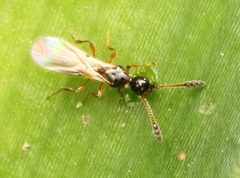
Basalys is a of minute in the Diapriidae. Members are among the smallest known insects, with some measuring less than 0.5 mm in body length. These wasps are internal parasitoids of dipteran larvae, particularly those developing in decaying organic matter. The genus has a Holarctic distribution with confirmed records from Scandinavia and other northern European regions.
Pronunciation
How to pronounce Basalys: /ˈbæsəlɪs/
These audio files are automatically generated. While they are not always 100% accurate, they are a good starting point.
Identification
Basalys are distinguished from other diapriid by their extremely small body size, reduced wing venation with few closed , and characteristic with 12–13 flagellomeres in females. The pronotum is short and does not reach the tegulae. Identification to species level requires examination of male genitalia and other microscopic characters.
Images
Habitat
Associated with moist, decaying organic matter including compost, , and rotting vegetation where develop. Often collected in leaf litter, soil , and through from reared dipteran .
Distribution
Recorded from Denmark, Norway, and Sweden; broader Holarctic distribution expected based on patterns but specific records limited.
Host Associations
- Diptera larvae - Internal of fly larvae developing in decaying matter
Ecological Role
that contribute to of dipteran flies in decomposition .
Human Relevance
Potential agents for nuisance flies associated with waste and composting facilities, though not commercially utilized.
Similar Taxa
- TrichopriaAlso minute diapriids with reduced wing venation; distinguished by antennal segmentation and pronotal structure
- DiapriaLarger diapriid with more complete wing venation and longer pronotum
More Details
Size
Basalys contains some of the smallest known insects, with body lengths approaching the theoretical minimum for functional and .
Taxonomic stability
The has undergone relatively little taxonomic revision compared to other diapriid genera, though -level diversity is likely underestimated due to collection difficulties.