
Eucoilinae
Tribe Guides
6Eucoilinae is the largest within Figitidae (Cynipoidea), comprising nearly 1000 described in over 80 . These small to minute are solitary koinobiont endoparasitoids of cyclorrhaphous dipteran larvae, attacking in diverse microhabitats including decaying vegetation, fungi, rotting wood, carrion, , and plant tissues. The subfamily is with highest diversity in tropical regions, particularly the Neotropics. Several species are important agents of pest flies, including tephritid fruit flies and agromyzid leaf miners.
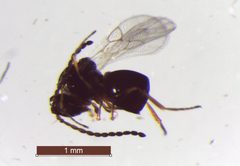
Identification
The definitive diagnostic character is the scutellar plate (or cup): a raised, distinctly margined structure on the surface of the containing a glandular pit. This feature is universally present in eucoilines and unique among parasitic . are small, typically 1–5 mm in length, with a usually shining black or brown polished body. Most are fully winged, though some are brachypterous. Females have 13-segmented often with a distally swollen club; males have 15-segmented antennae with the third or fourth segment modified to bear antennal sex glands. Many display a conspicuous ring of dense hairs ("hairy ring") anteriorly on the third abdominal tergite. The shape, size, , and position of the glandular pit on the scutellar plate vary considerably between genera and species, providing important taxonomic characters.
Images
Habitat
Associated with microhabitats where cyclorrhaphous dipteran larvae develop: decaying vegetation, fungi, rotting wood, carrion, , bird nests, refuse deposits, and living plant tissues where flies mine leaves or bore into fruits.
Distribution
distribution with highest in tropical regions, particularly the Neotropics. Well-documented from Argentina (primarily northwestern and northeastern regions), Brazil, Peru, Nicaragua, Mexico, and across North America including central regions. Present in the Afrotropical region and Asia (Vietnam, China).
Host Associations
- Diptera: Cyclorrhapha (larvae) - endoparasitoidkoinobiont ; include Tephritidae (fruit flies), Lonchaeidae, Drosophilidae, Agromyzidae (leaf miners), Ephydridae, and other cyclorrhaphous
- Drosophila suzukii - endoparasitoiddocumented for Dieucoila sp. and Ganaspis brasiliensis
- Liriomyza trifolii - endoparasitoid for Gronotoma micromorpha
- Liriomyza sativae - endoparasitoid for Gronotoma adachiae
- Melanagromyza tomaterae - endoparasitoid for Gronotoma melanagromyzae
- Hydrellia sp. - endoparasitoid for Hydrelliaeucoila egeria, mining in Egeria densa
- Agromyzidae - endoparasitoid for Preseucoela and Agrostocynips
- Tephritidae - endoparasitoid for Leptopilina haywardi; first record for this
Life Cycle
Koinobiont endoparasitoid development: the larva develops inside the larva, which continues to feed and grow. The emerges from the host by chewing an irregular exit hole. In Gronotoma micromorpha, maturation occurs during the stage (prosynovigenic), with a 3-day reproductive cycle; initial egg load is deposited in the first 3 days after , with egg maturation requiring 3 days to complete. Two reproductive cycles occur during the female lifetime.
Behavior
Solitary . Females attack first-instar larvae of cyclorrhaphous flies. The koinobiont strategy allows the to continue development while the parasitoid feeds internally, emerging only from the pupal stage.
Ecological Role
Important natural enemies of cyclorrhaphous Diptera, particularly in tropical . Along with Opiinae (Braconidae), among the most important natural enemies of frugivorous flies (Tephritidae, Lonchaeidae, Drosophilidae). Contribute to regulation of fly in diverse decomposition and plant-associated .
Human Relevance
Several are important agents against pest flies: Aganaspis pelleranoi is frequently associated with tephritid flies and considered particularly useful for biological control; Lopheucoila anastrephae is an important of lonchaeids; Dicerataspis grenadensis and Leptopilina boulardi are natural enemies of drosophilids. Studied in contexts. Gronotoma micromorpha and related species are used for control of agromyzid leaf miners.
Similar Taxa
- Emargininae (Figitidae)Also of Diptera and closely related to Eucoilinae; distinguished by lacking the diagnostic scutellar plate with glandular pit
- Pycnostigminae (Figitidae)Close relatives within core figitids; distinguished by different scutellar and associations
- Opiinae (Braconidae)Convergent ecological role as important of frugivorous flies; distinguished by different -level characters and lacking the eucoiline scutellar plate
Sources and further reading
- BugGuide
- Wikipedia
- iNaturalist taxon
- NCBI Taxonomy
- Distribution of Eucoilinae (Hymenoptera, Cynipoidea, Figitidae)
- Phylogeny of the Eucoilinae (Hymenoptera: Cynipoidea: Figitidae)
- Biodiversidad de <i>Ganaspini</i> (Hymenoptera: Figitidae: Eucoilinae) en la Argentina
- A revision of Ganaspidium Weld, 1952 (Hymenoptera, Figitidae, Eucoilinae): new species, bionomics, and distribution
- North American species of Agrostocynips Diaz (Hymenoptera: Figitidae: Eucoilinae), parasitoids of Agromyzidae (Diptera): bionomics and taxonomy
- The description of Preseucoela Buffington, new genus, with notes on the status of Nearctic species of Agrostocynips Diaz (Hymenoptera: Figitidae: Eucoilinae)
- Parasitism behavior of three species of Eucoilinae (Hymenoptera: Cynipoidea: Figitidae) fruit fly parasitoids (Diptera) in Brazil
- Egg Maturation and Daily Progeny Production in the Parasitoid, Gronotoma micromorpha (Hymenoptera: Figitidae: Eucoilinae)
- New distributional and host records for the parasitoid Gronotoma adachiae (Hymenoptera: Figitidae: Eucoilinae) in Asia
- Eucoilinae species (Hymenoptera: Cynipoidea: Figitidae) parasitoids of fruit-infesting dipterous larvae in Brazil: identity, geographical distribution and host associations
- Description of a New Genus and Species of Eucoilinae (Hymenoptera: Cynipoidea: Figitidae) Parasitoid of Ephydridae (Diptera)
- Redescription of the South American genus <i>Caleucoela</i> and description of the male of <i>C. striatipennis</i> (Hymenoptera: Figitidae: Eucoilinae: Ganaspini)
- Parasitismo de Gronotoma melanagromyzae Baerdsley (Hymenoptera: Figitidae: Eucoilinae), en el arrocillo del tomate de cáscara, Melanagromyza tomaterae Steyskal (Diptera: Agromyzidae)
- Short Communication: Mating Behavior of Aganaspis pelleranoi (Brèthes) (Hymenoptera: Figitidae, Eucoilinae), a Fruit Fly (Diptera: Tephritidae) Larval Parasitoid
- Rhoptromeris haywardi (Blanchard, 1947) is not Rhoptromeris Förster, 1869: new combination in Leptopilina Förster, 1869 (Hymenoptera: Cynipoidea: Figitidae: Eucoilinae)