
Hydrellia
Robineau-Desvoidy, 1830
hydrilla leaf mining flies (unofficial, for some species)
Species Guides
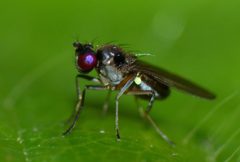
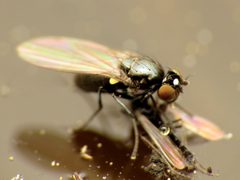
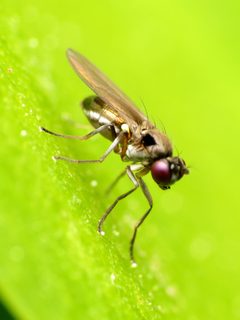
4Hydrellia is a large of shore flies ( Ephydridae) comprising more than 240 described . The genus is notable for containing aquatic leaf-mining species whose larvae develop inside the tissues of submerged aquatic plants. Several species, particularly H. pakistanae and H. balciunasi, have been introduced to North America as agents against the aquatic weed Hydrilla verticillata. Other species, such as H. tarsata, mine leaves of Water Soldier (Stratiotes aloides) in Eurasian freshwater systems.
Pronunciation
How to pronounce Hydrellia: //haɪˈdrɛliə//
These audio files are automatically generated. While they are not always 100% accurate, they are a good starting point.
Identification
Accurate identification to level requires examination of genitalia and other microscopic characters; the is distinguished from other Ephydridae by combination of aquatic larval habit and leaf-mining in many species. Species associated with specific plants (e.g., Hydrilla verticillata, Stratiotes aloides) may be tentatively recognized by collection context but require taxonomic confirmation.
Images
Habitat
Aquatic and semi-aquatic freshwater environments including lakes, rivers, and other water bodies. Many are specifically associated with beds of submerged aquatic macrophytes. Larval development occurs within living plant tissue of aquatic vegetation.
Distribution
Widespread; recorded from Europe (including Russia, Denmark, Norway, Sweden), Asia (native range of H. pakistanae), and North America (introduced of agents in Florida and elsewhere in the U.S.).
Diet
Larvae are leaf miners that feed internally on tissues of aquatic plants; specific associations vary by . may feed on plant exudates or organic matter in aquatic environments, though this has not been well documented for most species.
Host Associations
- Hydrilla verticillata - larval primary for H. pakistanae, H. balciunasi, H. bilobifera, and H. discursa; introduced and native respectively
- Stratiotes aloides - larval for H. tarsata; historically confused with multiple now synonymized
Life Cycle
are deposited on or near plant leaves in aquatic environments. Larvae mine within leaf tissue, creating internal tunnels that damage photosynthetic capacity. occurs within mines or in the surrounding aquatic environment. Multiple per year occur in suitable climates.
Behavior
Larvae exhibit leaf-mining , tunneling within aquatic plant leaves. This feeding strategy reduces plant vigor and competitive ability. Some have been deployed as agents, with varying degrees of establishment and impact.
Ecological Role
Herbivores of aquatic macrophytes; some function as agents that can reduce abundance of aquatic weeds such as Hydrilla verticillata. Native species may help regulate native aquatic plant . The supports including braconid wasps (Chaenusa spp.) and diapriid (Trichopria columbiana).
Human Relevance
Several (H. pakistanae, H. balciunasi) have been intentionally introduced to the United States as agents against Hydrilla verticillata, a Federal Noxious Weed. Establishment has been successful for some species, though levels and associated plant damage have remained lower than desired in some regions due to by native . Other species have potential for of aquatic weeds in additional regions.
Similar Taxa
- Other Ephydridae generaMany shore flies share aquatic ; Hydrellia is distinguished by the leaf-mining larval habit in combination with specific morphological characters. Other aquatic Diptera such as Chironomidae (non-biting midges) and Culicidae (mosquitoes) have aquatic larvae but do not exhibit leaf-mining in submerged macrophytes.
More Details
Taxonomic history
The has undergone significant taxonomic revision. At least three described from Stratiotes aloides (H. stratiotae, H. stratiotella, H. propingua) were synonymized with H. tarsata in 2023, resolving a century of confusion about associations.
Biological control limitations
Despite successful establishment of H. pakistanae in Florida water bodies, levels and plant damage have remained low. by the native endoparasitic Trichopria columbiana has been identified as a potentially limiting biotic factor.
Species diversity
With over 240 described , Hydrellia represents a diverse radiation of aquatic leaf-mining flies. plant associations are known for only a fraction of described species, suggesting substantial undiscovered ecological diversity.
Sources and further reading
- BugGuide
- Wikipedia
- GBIF taxonomy match
- iNaturalist taxon
- NCBI Taxonomy
- Catalogue of Life
- Hydrilla leaf mining flies (unofficial common name) Hydrellia spp. (Insecta: Diptera: Ephydridae)
- A comparison of host range and performance of congeneric leaf-mining flies, Hydrellia pakistanae (Diptera: Ephydridae) and Hydrellia sp., two candidate biological control agents for the South African biotype of Hydrilla verticillata (Hydrocharitaceae)
- Hydrellia (Diptera: Ephydridae) mining in Stratiotes aloides: a long history of confusion
- New data on Hydrellia from NW Russia (Diptera: Ephydridae)
- Hydrellia fly parasitic wasp Trichopria columbiana Ashmead (Insecta: Hymenoptera: Diapriidae)