
Diplolepis californica
(Beutenmüller, 1914)
leafy bract gall wasp
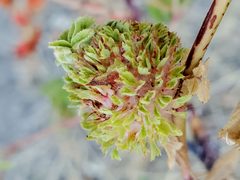
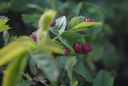
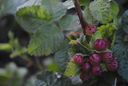
Diplolepis californica is a cynipid gall wasp that induces distinctive club-shaped bud galls on wild roses (Rosa ) along the Pacific coast of North America. The species was originally described as Rhodites californicus by Beutenmüller in 1914 and later transferred to Diplolepis. Its galls are characterized by flat, leafy lobes projecting from the main gall body—structures that resemble aborted leaflets and distinguish this species from other rose gall wasps. Each gall contains multiple larval chambers, indicating communal development within a single gall structure.
Pronunciation
How to pronounce Diplolepis californica: //ˌdɪploʊˈlɛpɪs ˌkælɪˈfɔrnɪkə//
These audio files are automatically generated. While they are not always 100% accurate, they are a good starting point.
Identification
The galls of Diplolepis californica are distinguished from all other rose galls by their flat, leafy lobes that emanate from the main gall body and resemble aborted leaflets. The galls are club-shaped and develop on rose buds. The itself is a small cynipid with typical reduced wing venation characteristic of the . Identification to level is most reliably accomplished by examining gall on known plants rather than wasp characteristics alone.
Images
Habitat
Found in coastal and near-coastal where wild roses (Rosa ) occur, including Rosa californica. The galls form on the buds of roses in shrubby or open vegetation along the Pacific coast of North America.
Distribution
Pacific coast of North America, from California northward. The distribution corresponds to that of its primary plant, Rosa californica, and related wild rose in coastal regions.
Host Associations
- Rosa californica - plantWild rose on which galls are induced
Life Cycle
Like other cynipid gall wasps, Diplolepis californica exhibits an with both bisexual (spring) and agamic (, winter) typical of the . The bisexual generation produces the large, conspicuous galls from which winged of both sexes emerge to mate. The agamic generation consists of parthenogenetic females that are typically wingless and emerge from smaller, less conspicuous galls. Each gall contains multiple larval chambers, indicating that several larvae develop together within a single gall structure.
Behavior
Induces gall formation on rose buds through chemical stimulation of plant tissue during oviposition and subsequent larval feeding. The gall provides both nutrition and protection for developing larvae.
Ecological Role
As a gall inducer, creates structure that may be exploited by other organisms including and (guest organisms that inhabit galls without parasitizing the gall wasp larvae). The galls represent a localized concentration of plant resources that can support a of associated arthropods.
Human Relevance
Of interest to naturalists and entomologists studying gall wasp and plant-insect interactions. Not considered an economic pest; galls cause cosmetic damage to wild roses but do not typically threaten plant survival.
Similar Taxa
- Diplolepis rosaeAlso induces galls on roses (the mossy rose gall), but produces spherical, mossy-textured galls rather than the club-shaped galls with leafy bracts characteristic of D. californica. D. rosae is likely introduced from Europe and has a different gall .
- Other Diplolepis species on rosesMultiple Diplolepis induce galls on roses in North America; all can be distinguished by gall . D. californica is specifically identified by the flat, leafy lobes projecting from the main gall body.
More Details
Taxonomic History
Originally described as Rhodites californicus by Beutenmüller in 1914, this was later transferred to the Diplolepis based on revised understanding of cynipid and classification.
Gall Morphology
The distinctive leafy bracts that give this its are unique among North American rose gall wasps and represent an unusual elaboration of gall structure beyond the simple swelling typical of most cynipid galls.
Sources and further reading
- BugGuide
- Wikipedia
- GBIF taxonomy match
- iNaturalist taxon
- NCBI Taxonomy
- The Big 43: The California Native Plants, Plus One, Studied in UC Davis Research | Bug Squad
- Bohart Museum: Learn about California's State Insect on UC Davis Picnic Day | Bug Squad
- A Mural Like No Other | Bug Squad
- A Flash of Orange: Welcome, California Tortoiseshell! | Bug Squad
- California Dogface Butterfly: What the Fire Did | Bug Squad
- Bug Eric: Wasp Wednesday: Gall Wasps