
Zapatella davisae
Buffington & Melika, 2016
black oak gall wasp
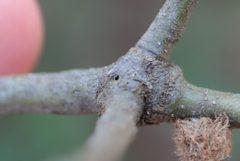
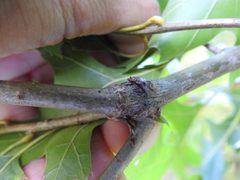
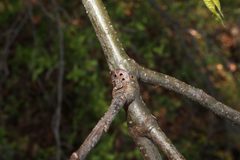
Zapatella davisae is a cynipid gall wasp (Hymenoptera: Cynipidae) described in 2016 that has become a significant pest of black oak (Quercus velutina) in the northeastern United States. Larvae develop under bark in late summer, with emerging in early spring. The has undergone notable on Long Island, NY (first documented 1990), Cape Cod and Martha's Vineyard, MA (2008), and more recently in coastal Rhode Island and Nantucket, MA. High rates by Sycophila species can lead to rapid population collapse, as observed on Long Island in 2016.
Pronunciation
How to pronounce Zapatella davisae: /zəˈpætɛlə ˈdevɪsaɪ/
These audio files are automatically generated. While they are not always 100% accurate, they are a good starting point.
Identification
Zapatella davisae can be distinguished from other oak gall wasps by its association with black oak (Quercus velutina) and the specific gall it produces on stems. The was formally described in 2016, separating it from previously misidentified or undescribed Zapatella species. Identification to species level typically requires examination of morphological features; has been used to confirm associations and may aid in distinguishing closely related species.
Images
Habitat
Mature black oak (Quercus velutina) forests in the northeastern United States. Larvae develop beneath bark on stems and branches.
Distribution
Northeastern United States: Long Island, New York; Cape Cod, Martha's Vineyard, and Nantucket, Massachusetts; coastal Rhode Island. The ' range is actively expanding, with newer documented in Nantucket, MA and coastal Rhode Island following initial areas.
Seasonality
Larvae develop under bark in late summer; emerge in early spring.
Diet
Phytophagous; feeds on black oak (Quercus velutina).
Host Associations
- Quercus velutina - primary plantGall formation and larval development occur on stems and branches of black oak. This is the only confirmed plant.
Life Cycle
Larvae develop under bark in late summer; emerge in early spring. The sexual/ status of remains uncertain; genetic studies found significant deviations from Hardy–Weinberg equilibrium and excess clonal individuals, but were inconclusive regarding the Meselson effect due to limited sampling.
Behavior
Forms stem galls on black oak. During , causes extensive foliar damage including flagging, leaf clumping, and limb loss. are strongly influenced by ; near-total population collapse has been observed following high parasitism rates.
Ecological Role
Herbivore capable of causing significant tree mortality and damage during . Serves as for a dominated by Sycophila , particularly S. nr. novascotiae and S. foliatae. rates appear to regulate densities, with lag effects observed in newly invaded regions where natural enemy communities may be less established.
Human Relevance
Significant forest pest causing extensive damage and mortality to black oak trees, with economic and ecological impacts on northeastern U.S. oak forests. Management concerns focus on predicting spread and impact in newly invaded areas.
Similar Taxa
- Other Zapatella speciesCongeneric oak gall wasps; Z. davisae distinguished by specificity to Quercus velutina and formal description in 2016
- Other Cynipini on QuercusMany oak gall wasps share similar ; identification requires association and gall examination
Sources and further reading
- BugGuide
- iNaturalist taxon
- NCBI Taxonomy
- Development of microsatellite markers for an outbreaking species of oak gall wasp,Zapatella davisae(Hymenoptera: Cynipidae), in the northeastern United States
- Life History and Potential Hosts of Zapatella davisae (Hymenoptera: Cynipidae), a Recent Invader on Black Oak in the Northeastern United States
- Identification of the parasitoid community associated with an outbreaking gall wasp,Zapatella davisae, and their relative abundances in New England and Long Island, New York