
Feron pattersonae
(Fullaway, 1911)
Plate Gall Wasp
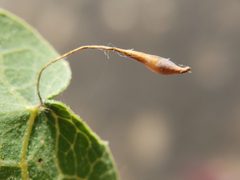
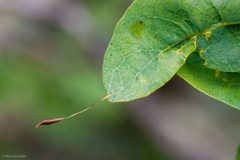
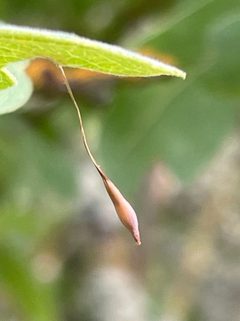
Feron pattersonae, the plate gall wasp, is a cynipid that induces distinct galls on white oaks, particularly blue oak (Quercus douglasii). The exhibits cyclical with two alternating per year: an all-female parthenogenetic generation and a bisexual generation. Each generation produces morphologically different galls—flat, circular, plate-like galls in summer, and pointed capsule galls on hair-like stems later in the year. The bisexual generation's galls were originally described as a separate species, Andricus pedicellatus, by Alfred Kinsey in 1922.
Pronunciation
How to pronounce Feron pattersonae: //ˈfɛr.ɒn ˌpætərˈsoʊniː//
These audio files are automatically generated. While they are not always 100% accurate, they are a good starting point.
Identification
The all-female produces diagnostic flat, circular galls 7–9 mm in diameter with scalloped edges, attached to the undersides of leaves. These galls are initially green, turn yellow, and fade to brown, each containing a single larval chamber. The bisexual generation produces fundamentally different galls: a pointed capsule borne on a slender, hair-like stem. The two gall morphologies on blue oak or other white oaks in the same locality, combined with seasonal timing, allow separation from other oak gall wasps. are small, dark cynipid typical of the ; specific adult diagnostic features require examination.
Images
Habitat
Associated with white oak group (Quercus sect. Quercus) woodlands, particularly where blue oak (Quercus douglasii) occurs. include oak savannas, foothill woodlands, and mixed oak forests of western North America.
Distribution
Western North America; distribution corresponds with that of its primary , blue oak, and other white oaks in California and adjacent regions.
Seasonality
Two per year with distinct seasonal timing. The all-female parthenogenetic generation is active in summer, producing plate galls during this period. The bisexual generation follows, with its distinct gall type appearing later in the year. Exact timing varies with locality and climate.
Diet
Larvae develop within plant tissue galls; the does not feed externally. likely feed on nectar or honeydew, as is typical for cynipid wasps, though specific observations for this are not documented.
Host Associations
- Quercus douglasii - blue oak, primary and common
- Quercus sect. Quercus - white oak group, broader range
Life Cycle
Complex with alternating : (1) an all-female parthenogenetic generation that produces plate galls on leaf undersides in summer; (2) a bisexual generation that produces capsule-on-stem galls, with producing both males and females. This cyclical pattern is characteristic of many Cynipini.
Ecological Role
Induces galls on oak leaves, creating microhabitats that may support , , and other gall-associated arthropods. The functions as a herbivore with localized impact on oak foliage.
Human Relevance
No significant economic or medical importance. Of interest to entomologists, botanists, and natural historians studying gall wasp and oak . The historical taxonomic confusion with Kinsey's Andricus pedicellatus illustrates challenges in cynipid .
Similar Taxa
- Andricus pedicellatusOriginally described as a separate by Kinsey in 1922 based on the bisexual 's capsule galls; now recognized as the same species as Feron pattersonae. Historical misidentification risk when only one gall type was known.
- Other Feron and Andricus species on white oaksMany cynipids produce oak galls; F. pattersonae is distinguished by the specific combination of plate galls (female ) and capsule-on-stem galls (bisexual generation) on blue oak and related white oaks.
Misconceptions
The bisexual and parthenogenetic were originally described as separate due to their radically different gall morphologies, a common source of taxonomic error in gall wasps before integration was understood.
More Details
Taxonomic history
Originally described as Andricus pattersonae by Fullaway in 1911, later transferred to Feron. The bisexual was described as Andricus pedicellatus by Alfred Kinsey in 1922, creating a synonymy that was later resolved.