
Andricus coquilletti
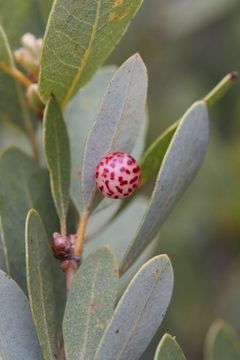
Andricus coquilletti is a of gall wasp in the Cynipidae, a group renowned for inducing characteristic plant galls on oaks. Like other members of its , this species has an intimate ecological relationship with oak trees (Quercus spp.), where females deposit into developing leaf tissue using their ovipositor, triggering the formation of protective galls that house developing larvae. The species is part of one of the most diverse radiations of gall-forming insects, with each cynipid species typically producing a distinct gall on specific tissues.
Pronunciation
How to pronounce Andricus coquilletti: //ˈæn.drɪ.kəs koʊˈkiː.jɛ.ti//
These audio files are automatically generated. While they are not always 100% accurate, they are a good starting point.
Identification
Identification of Andricus coquilletti requires examination of the specific gall it induces on oak , as are minute (typically 2-4 mm) with reduced morphological differentiation between closely related . The galls produced by this species would be distinguishable from those of such as Andricus palustris by their specific location on the plant (leaf blade, petiole, or ), size, shape, and surface texture. Adult specimens may be identified through microscopic examination of antennal segmentation, wing venation patterns, and genitalia structure, ideally by comparison with .
Images
Habitat
Found in supporting oak (Quercus), including deciduous woodlands, mixed forests, savannas, and urban parks with mature oak trees. The presence of suitable oaks is the primary habitat requirement.
Distribution
Distribution corresponds to the range of its oak ; specific range records are limited in available sources but the Andricus is broadly distributed across North America, Europe, and Asia with highest diversity in temperate regions.
Seasonality
timed to coincide with oak leaf flush in spring; galls visible on developing leaves from late spring through summer. Specific data for this is not documented in available sources.
Diet
Larvae feed on nutritive tissue within the gall induced on oak leaves. are not known to feed extensively, though some cynipids may consume honeydew or nectar.
Host Associations
- Quercus - gall Specific oak not documented in available sources
Life Cycle
Females deposit into developing oak leaf tissue using a slender ovipositor. The egg-laying event and subsequent larval secretions induce localized plant proliferation, forming a gall that encloses the developing larva. The larva grows within the gall, feeding on specialized nutritive plant tissue, and pupates within a chamber inside the gall. emerge from the gall to seek mates and oviposition sites. Many Andricus exhibit complex heterogonic with alternating sexual and that may produce different gall types, though this has not been explicitly documented for A. coquilletti.
Ecological Role
As a gall inducer, modifies oak leaf architecture and creates microhabitats that may be exploited by (other insects that inhabit galls without inducing them) and . The galls represent a significant sink for plant resources and may influence leaf-level and tree , though typically without causing severe damage.
Human Relevance
Of minor direct economic importance; oak galls generally do not require management intervention. The may be encountered by arborists, foresters, and naturalists observing oak trees.
Similar Taxa
- Andricus palustrisAlso induces spherical galls on pin oak leaves; differentiation requires examination of gall size, surface texture, and specific location on leaf or petiole, or microscopic identification of specimens
- Other Cynipidae on QuercusNumerous and related (e.g., Neuroterus, Cynips) induce galls on oaks; precise identification relies on gall and tissue specificity
Sources and further reading
- BugGuide
- iNaturalist taxon
- Bembicid Holdings | Entomology Research Museum
- Bug Spotlight | Entomology Research Museum
- Primary Type List | Entomology Research Museum
- Field Guide Selected References
- Gall darn it! Gall insects on hickory, oak, and elm, Phylloxera caryaecaulis, Andricus palustris, Colopha ulmicola — Bug of the Week
- Bug Eric: Wasp Wednesday: Poecilopompilus algidus